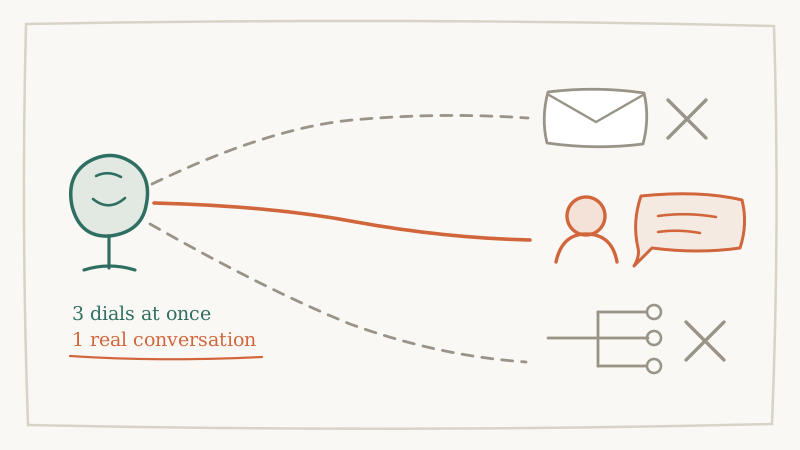
Every parallel dialer is sold with the same arithmetic. Your reps currently get four or five live conversations in an hour of calling. The dialer promises fifteen. Multiply that by a quarter, apply your historical conversation-to-meeting rate, and the business case writes itself on a napkin.
The napkin is usually wrong, and it is wrong in a specific way. Dialers do not manufacture conversations. They remove waiting. The waiting is real, it is expensive, and removing it is genuinely worth money. But the moment you stop waiting, every other weakness in the motion gets exposed at three times the speed: bad phone data burns through faster, a weak opener fails more often per hour, and a rep who could not handle four conversations well will not handle fifteen.
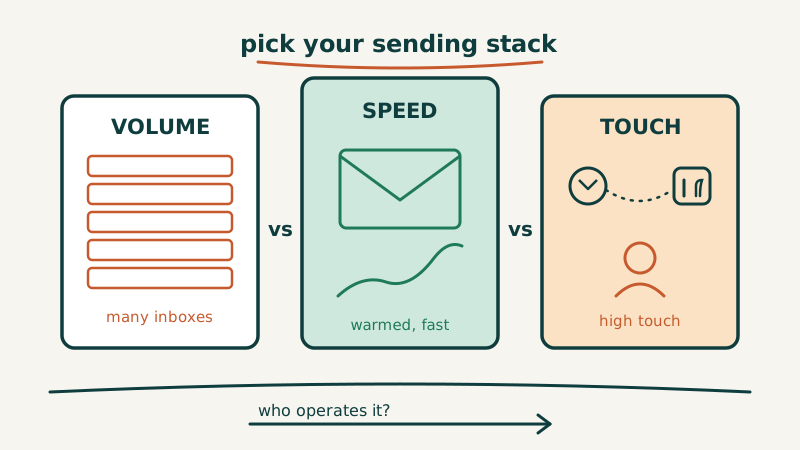
Orum, Nooks, and ConnectAndSell are the three names that come up in almost every dialer evaluation, and buyers tend to treat them as the same product at different price points. They are not. They solve the waiting problem with three different architectures, and each architecture depends on a different input you have to supply yourself.
Here is what each one is actually doing, and how to decide.
The Short Version
- Orum is the purest expression of the category: an AI parallel dialer that dials multiple numbers at once, filters out voicemails, dead lines, and phone trees, and drops your rep into the call only when a human answers. It is software, it is fast, and it assumes you already have good lists, good scripts, and reps who can talk.
- Nooks sells the same parallel dialing capability wrapped in a virtual sales floor and a call-analysis layer. You get the dialing speed plus the coaching surface: shared rooms where reps call together, recordings, and AI review of what happened on the calls. It is aimed at teams where rep skill is the bottleneck, not rep activity.
- ConnectAndSell is the oldest and most structurally different. Rather than only automating the dialing, it puts human agents in front of the queue who navigate gatekeepers, phone trees, and transfers, then hand your rep a live decision maker. You buy conversations, not dial attempts.
That last distinction is the one that decides most evaluations, so start there.
Software Speed Versus Purchased Conversations
The three products split cleanly into two philosophies.
Orum and Nooks are software that makes your reps faster. The rep is still the one doing the work. The system dials ten, twenty, thirty numbers concurrently, suppresses everything that is not a live human, and compresses the dead air between conversations to nearly nothing. Your rep’s hour goes from mostly waiting to mostly talking. The cost per seat is predictable, and the ceiling on conversations is set by your list quality and your dial-to-connect rate.
ConnectAndSell is labor that produces conversations. A human agent works your list, gets past the receptionist, handles the “he’s in a meeting, try his cell” detour, and only then conferences your rep in. Because a person is doing the navigation, it reaches prospects that pure automation cannot: anyone behind a switchboard, an executive assistant, or a multi-step phone tree. You are paying for conversations rather than for dialing capacity, and the economics follow accordingly.
That difference shows up most clearly in who you are calling.
If your buyer answers their own direct mobile line, which is typical of founders, heads of growth, operations leads at mid-market companies, and most technical buyers, software parallel dialing is highly efficient. There is nothing to navigate. The number either connects to a human or it does not, and that is exactly the case automation handles well.
If your buyer sits behind a corporate switchboard, which is typical of enterprise finance, healthcare administration, manufacturing operations, and most of the public sector, the automated dialer will mostly log phone trees. A human-assisted model earns its premium precisely here, because the expensive part of the call is the navigation and not the dial.
So the first question in a dialer evaluation is not about the dialer at all. It is: what fraction of my list is a direct line to the person I want? Pull a hundred records and check. If it is above roughly seventy percent, you are shopping for software. If it is below forty, you are shopping for assisted dialing or you are shopping for better data.
Where Orum Fits
Orum is the right answer when your constraint is unambiguously rep time and your fundamentals are already working.
The profile that gets the most out of it looks like this. You have three or more reps who dial regularly. Your lists are mobile-heavy. Your connect rate per dial is reasonable. Your opener works often enough that reps are not demoralized. Someone owns list hygiene. In that setting, the speed gain is close to the number on the napkin, because speed is genuinely the thing standing between your team and more conversations.
Orum is the wrong answer when any of those pieces is missing, and the failure is worth describing precisely because it is so common. A team with mediocre phone data and an unrehearsed opener buys a parallel dialer and triples its dial volume. Connect rate per dial does not improve, so the absolute number of conversations rises somewhat. But the rate at which conversations go badly also rises, carrier spam heuristics notice the volume spike from the new number pool, and within a few weeks the answer rate drops. The team concludes the dialer did not work. The dialer worked exactly as designed. It accelerated a motion that was not ready to be accelerated.
Parallel dialing is an amplifier. It amplifies a good motion into a much better one, and it amplifies a broken motion into a faster, more visible failure.
Where Nooks Fits
Nooks makes the most sense when you look at your call recordings and conclude that the problem is not how many conversations your reps have but what happens inside them.
The sales floor concept is the real product. Reps call in a shared virtual room, hear each other work, and get coached in the moment rather than in a Thursday one-on-one reviewing calls from eight days ago. For a team of newer reps, especially a distributed one that lost the ambient learning of a physical floor, that compression of the feedback loop is worth more than the raw dialing speed. New reps pick up objection handling by hearing it handled, which is how phone skill has always actually transferred.
The call-analysis layer matters for a less obvious reason: it gives you a way to diagnose a bad week. When conversations stop converting, the three candidate explanations are list, script, and execution. Without recordings and structured review you will argue about which one it is and probably guess wrong. With them you can listen to twenty calls and know by lunchtime.
The trade-off is scope. You are buying a dialer and a coaching system together, and you will pay for the coaching system whether or not you use it. For a tenured team that already runs disciplined call reviews, that bundle is partly redundant, and a leaner dialer plus the review process you already have will cost less and do the same job.
Where ConnectAndSell Fits
ConnectAndSell is the right answer in three situations, and they are narrower and more specific than the other two.
Enterprise lists behind switchboards. Already covered above, and it is the clearest case. When navigation is the expensive step, pay for navigation.
A small number of very senior reps whose time is genuinely scarce. If you have two experienced AEs rather than eight SDRs, you do not want them dialing at all. You want them talking. A model that delivers a live, qualified-enough human into their calendar block converts their scarce hours into conversations at a rate no self-serve dialer matches.
Short, intense campaigns. Event follow-up, a competitor’s pricing change, a product launch window, a territory you want saturated in nine days. Spinning up assisted dialing for a two-week push is operationally much simpler than hiring, onboarding, and then unwinding headcount for the same burst.
Where it breaks down is sustained high-volume prospecting into a large mid-market TAM. Per-conversation economics that look fine on a thousand-account enterprise list stop looking fine when you need twelve thousand touches a month. That is exactly where software parallel dialing wins on cost structure.
The Metric Every Vendor Will Try To Move
Dialer demos are built around connects per hour, because that is the number the product most directly improves. It is also the number that correlates least reliably with pipeline.
Insist on tracking four things, in this order:
- Dials per hour. Pure activity. Every dialer improves this and it proves almost nothing.
- Connects per hour. A live human picked up. This is the vendor’s headline number.
- Conversations per hour. The prospect engaged past the first ten seconds. A hangup at “who is this” is a connect, not a conversation, and the gap between those two columns is where most dialer disappointment actually lives.
- Meetings per hour of calling. The only number that pays for anything.
Many teams see dials triple, connects double, conversations rise modestly, and meetings stay flat. That pattern is not a dialer problem. It is a signal that the binding constraint was always the list or the message, and you have just purchased a faster way to deliver the wrong message to the wrong people.
Track all four from day one. The relationship between rows two and three tells you whether your opener survives contact at volume. The relationship between rows three and four tells you whether you are calling accounts that should be called at all.
What A Dialer Cannot Fix
Four things, and each one will quietly cap your results no matter which vendor you choose.
Bad phone data. Direct dials decay faster than email addresses because people change roles and carriers, and because a meaningful share of purchased mobile numbers were never correct. If a third of your numbers are wrong, a third of your dialing capacity burns on nothing. The same discipline that applies to email list hygiene applies here, and for the email side of the same list, a validator like Scrubby exists to safely clear catch-all addresses rather than guess at them. Phone data deserves the same scrutiny before you pay per seat to dial it faster.
Who you call, and when. A dialer optimizes the mechanics of reaching a list. It has no opinion about whether that list is worth reaching this week. Account selection and timing are separate problems, and they are usually the larger ones. This is the gap signal data closes: CAM collects every buying signal on your market into one feed, which is what turns a flat alphabetical list into a call queue ordered by who is actually in motion. Dialing a prioritized queue at four hundred dials a day beats dialing a random one at eight hundred.
Saturated channels. Pick up rates fall when a segment is being called by everyone. Volume is not the lever at that point, channel mix is. Teams that run into a phone ceiling usually recover by moving some of the load elsewhere: a calendar-first motion like KALI lands on the prospect’s calendar instead of competing for attention in the inbox or on the handset, and the two motions tend to reach different slices of the same list.
Reply capacity. More conversations generate more follow-up, and follow-up is where booked meetings are won or lost. If callbacks, inbound replies, and LinkedIn responses live in three separate places, a dialer will reliably create more dropped threads. A unified surface for email and LinkedIn wired into the CRM, which is what Underfive provides, is the unglamorous prerequisite for turning a volume increase into pipeline rather than into a backlog.
How To Run The Pilot
Two weeks, structured so the result is interpretable.
Before you start. Pull a sample of a hundred records and verify, by hand, the share that are direct lines to the named person. This single number tells you whether you are evaluating software or assisted dialing, and it prevents the most expensive mistake in the category. Record your current baselines for all four metrics above. Without a baseline, every post-pilot number is a vendor’s claim rather than your measurement.
Week one, same list, same script. Change only the dialing mechanism. Hold the list and the messaging constant so the delta is attributable. Use your reps, not the vendor’s best demo operator.
Week two, segment it. Split the list into one segment you believe is strong and one you believe is weak. Run both. If the dialer only performs on the strong segment, you have learned that your list quality, not your dialing capacity, is the real constraint, and that is a cheaper problem to fix.
Questions to answer before signing. How are numbers provisioned, and is your caller ID being burned across other customers’ campaigns? What happens to answer rates in week three, once carriers have seen the volume pattern? How is the abandoned-call rate controlled, and who carries the compliance obligation when a parallel dial drops? What is the real ramp time before reps stop fighting the tool? What does the contract look like if you want to halve your seat count in month four?
That last question matters more than most buyers expect. Dialer spend scales with headcount, and headcount is exactly what changes when outbound strategy changes.
The Decision, Compressed
- Mobile-heavy lists, three or more active dialers, fundamentals working, speed is the constraint: Orum.
- Newer or distributed team, rep skill is the constraint, you want coaching and call review in the same system: Nooks.
- Enterprise lists behind switchboards, very few senior reps, or a short saturation campaign: ConnectAndSell.
- Under forty percent direct lines, no owner for list hygiene, or an opener you have not pressure-tested: none of them yet. Fix the inputs first. A dialer bought at this stage will make the existing problem arrive faster and cost more.
There is also a fourth answer that evaluations tend to skip. The reason teams buy dialers is rarely a love of dialing. It is that calling is the channel they have the least leverage in, so they try to buy leverage. If the underlying goal is more qualified conversations rather than more dial attempts specifically, the comparison worth running is not Orum against Nooks. It is a dialer purchase against an operated outbound motion where the data, the infrastructure, the sequencing, and the follow-up are run as one system. That is the model Vendisys runs, and the honest version of the comparison includes it rather than assuming the only choice is which tool to hand your reps.
Whichever way that lands, the sequence does not change. Verify your phone data. Prioritize your list by signal. Pressure-test the opener on a hundred manual calls. Then buy the thing that makes a working motion faster.
Buying it in the other order is how teams end up with an expensive dialer and the same pipeline number they started with.