Every team that decides to run cold email at scale hits the same fork within about a week: which sending platform do we actually buy? The shortlist is almost always the same three. Smartlead, Instantly, and Lemlist dominate the category, they all promise unlimited inboxes and deliverability protection, and their marketing pages are nearly interchangeable.
They are not interchangeable. Each one was built around a different operator profile, and picking the wrong one costs you either money you did not need to spend or deliverability you cannot get back. This comparison breaks down where each platform genuinely wins, where the pricing math turns, and the uncomfortable thing all three have in common.
The Short Version
If you want the answer before the reasoning:
- Smartlead is the agency and high-volume choice. Unlimited inbox rotation at a flat tier, strong API, built for people running many clients or many domains at once.
- Instantly is the operator-friendly choice for a single company sending real volume. Cleanest onboarding, bundled lead database, good warmup, opinionated defaults.
- Lemlist is the multichannel and personalization choice. Best at LinkedIn plus email sequencing in one place and at image and video personalization, weakest at raw volume economics.
Now the detail that actually matters when you are the one who has to run it.
Smartlead: Built for Volume and Many Domains
Smartlead’s core design assumption is that you will be sending from a lot of inboxes. Its inbox rotation is the most mature of the three: you connect dozens or hundreds of mailboxes, assign them to a campaign, and the platform spreads sends across them with per-inbox daily caps so no single mailbox burns.
What it does well:
- Unlimited mailboxes on paid tiers. You are priced on leads and campaigns, not seats and inboxes, which is the right shape if your volume strategy depends on many low-volume senders.
- Master inbox. All replies across every connected mailbox land in one unified view, which is the difference between workable and unusable once you pass roughly 20 inboxes.
- A real API and webhooks. If you are wiring sends into your own orchestration layer or CRM, Smartlead is the least painful of the three to automate against.
- Subsequences. Branching follow-ups based on reply sentiment, which saves a lot of manual reply triage.
Where it bites:
- The UI assumes you already know what you are doing. There is very little hand-holding on sequence structure, cadence, or copy.
- Deliverability reporting tells you what happened, not why. You still need external monitoring on domain reputation and blacklists.
- Warmup is an add-on in practice. It works, but it is not the strongest warmup engine in the category.
Smartlead is the right pick when you are an agency, a multi-brand company, or an in-house team committed to a many-domain, many-inbox architecture. If you have not already thought through how many sending domains and inboxes you need, Smartlead’s flexibility will mostly let you make that mistake faster.
Instantly: The Cleanest Single-Company Setup
Instantly made a different bet: most buyers are one company trying to book meetings, not an agency juggling fifteen. So it optimizes for getting a competent campaign live fast with sane defaults.
What it does well:
- Warmup is first-class. The warmup network is the most consistently praised feature across the three, and it is integrated rather than bolted on.
- Bundled lead data. The higher tiers include a B2B contact database, so you can build a list and send in the same tool instead of licensing data separately.
- Opinionated onboarding. It nudges you toward reasonable daily caps, sensible ramping, and plain-text sending without you having to know the theory.
- Unibox plus a lightweight CRM. Enough pipeline tracking that a small team can run outbound without touching Salesforce.
Where it bites:
- Pricing splits across sending and lead credits, so the real monthly cost is higher than the headline tier once you buy data.
- Less flexible than Smartlead for unusual architectures and heavy API-driven workflows.
- The bundled data is convenient, not best-in-class. Coverage and accuracy on niche or non-US segments is uneven.
Instantly is the right pick for a founder-led or small-team motion that wants to be sending correctly in a week rather than architecting for a year.
Lemlist: Multichannel and Personalization First
Lemlist came from a different place than the other two. It was a personalization tool before cold email platforms were a category, and that heritage still shows.
What it does well:
- Email plus LinkedIn in one sequence. Native LinkedIn steps (visit, connect, message) interleaved with email, which neither of the others does as cleanly.
- Deep personalization. Dynamic images, custom landing pages, and video thumbnails that actually render. If your differentiator is that your outreach looks handmade, this is the tool.
- Lemwarm. A genuinely good warmup product that predates the current crop.
- Good template and inspiration library. Useful if your team is new to writing cold copy.
Where it bites:
- Per-seat, per-inbox pricing. The economics get rough fast if your strategy is many mailboxes at low volume per mailbox.
- Not designed for the volume tier where Smartlead lives. You will feel the ceiling.
- Heavy personalization encourages spending 20 minutes on a prospect who was never going to reply. The tool makes a tempting trap very easy to fall into.
Lemlist is the right pick when your total addressable market is small enough that every account deserves a custom touch, or when LinkedIn is a genuine primary channel rather than an afterthought. If you are running outbound against a small TAM, Lemlist’s bias toward quality over quantity matches the constraint.
Side-by-Side
| Factor | Smartlead | Instantly | Lemlist |
|---|---|---|---|
| Inbox pricing model | Unlimited inboxes, priced on leads | Unlimited inboxes, priced on sends plus data | Priced per seat and per inbox |
| Best volume range | High, many domains | Medium to high, one brand | Low to medium, high touch |
| Warmup strength | Adequate | Strongest | Strong (Lemwarm) |
| Unified inbox | Master Inbox, mature | Unibox, good | Present, lighter |
| LinkedIn steps | No native | Limited | Native, best in class |
| Bundled lead data | No | Yes, on higher tiers | Limited |
| API depth | Deepest | Moderate | Moderate |
| Learning curve | Steep | Gentle | Moderate |
| Ideal buyer | Agency or multi-brand | Single company, lean team | ABM and small TAM teams |
The Pricing Trap Nobody Flags
All three publish a monthly number that is not what you will pay. The real cost of a cold email platform is the platform fee plus four things it does not include.
Domains. A many-inbox architecture means buying and configuring secondary domains. At a realistic ratio you are adding a recurring domain spend plus the setup time for SPF, DKIM, and DMARC on each one. None of the three do this for you, and misconfigured authentication is still the single most common reason campaigns die. Our SPF, DKIM, and DMARC setup guide covers what correct looks like.
Mailbox licenses. Every connected inbox is a Google Workspace or Microsoft 365 seat you pay for separately. At 40 inboxes this line item routinely exceeds the sending platform itself.
Data. Instantly bundles some. Smartlead and Lemlist expect you to bring your own. Either way you will layer on enrichment, and enrichment is not verification.
Verification. This is the one teams skip and regret. Enriched lists carry catch-all domains, role accounts, and addresses that went stale six months ago. Sending into them spikes your bounce rate, and a bounce spike on a new domain is how you get a sending reputation you cannot repair. Running the final list through a deep validation layer like Scrubby before it reaches the sequencer is what keeps catch-alls and dead addresses from becoming a deliverability incident. No sending platform does this at the depth cold outbound requires, because it is not what they are for.
Add those four up and the platform fee is usually 20 to 30 percent of the true monthly cost of sending.
What All Three Leave on Your Desk
Here is the part that the comparison table cannot capture. Every one of these tools is a sender. None of them is an outbound program.
After you pick a platform, you still own:
- ICP definition and segmentation. The tool will happily send a perfect sequence to the wrong market.
- Offer and copy. Templates get you to generic. Generic does not get replies in 2026.
- Testing discipline. Someone has to run structured experiments rather than changing three variables at once and guessing.
- Deliverability monitoring. Reputation drift, blacklist hits, and placement decay are ongoing surveillance jobs, not setup tasks.
- Reply handling. The meeting is booked in the reply thread, not in the sequence. This is human work and it is where most self-run programs quietly fail.
- Routing and speed to lead. A positive reply that sits for 11 hours is a lost meeting.
That list is the actual job. The platform is maybe 15 percent of it. Which is why the honest version of this comparison is not “which of these three” but “do I want to own the other 85 percent?”
When the Right Answer Is None of Them
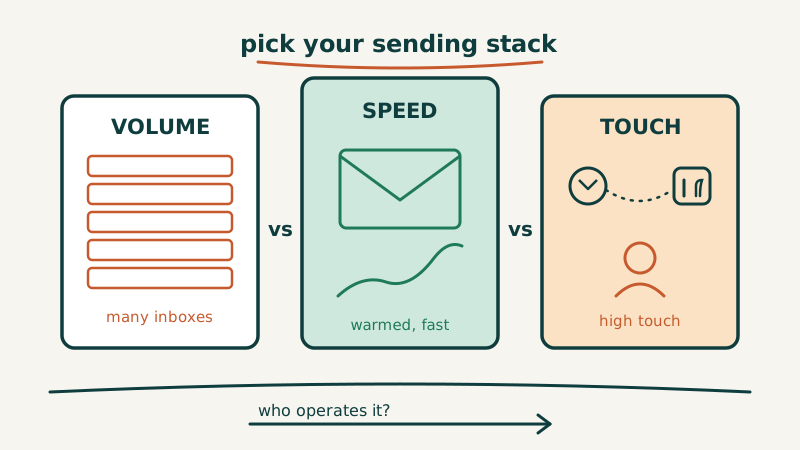
If you have an operator who will own sending infrastructure as a real part of their week, pick from the three above based on your volume shape and move on. Smartlead for many domains, Instantly for one brand and speed, Lemlist for high-touch multichannel.
If you do not have that person, buying a sending platform is buying a tool you will not operate well. The alternative is buying the outcome instead: an outsourced engine where the domains, mailboxes, warmup, verification, copy, testing, monitoring, and reply handling already exist and already run. That is what we do at Vendisys, and the practical difference is time to first meetings. A self-built stack takes most teams two to three months to produce predictable volume. A running engine is sending verified, authenticated outreach in a couple of weeks because the hard parts are already standing.
The same logic applies to the layers you would otherwise bolt on. Instead of stitching intent data into your sequencer by hand, website and buying signals can feed the motion directly through something like CAM. Instead of running cold into accounts where you already have a relationship, job-change triggers on former champions through GetChampions turn a cold sequence into a warm one. And if you want an AI SDR layer drafting and personalizing at volume while humans work the replies that matter, vSDR handles that tier without you having to assemble it from three subscriptions and a Zapier account.
How to Decide This Week
Run this in order and you will land on the right answer without a six-week evaluation.
- Count your intended inboxes. Under 10, Lemlist or Instantly. 10 to 40, Instantly. Over 40 or multi-brand, Smartlead.
- Decide if LinkedIn is primary. If yes, Lemlist wins on native sequencing and the volume ceiling stops mattering.
- Price the full stack, not the tier. Platform plus domains plus mailbox licenses plus data plus verification. Compare that number, not the website number.
- Name the owner. Write down the specific person who will spend 8 to 15 hours a week on deliverability, copy, testing, and replies. If you cannot name them, you are not choosing a platform, you are deferring a decision.
- Set a kill criterion before you start. Define what reply rate and meeting volume at day 60 means “keep going” versus “this is not working.” Our guide to cold email reply rate benchmarks gives you the numbers to set that bar honestly.
Step four is the one that decides most of these evaluations, and it is the one almost nobody writes down. The platform comparison is real and the differences matter, but a great sending tool with nobody operating it produces exactly the same pipeline as no tool at all. If naming that owner is the sticking point, the build versus buy conversation is the one worth having first, and that is what we run at Vendisys.