You can nail the subject line, write a first line that earns the read, and end with a clean soft-ask call to action, and still get nothing back. When a well-crafted cold email dies in silence, the problem is almost never the packaging. It is the offer. Somewhere between “hello” and “worth a chat?” you forgot to give the prospect a reason to trade fifteen minutes of their calendar for whatever you are selling.
The offer is the case you make for the meeting. It is the single most under-engineered part of most outbound sequences, because teams pour hours into deliverability, personalization, and cadence, then paste in the same tired “I would love to show you a quick demo” that every other vendor sends. This is a framework for building an offer that makes the meeting feel like the prospect’s idea.
What a cold email offer actually is
Start by separating three things that get blurred together: the product, the pitch, and the offer.
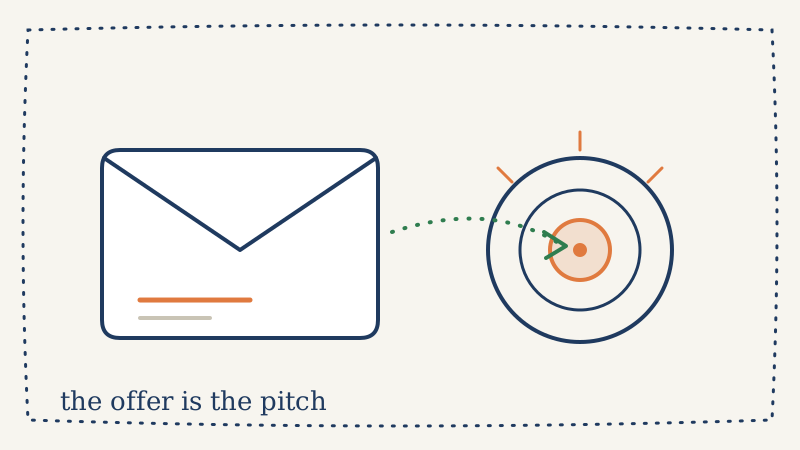
The product is what you sell. The pitch is how you describe it. The offer is the specific, low-friction next step you are asking the prospect to take, plus the reason that step is worth their time right now. A meeting request with no reason attached is not an offer. It is a favor request, and cold prospects do not do favors for strangers.
A real offer answers three questions before the reader consciously asks them:
- Why should I care about this problem at all?
- Why should I believe you can help with it?
- Why is right now the moment to act, instead of never?
Miss any one of those and the email collapses into noise. Nail all three in four sentences and you have something a busy buyer will actually respond to.
The four building blocks of a high-converting offer
Every offer that consistently books meetings contains the same four components. They do not have to appear in this exact order, but all four have to be present.
1. A sharp problem statement
Lead with a problem the prospect already feels, described in their language, not yours. “Your reps are spending twelve hours a week on manual list building” beats “our platform streamlines sales productivity.” The first sentence is a mirror; the buyer should see their own reality reflected back with uncomfortable precision.
The trap here is vagueness. “Struggling to hit pipeline targets” is true of almost everyone, which makes it true of no one in particular. Get specific enough that the reader thinks, “how do they know that about us?” That specificity is what separates a mirror from a horoscope.
2. A credible mechanism
Once you have named the problem, you have to make the reader believe you can solve it, in one sentence, without a pitch deck. This is the mechanism: the reason your solution works, stated plainly.
Weak: “We help companies grow revenue.” Strong: “We validate every address against the live mail server before your reps send, so bounces stay under one percent and your domain reputation survives.” The second version tells the reader exactly how the result happens. Tools like Scrubby make that kind of claim concrete, because the mechanism (real-time inbox verification) is something the buyer can picture working. A mechanism the reader can visualize is far more persuasive than an outcome they have to take on faith.
3. Proof that shrinks the risk
Cold prospects assume you are exaggerating, because most senders are. Proof deflates that skepticism. It can be a named customer, a specific number, a relevant case, or a comparison to a company they respect. One concrete proof point beats three vague superlatives.
Keep it proportional. A single sentence such as “we did this for two other Series B fintechs and cut their cost per meeting by roughly forty percent” carries more weight than a paragraph of adjectives. If you do not have customer proof yet, use a mechanism-based guarantee instead: something the reader can verify quickly and cheaply.
4. A right-sized ask
The final block is the next step, and its size has to match the temperature of the relationship. You are a stranger. Asking a stranger for a full discovery call, a demo, and a follow-up with their VP is asking for marriage on a first date. Right-size the ask to the trust you have earned, which on a cold first touch is close to zero.
Good cold offers ask for something small: a reply to a yes-or-no question, permission to send a two-minute overview, or fifteen minutes rather than “a quick 30.” The lower the friction, the higher the response. You can escalate the ask across the sequence as the relationship warms.
Match the offer to buying intent
Not every prospect is at the same stage, and the same offer will not fit all of them. The strongest outbound programs vary the offer based on the signal that triggered the outreach.
For accounts showing an active buying signal, a new funding round, a relevant executive hire, a competitor switch, you can make a bolder, more direct offer, because the timing question is already answered. Monitoring tools like CAM surface those signals (a competitor’s pricing change, a new page shipping, a status-page outage) so your reps reach out at the exact moment the problem is top of mind. When you lead with a trigger, “I saw you just moved off Competitor X” earns a much stronger offer than a cold guess.
For accounts with no visible signal, stay humble and curiosity-driven. The offer becomes lighter: a useful benchmark, a relevant teardown, or a single provocative question. You are trading a hard ask for a soft one because you have less permission. The mistake is running one offer across your entire list regardless of intent, which guarantees you overshoot the cold accounts and undershoot the hot ones.
Rewrite this weak offer with me
Here is a real-world-shaped example. The before:
Hi Sarah, I hope you are doing well. My name is Jordan and I work at Acme, a leading sales engagement platform. I would love to hop on a quick call to show you a demo of how we can help your team be more productive. Are you free Thursday?
Every block is missing. No problem, no mechanism, no proof, and an oversized ask wrapped in a filler opener. Now the after:
Hi Sarah, most 15-rep SDR teams I talk to lose a full day a week to reps rebuilding lists by hand and still emailing dead addresses. We plug that leak two ways: verified data on the way in, and an AI SDR that drafts and sends the first-touch sequences so your humans only work the replies. One 12-rep team cut manual prospecting from 11 hours a week to under 2. Worth me sending a 90-second overview, or is list quality already handled on your end?
The rewrite names a specific problem, states a mechanism the reader can picture, offers a concrete proof point, and closes with a genuinely small ask. That is the difference between an offer and a favor request.
Where the AI SDR angle changes the math
The offer framework does not change when an AI SDR is doing the sending, but it does raise the stakes on getting the offer right. A human rep sends a few dozen thoughtful emails a day and can course-correct on the fly. An AI SDR platform like vSDR can run the same offer across thousands of prospects before you have a single data point back, which means a weak value proposition scales into a weak result at volume, fast.
That is an argument for treating the offer as the highest-leverage thing you tune, not the last. Before you scale send volume, pressure-test the four blocks on a small segment, watch the reply rate, and only pour on volume once the offer earns responses. Automation multiplies whatever you feed it, so feed it an offer that already works.
Common ways offers fail
A few failure patterns show up again and again in underperforming sequences:
- Feature dumping. Listing five capabilities instead of solving one problem. The reader cannot tell which of the five is for them, so they pick none.
- Us-centric framing. Every sentence starts with “we” or “our.” Flip it: the prospect should be the subject of most sentences, not your company.
- The mega-ask. Requesting a 45-minute deep dive on the first touch. Shrink it.
- Manufactured urgency. “Limited spots” and “act now” on a cold email read as desperate, not scarce. Real urgency comes from a real trigger, not a fake deadline.
- No offer at all. The email describes the company, then asks “open to connecting?” with nothing in between. Connecting for what?
If a sequence is underperforming, audit the offer against these before you touch the subject line or the send times.
Test your offer before you scale it
Treat the offer as a hypothesis. Write two or three genuinely different versions, not cosmetic variations of the same sentence, and run them against comparable segments. Vary the problem statement or the mechanism, hold the audience constant, and read reply rate rather than open rate, because the offer lives in the body, not the subject line.
Give each version enough volume to mean something before you call a winner, then fold the winner back into your default sequence and start the next test. Outbound is never finished; buyer priorities shift, and an offer that crushed last quarter can go flat this one. The teams that win are the ones that keep a live experiment running instead of setting a sequence and forgetting it.
The takeaway
Deliverability gets your email into the inbox. The subject line earns the open, the first line earns the read, and the call to action tells the reader what to do next. But the offer is the only part that earns the meeting. It is the case you make for why this problem matters, why you can solve it, and why now.
Build every cold email offer from the same four blocks: a sharp problem, a credible mechanism, proof that shrinks the risk, and a right-sized ask. Match it to the buyer’s intent, test it before you scale it, and never let an AI SDR run a value proposition you have not proven by hand. If your outbound is landing in the inbox but not booking meetings, the offer is almost always where the fix lives. If you would rather have a partner build and run that motion end to end, that is exactly what Vendisys does for outbound teams every day.