Ask most outbound leaders how they divide accounts among their SDRs and you will hear some version of “we round-robin the list.” A new batch of accounts drops in, the system deals them out like a deck of cards, and each rep works whatever landed in their pile. It feels fair. It is also one of the quietest ways to leak pipeline.
Round-robin optimizes for equal counts, not for coverage, context, or continuity. Two reps end up emailing different people at the same target account in the same week. A rep who happens to draw a cluster of enterprise logos gets buried while a teammate burns through 200 small accounts. And when someone ramps down or rotates off, their accounts scatter back into the pool with no memory of who was already touched.
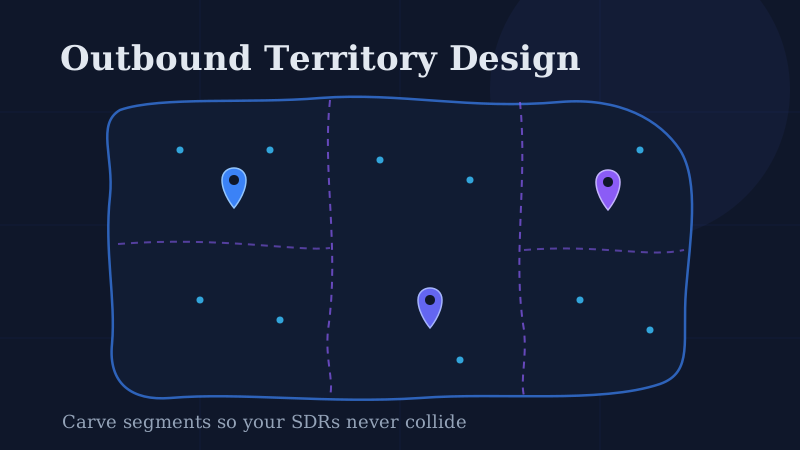
Territory design fixes this. It is the deliberate practice of dividing your total addressable market into segments, then assigning clear, non-overlapping ownership so every account has exactly one SDR responsible for it. Done well, it prevents collisions, balances workload against real effort (not raw count), and gives each rep enough concentration to build genuine expertise in their patch. Here is how to build it.
Why round-robin quietly costs you pipeline
Start with the failure modes, because naming them makes the fix obvious.
Collisions. When two reps can both see the same account, both eventually work it. The prospect receives two cold emails with slightly different pitches, from two people at the same company, sometimes on the same day. To the buyer this reads as either spam or disorganization, and it torches your credibility before a conversation ever starts. Multithreading a deal on purpose is powerful. Two reps unknowingly stepping on each other is not multithreading, it is friction.
Uneven load. Not all accounts cost the same to work. An enterprise account with a seven-person buying committee takes far more research and touches than a 40-person startup. Round-robin counts logos, so a rep holding 30 enterprise accounts can be more overloaded than a rep holding 120 SMB accounts. Activity looks balanced on a dashboard while output quietly diverges.
No continuity. Territories accumulate context. A rep who has owned the fintech segment for a quarter knows which objections land, which trigger events matter, and which competitors keep showing up. Reshuffle that list every month and you throw away the compounding knowledge that makes outbound get better over time.
Coverage gaps. When nobody owns a slice of the market, nobody notices it going untouched. Accounts that match your ICP perfectly sit idle because they fell between two reps’ mental maps of “my accounts.”
Step 1: Pick the axis you cut on
A territory is just a rule that says “these accounts belong to this rep.” The art is choosing the dimension you cut along. The four most common axes, roughly in order of how often they work for outbound teams:
- Segment or vertical. Group accounts by industry or use case (fintech, healthcare, logistics). This is usually the strongest axis for outbound because messaging is shared within a vertical. A rep who owns healthcare can reuse the same value props, case studies, and objection handling across their whole patch.
- Company size or tier. Split enterprise, mid-market, and SMB. Sales motions differ so much across these bands that mixing them in one territory forces a rep to context-switch between long committee-driven cycles and fast single-threaded ones.
- Geography. Cut by region or time zone. Less about messaging, more about operational fit: call windows, language, and local compliance. Geography pairs well as a secondary cut on top of segment.
- Named accounts. For a small set of strategic logos, assign them by name to your strongest reps regardless of any other rule. These get bespoke treatment and should be carved out before the automated logic runs.
Most teams land on a primary axis (usually segment or tier) plus one secondary axis (usually geography). The goal is a rule simple enough that any rep can look at an account and instantly know whether it is theirs.
Step 2: Size territories by effort, not by count
Once you have an axis, resist the urge to split accounts into equal piles. Equal counts produce unequal work. Size each territory by expected effort instead.
A workable method: assign every account a rough weight based on how much touch it will require. An enterprise account might be a 5, a mid-market account a 3, and an SMB account a 1. Sum the weights, divide by your number of reps, and build territories that hit roughly equal weighted totals rather than equal headcounts. A rep might own 40 heavy accounts while another owns 110 light ones, and both are carrying the same real load.
This is also the moment to right-size the territory itself. Too big and the rep skims, never getting deep enough on any account to personalize well. Too small and they exhaust their list in a month and start recycling contacts, which is where deliverability and reputation start to suffer. For most full-time SDRs, a territory of roughly 100 to 200 actively worked accounts at a time is a sane starting band, adjusted up or down by how heavy those accounts are.
Step 3: Enforce single ownership and clean handoffs
The whole point of territory design is that every account has exactly one owner at any given time. That rule only holds if two things are true.
First, ownership has to be visible and enforced wherever reps pull accounts. If your system lets two reps independently surface the same logo, collisions are inevitable no matter how clean the map looks on paper. The assignment has to be a hard boundary, not a suggestion.
Second, handoffs need explicit rules. Territories are not permanent. Reps ramp, rotate, take leave, and get promoted, and accounts move with those changes. Define upfront what happens to an account’s history when it changes hands: which contacts were already touched, what was sent, and what the last response was. Without that memory, the new owner re-sends a first-touch email to someone who already replied “not now, check back in Q3,” and you look like you were not paying attention. This is exactly the kind of continuity that a coordinated GTM operation is built to preserve, and running your outbound through a partner like Vendisys means territory ownership and account history stay intact even as individual reps rotate on and off your program.
Step 4: Route inbound and signals into the same map
Outbound territories should not live in a separate universe from the rest of your go-to-market. When an inbound lead arrives, or an intent signal fires on an account, it should route to whoever already owns that account, not to a random rep or a separate inbound queue. Otherwise you recreate the collision problem from the other direction: an SDR is patiently working an account through cold outbound while an inbound rep swoops in on the same logo because a form got filled out.
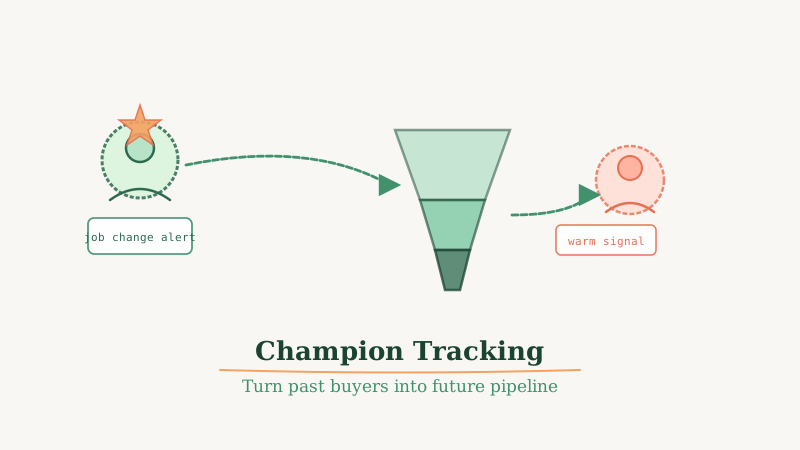
Wire your signals to respect ownership. If an account in a rep’s territory shows a buying trigger (a funding round, a new executive hire, a competitor mention), that alert should land with the owner so they can accelerate, not with a stranger who starts from zero. The territory becomes the routing key for everything that touches the account.
Step 5: Keep the map clean
Territory design is not a one-time exercise you run at the start of a quarter and forget. Two maintenance habits keep it healthy.
Protect data quality. A territory map is only as good as the account and contact data underneath it. If half the emails in a segment are stale or invalid, that rep’s effective territory is far smaller than it looks, and their weighted load is wrong. Validate contacts before they enter a sequence so bounces and catch-all traps do not quietly hollow out a patch. Running lists through a verification service like Scrubby before assignment keeps each territory’s real coverage honest, which matters most for enterprise domains where catch-all configurations hide dead addresses.
Rebalance on a cadence, not on impulse. Markets shift, reps ramp, and some segments outperform others. Review territory balance on a fixed cadence (monthly or quarterly), look for reps who are consistently exhausting their list or consistently underwater, and adjust. Rebalancing on a schedule preserves the continuity that makes territories valuable. Reshuffling reactively every time a number dips throws it away.
A simple sequence to put this in place
If you are starting from round-robin today, you do not need a six-week project. A tight version looks like this:
- Choose one primary axis (segment or tier) and, if useful, one secondary axis (geography).
- Carve out named strategic accounts and assign them by hand.
- Weight remaining accounts by expected effort and build territories to roughly equal weighted totals.
- Lock single ownership so no two reps can surface the same account, and write down your handoff rules.
- Route inbound and intent signals to the existing owner.
- Validate the data underneath each territory, then set a monthly rebalance check.
The difference shows up fast. Buyers stop getting double-emailed, reps stop skimming or drowning, and the accounts you actually care about stop slipping through the cracks between two people’s mental maps.
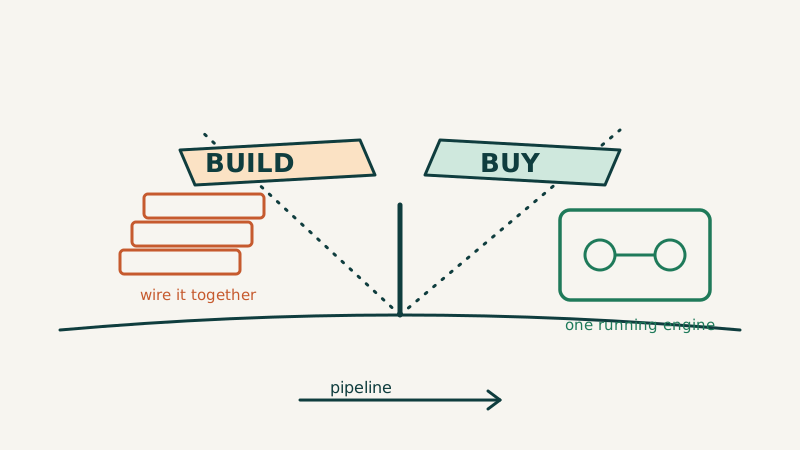
Territory design is unglamorous work, which is exactly why so many teams skip it and default to round-robin. But coverage, not activity, is what turns a target market into pipeline. If you would rather not build and maintain the map in-house, an outsourced outbound program from Vendisys can own the segmentation, the routing, and the rebalancing as part of the infrastructure, so your reps spend their time on conversations instead of arguing over who owns which logo.