AI SDR Guardrails: How to Review and Approve AI-Written Outbound Before It Ever Hits Send
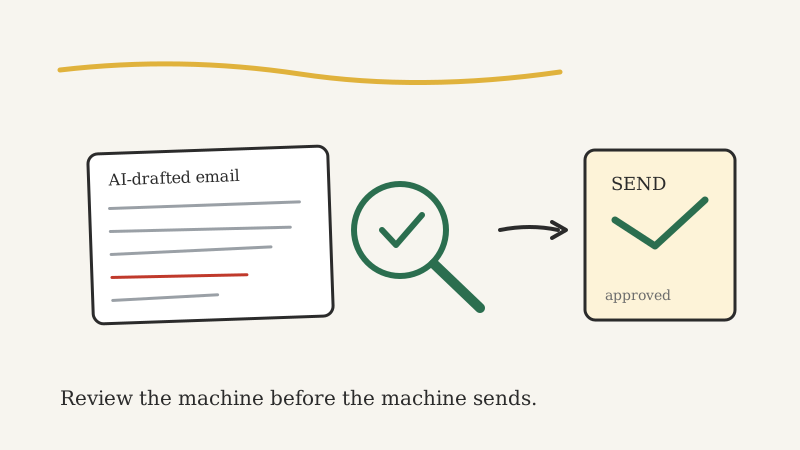
The pitch for an AI SDR is speed. It reads a list, researches each account, writes a personalized message, and queues the follow-ups, all without a human touching a keyboard. That speed is real. So is the flip side nobody puts on the sales deck: an engine that can draft a thousand emails an hour can also send a thousand wrong emails an hour, and it will do it cheerfully, at scale, before anyone notices.
Most teams that get burned by AI outbound were not burned by the technology. They were burned by pointing it at their prospect list and walking away. The teams that actually book meetings with it treat the AI as a very fast junior rep whose work still has to clear a desk before it goes out. This is a guide to building that desk: the guardrails and the review workflow that sit between “the machine drafted it” and “the prospect received it.”
Why AI outbound needs a review layer at all
A human SDR who writes a bad email sends one bad email. The damage is contained to one prospect and one inbox. An AI SDR that misfires does so systematically, because it is applying the same flawed logic across your entire list at once. The failure is never one email. It is a pattern replicated hundreds of times before the first reply comes back annoyed.
The mistakes cluster into a few predictable buckets:
- Hallucinated personalization. The AI invents a detail: a funding round that never happened, a product the company does not sell, a role the contact does not hold. It reads confident and it is completely wrong.
- Stale or bad data. The model writes a flawless message to someone who left the company eight months ago, or to a role-based inbox that forwards straight to legal.
- Tone drift. The AI picks up a register that does not match your brand, too casual, too aggressive, or uncannily fluent in a way that reads as machine-written.
- Deliverability self-harm. High send volume to unverified addresses spikes your bounce rate, and the whole domain reputation you spent months building erodes in a week.
None of these are exotic. They are the default output of an unsupervised AI SDR, and every serious product in the category, vsdr.ai, getchampions.io, getaia.io, and triguna.ai among them, is only as safe as the review process wrapped around it. The tool sets the ceiling. Your guardrails set the floor.
Guardrail one: clean the inputs before the AI ever sees them
The cheapest error to prevent is the one that never enters the system. Most “AI mistakes” are actually data mistakes that the AI faithfully amplified. Garbage in, confident garbage out.
Before a single record reaches your AI SDR, it should pass through validation. Every email verified against real inbox existence, not just syntax, so catch-all domains and dead addresses get flagged rather than mailed. Every contact checked for a recent job change, because the highest-converting message in the world converts nothing if the person left. This is where a validation layer like Scrubby earns its place in the stack: it verifies deliverability before the send, so your AI is drafting to real, reachable humans instead of burning reputation on bounces.
Set a hard rule: no record enters the AI’s queue until it clears verification. This single guardrail eliminates the entire “great message, wrong or dead recipient” category, and it protects the sending infrastructure that everything else depends on.
Guardrail two: constrain what the AI is allowed to claim
The most dangerous freedom you can give an AI SDR is the freedom to make things up. Personalization is the whole value proposition, but personalization built on invention is worse than no personalization at all, because a prospect who catches one fabricated detail distrusts the entire message.
The fix is to fence the source material. Give the model a defined, factual context window, verified firmographic data, real trigger events, confirmed role and seniority, and instruct it to personalize only from that set. If a fact is not in the provided context, the AI is not allowed to assert it. Teams that skip this step end up with emails referencing a “recent Series B” that came from the model’s imagination rather than your data.
The best signals to feed it are the ones you can verify independently. Buying intent, competitive displacement, and hiring activity are strong because they are checkable and time-bound. A tool like CAM surfaces which accounts are showing competitive or website-monitoring signals right now, which gives the AI a real, current reason to reach out instead of a manufactured one. Real signal in, relevant message out. The guardrail is simple: personalize from evidence, never from inference.
Guardrail three: sample and score the output before it ships
You cannot read every AI-drafted email at scale, and you should not try. But you can sample. The discipline that separates teams who trust their AI from teams who get surprised by it is a review cadence applied to a representative slice of every batch.
Pull a random sample from each send batch, ten to twenty messages, and score them against a fixed rubric before the batch releases:
- Factual accuracy. Is every claim in the message traceable to your source data? One invented detail fails the batch.
- Relevance. Would this specific person care about this specific opener, or is it generic filler dressed up as personalization?
- Tone match. Does it sound like your company, or does it sound like a language model doing an impression of a salesperson?
- Compliance and safety. Correct opt-out language, no risky claims, no misgendering, nothing that would embarrass you if it were screenshotted.
If the sample passes, the batch ships. If it fails, the batch holds and the underlying prompt or data gets fixed before anything sends. This is the core loop, and it is why the mature approach keeps a human in the loop for review even when the drafting is fully automated. You are not authoring the messages anymore. You are auditing them.
Guardrail four: throttle the send, watch the reputation
Even perfect messages will torch your deliverability if you fire them out of the gate at full volume. AI makes it trivially easy to send more, which makes it trivially easy to send too much, too fast, from domains that have not earned that volume.
Ramp deliberately. New sending domains and inboxes need a warmup period where volume climbs gradually, not a cold start into thousands of sends. Cap the daily volume per inbox at a human-plausible number. Rotate across a pool of domains so no single one carries the whole load. And monitor the leading indicators continuously, bounce rate, spam-complaint rate, and reply sentiment, because those move before your open rates crater, not after.
Treat a rising bounce rate as a circuit breaker. When it crosses a threshold, the system should pause sending automatically rather than plow ahead. An AI SDR left unthrottled will happily send its way onto a blocklist, because staying off one was never part of its objective. That has to be your guardrail, enforced by your process, not the model’s good intentions.
Guardrail five: close the loop with reply review
The last guardrail is the one most teams forget: the conversation does not end when the AI sends. It ends when a human owns the reply. AI-generated replies to positive responses are where automation most often overreaches, because a warm prospect who gets an obviously robotic answer to a genuine question cools off instantly.
Set the handoff rule explicitly. When a prospect replies with real intent, a human takes the thread. The AI can flag, categorize, and draft a suggested response, but a person approves it before it goes back. This protects the highest-value moment in the entire sequence, the one where a stranger just became a lead, from being fumbled by an automation that does not know when it is out of its depth.
The pattern underneath all five
Read the guardrails together and a single principle emerges. The AI SDR is not the system. It is one component inside a system, and the system is what keeps it honest. Clean data going in, constrained claims, sampled output, throttled sends, and human-owned replies are not five separate rules. They are one review layer wrapped around a fast, tireless, occasionally overconfident drafting engine.
This is why the “AI replaces your whole outbound motion” framing sells software but disappoints buyers. The products are genuinely good and getting better every quarter. What they cannot do is supervise themselves, and the teams that pretend otherwise are the ones who show up three months later asking why their domain is blocklisted and their reply rate is negative. The AI did exactly what it was told. Nobody built the layer that told it when to stop.
Getting that layer right, the data hygiene, the signal sourcing, the review cadence, and the deliverability discipline, is most of the work of running AI outbound well. It is also the part no tool ships with, because it depends on your standards and your process. That is the piece we build with teams every day at Vendisys: not just pointing the machine at a list, but constructing the guardrails that make its speed an asset instead of a liability. Buy the fastest AI SDR on the market. Then build the desk its work has to clear before it reaches a prospect. The speed is only worth having if you can trust what it ships.