Most outbound teams treat their ICP like a velvet rope: if a company clears the entry criteria, it goes into the sequence. Industry, headcount, funding stage — check, check, check — and the account lands in a cadence alongside hundreds of others that look identical on paper.
The problem is that “inside the ICP” is not a binary state. Some accounts are a tight fit and will close in one quarter. Others technically qualify but will churn in year two or drag the deal out for six months. Running the same outbound motion on both groups wastes rep time, burns deliverability, and produces a pipeline that feels full but converts poorly.
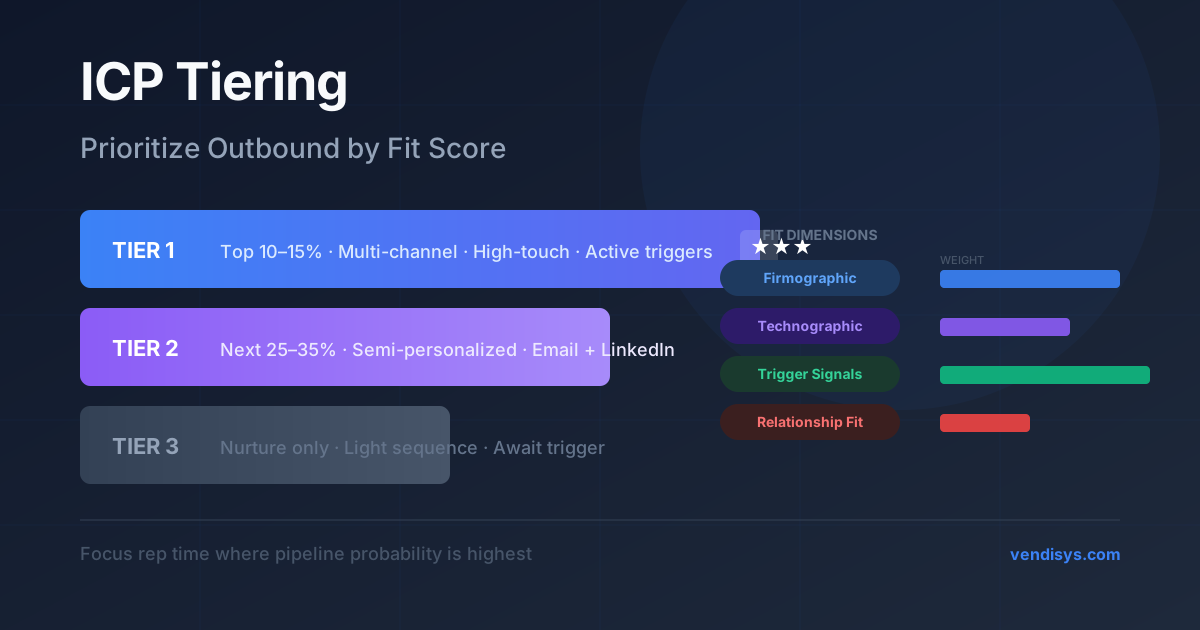
ICP tiering solves this. It is the practice of segmenting accounts that pass your basic ICP filter into priority bands — usually Tier 1, Tier 2, and Tier 3 — based on how closely they match the attributes of accounts that close fast, pay well, and stay. Tier 1 gets your highest-touch, multi-channel outbound. Tier 3 gets a lighter automated sequence, or nothing at all.
Here is how to build a tiering model that actually changes rep behavior.
Why Flat ICP Lists Hurt Pipeline Quality
Before we get into the mechanics, it is worth naming what a flat list costs you.
Rep time is finite. A skilled SDR can meaningfully personalize outreach to roughly 20 to 30 accounts per week at high touch. If your list has 2,000 accounts and no tiers, reps default to the path of least resistance: spray the same template across everyone. Response rates drop, and the reps who do book meetings bring in accounts that drag through the funnel.
Buying committees differ by fit. Your strongest ICP accounts often have a clear economic buyer, a defined pain, and a budget cycle that aligns with your outreach timing. Mid-tier accounts may have the pain but no budget authority on the contact you are reaching. Knowing who is worth a six-touch sequence versus a two-touch test changes how you allocate calls, LinkedIn touches, and direct mail.
Data costs money. Premium intent data, phone-verified mobile numbers, and enriched technographic signals cost real money per record. Spending that budget on Tier 3 accounts is a guaranteed loss. Concentrating it on Tier 1 is how you get positive ROI on the data stack.
The Four Dimensions of a Fit Score
A useful fit score combines four dimensions. Each dimension gets a weighted score, and the total determines the tier.
1. Firmographic fit (20–30%)
This is your baseline ICP filter: industry vertical, employee count, revenue range, geography, and business model. Every account on your list should already clear this filter. What you are scoring here is how close to the center of your ICP a given account sits. A 200-person SaaS company in your core vertical scores higher than a 480-person company at the edge of your size range.
Weight this dimension lower than the others because it is the easiest to game and the least predictive of close rate on its own.
2. Technographic fit (20–30%)
What tools does the account currently use, and do those tools signal a buying context for your solution? A company running Salesforce and Outreach that just posted three SDR job openings is a different kind of opportunity than one running a generic CRM with no outbound motion. Technographic fit captures the infrastructure context that determines whether your product can plug in and whether the account has the operational maturity to use it.
Sources: G2 Buyer Intent, Bombora, Clearbit Reveal, BuiltWith, and job postings.
3. Trigger fit (30–40%)
This is the highest-weight dimension and the most perishable. Triggers are time-bound signals that indicate a buying window: a new VP of Sales hired in the last 90 days, a Series B closed in the last six months, a recent headcount spike in the sales or marketing org, a competitor contract expiring based on intent data, or a news event that creates urgency.
Accounts with active triggers should almost always land in Tier 1, even if their firmographic and technographic fit is only moderate. A trigger is evidence that the buying window is open. Without a trigger, you are showing up to a conversation the account is not ready to have.
4. Relationship and proximity fit (10–20%)
Do you have a mutual connection? Has the account engaged with your content — downloaded a resource, attended a webinar, visited your pricing page? Did they previously request a demo but go dark? Relationship signals lower the barrier to a response and should bump an account up a tier even when the other scores are middling.
Building the Tier Bands
Once you have scored accounts across all four dimensions, set cutoffs that reflect your capacity. A simple three-tier model looks like this:
Tier 1 (top 10–15% of scored accounts)
These are accounts where at least two of the four dimensions score in the top quartile, and at least one is a high-confidence trigger. Tier 1 gets a full multi-channel sequence: personalized email, LinkedIn connection plus message, phone calls, and potentially a direct mail piece for deals above a certain ACV threshold. Reps should spend 30 to 45 minutes on pre-call research for each Tier 1 account before the first touch.
Capacity rule of thumb: an SDR running a full Tier 1 motion can work 15 to 25 accounts per week, not 100.
Tier 2 (next 25–35% of scored accounts)
Strong firmographic and technographic fit but no active trigger, or a moderate trigger without a strong fit profile. Tier 2 gets a semi-personalized email sequence with one or two LinkedIn touches. No phone calls unless the account replies or visits your site. The sequence is longer (7 to 9 touches over 30 days) to account for the lower urgency.
Tier 3 (remaining ICP-qualified accounts)
These pass the baseline ICP filter but score below the threshold for meaningful investment. Tier 3 can go into a lightweight nurture track — two or three templated emails over 60 days — or into a programmatic ad audience to warm them before an SDR ever reaches out. Do not burn rep time here until a trigger fires and elevates them.
Operationalizing Tiers in Your Outbound Stack
Tiering is worthless if it lives in a spreadsheet that no one opens. The model has to live inside the tools reps use every day.
CRM: Add a custom field for Account Tier and Fit Score. Keep the score visible on the account page so reps can see it without hunting. Automate tier assignment using enrichment webhooks when new accounts enter the system.
Sequencer: Build separate sequences for each tier in your sales engagement platform (Outreach, Salesloft, Apollo, or equivalent). Lock Tier 1 sequences behind a checkpoint — the rep must complete a pre-call research card before launching a contact into the sequence. This forces the habit.
Routing rules: When inbound leads come in, cross-reference the account against your tier model before routing. A Tier 1 account with an inbound touch should skip the standard SDR queue and go directly to a senior rep with a 5-minute SLA.
Trigger monitoring: Assign someone (or a tool like Clay) to watch for trigger events that upgrade accounts from Tier 3 to Tier 1. A Tier 3 account that hires a new CRO this morning should be in a Tier 1 sequence by this afternoon.
Measuring Whether the Tiers Are Working
Run a monthly tier audit covering three metrics:
Tier 1 meeting rate: What percentage of Tier 1 accounts contacted book a meeting? If it is below 8%, either your tier definition is too broad or your outbound execution is not differentiated enough from Tier 2.
Tier-to-close rate by tier: Track which tier each closed-won deal originated from. Over time, this data refines your scoring weights. If Tier 2 accounts close at the same rate as Tier 1, you have defined Tier 1 too narrowly and are leaving pipeline on the table.
Tier 3 response rate: If Tier 3 accounts are responding at a meaningful rate, some of your highest-value accounts may be miscategorized. Revisit the scoring model quarterly.
The Maintenance Problem (And How to Solve It)
Fit scores decay. A Tier 1 account that does not respond in 60 days may have had a leadership change, a budget freeze, or a competitor win. A Tier 3 account that just closed a funding round deserves a second look.
Build a quarterly scoring refresh into your RevOps calendar. Re-pull enrichment data, re-evaluate trigger signals, and re-tier the accounts that have moved. Treat the tier model as a living document, not a one-time project.
The teams that do this consistently find that their Tier 1 list shrinks over time — not because there are fewer good accounts, but because their scoring gets more precise. Fifty laser-focused Tier 1 accounts outperform five hundred loosely defined ones every quarter. That is the whole point of tiering.
Vendisys helps B2B companies build and operate outbound systems that prioritize correctly from day one. If you want to discuss how to tier your target accounts and route effort where it converts, reach out at vendisys.com.