Intent data is the easiest thing in the GTM stack to buy and the hardest to get value from. The pitch is irresistible: stop guessing which accounts to work, and let the data tell you who is already shopping. Every revenue leader who has ever stared at a flat pipeline number wants that to be true.
What actually happens in most deployments is less dramatic. The data lands, it gets wired into a dashboard, a surging-accounts list appears, and six months later nobody can say whether the meetings would have happened anyway. The contract renews because cancelling feels like admitting you cannot read the market.
The problem usually is not the vendor. It is that buyers compare these three providers as if they were competing versions of the same product. They are not. Bombora, 6sense, and G2 Buyer Intent observe genuinely different behavior, at different points in the buying process, with different confidence. Pick the one whose observation window does not match your motion and you will get signals that are technically accurate and commercially useless.
Here is what each one is actually watching, and how to decide.
The Short Version
- Bombora is the broadest. It aggregates content consumption across a large cooperative of B2B publishers and reports which topics an account is reading more than its own baseline. Best when you need wide top-of-funnel coverage and your TAM is large.
- 6sense is a platform, not a data feed. It blends third-party intent with its own anonymous web de-anonymization, predictive account scoring, and orchestration. Best when you have a revops function to run it and your deal cycles are long enough that stage prediction pays for itself.
- G2 Buyer Intent is the narrowest and the latest-stage. It reports named accounts researching specific product categories and specific vendors on a review site. Lowest volume of the three, highest per-signal value, and the only one that routinely tells you a competitor is in the deal.
Those differences matter more than any feature grid, so here is the detail that drives the decision.
What “Intent” Means in Each Case
The word intent papers over three very different measurements, and most comparison content never separates them.
Bombora measures topic surges. It sits in a data cooperative where participating publishers share consumption data, then maps that consumption to companies and to a taxonomy of thousands of B2B topics. When an account consumes materially more content on a topic than its historical baseline, that is a surge. The signal is “this company is reading about this subject more than it usually does.”
6sense measures a modeled buying stage. It pulls third-party intent (including cooperative data), de-anonymizes traffic on your own web properties, factors in technographics and firmographics, and outputs a predicted stage: target, awareness, consideration, decision. The signal is “our model believes this account is this far along.”
G2 measures explicit research on a review site. Someone from a named company visited a category page, compared two products, or read your competitor’s reviews. The signal is “a person at this company was actively evaluating software in your category.”
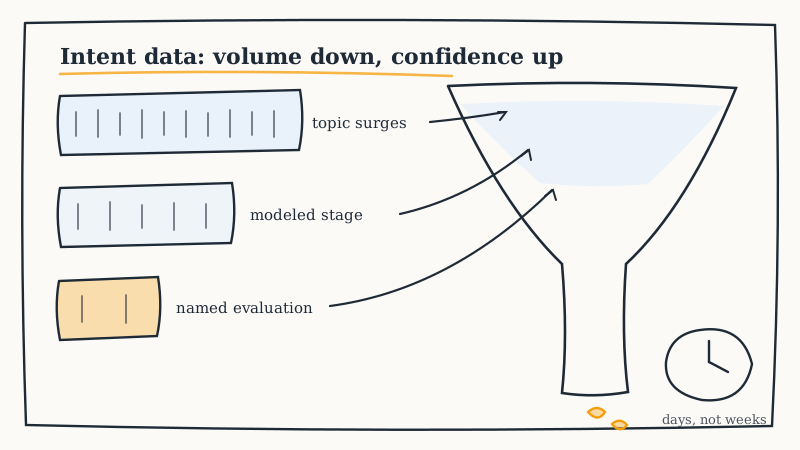
Notice the ladder. Bombora tells you a topic got warm somewhere inside a company. 6sense tells you a model thinks the account is progressing. G2 tells you a human was comparing vendors. Volume drops at every step and confidence climbs at every step. There is no provider that gives you both ends.
The Attribution Problem Every Provider Shares
Before comparing them further, there is a structural limitation worth naming, because no vendor will lead with it.
All three providers report at the account level, not the person level, and for good reason: privacy regulation and the mechanics of IP-to-company resolution make reliable person-level intent legally and technically fraught. What that means operationally is that a surge tells you a person at a 4,000-person enterprise read something. It does not tell you who, what their role is, or whether they have any influence over the purchase.
This is why intent data so often disappoints teams that treat it as a lead source. It is not a lead source. It is a prioritization input. The account got more interesting; you still have to do the work of figuring out who inside it matters and reaching them. If your team does not already have a reliable way to map a buying committee and run a multi-threaded sequence into it, adding intent data will not fix the pipeline. It will just reorder the same broken outreach. Our guide to multithreading outbound deals to reach the full buying committee is the prerequisite, not the follow-up.
The second shared limitation is decay. Intent is perishable in a way firmographic data is not. A surge from three weeks ago is close to worthless, because either someone else already reached them or the evaluation moved on. Any intent deployment that is not wired to a workflow capable of reacting within days is buying freshness it cannot use.
Bombora: Wide Coverage, Shallow Depth
Bombora’s advantage is reach. Because it operates a cooperative rather than relying on a single property, it sees content consumption across a very large slice of B2B publishing. For a company with a broad total addressable market, that coverage matters: you will get surges on accounts that never touch your site and never visit a review site.
The taxonomy is also genuinely useful if you invest in it. Thousands of topics means you can build a surge definition that maps to your actual problem space rather than a generic category. A company selling deliverability tooling can watch topics around email authentication and sender reputation rather than just “email marketing.”
Where it gets misused: teams treat a single-topic surge as a buying signal. It usually is not. One surge on one broad topic is noise at scale, and if you route it straight to a sequence you will burn goodwill on accounts that were reading an industry explainer. The deployments that work build composite definitions, where several related topics surge together, combined with a fit filter so you are only looking at accounts that could buy in the first place. If you have not already defined that fit layer, start with ICP tiering to prioritize outbound accounts by fit score and layer intent on top of it. Intent on a bad-fit account is a distraction with a timestamp.
The honest summary on Bombora: highest volume, lowest per-signal confidence, and the most dependent on you doing the modeling work. It rewards teams that treat it as a raw input to a scoring system rather than a list to call.
6sense: A Platform That Happens to Include Intent
6sense is in a different category of purchase. You are not buying a feed, you are buying an account engagement platform with intent as one component. The predictive scoring, the anonymous visitor resolution, the segment orchestration, and the ad activation are the product.
When this is the right call: you have long, multi-stakeholder deal cycles where knowing an account has moved from awareness to consideration genuinely changes what you do next. You have a revops or marketing ops person who will own the model, validate it against closed-won data, and maintain the segments. And you have enough first-party traffic for the de-anonymization piece to add real information, because that is where 6sense differentiates most from a pure third-party feed.
When it is the wrong call: you bought it to get a list of hot accounts. At that point you are paying platform pricing for the least differentiated layer of the product, and you will not use the orchestration that justifies the cost. The predictive stage output is also a model, which means it requires validation. Until you have back-tested predicted stages against deals that actually closed, you are trusting a number whose accuracy on your specific market is unverified. Ask the vendor for the methodology, then check it yourself after two quarters.
There is a second-order risk with platform purchases that is worth flagging: consolidation pressure. Buying 6sense tends to absorb budget and workflow that previously lived in several point tools, which is often good, but it also makes the renewal conversation much harder to walk away from. If your stack is already sprawling, read our take on auditing your outbound tech stack before renewing annual contracts before you add a platform-sized line item.
G2 Buyer Intent: Low Volume, High Signal
G2 is the one most teams underrate, because the volume looks disappointing next to a cooperative feed. You will see far fewer accounts. The ones you see are much further along.
What makes G2 distinctive is vendor-level specificity. It is the only one of the three that routinely tells you an account was looking at a named competitor, or comparing you against one. That is not a topic surge, it is a live evaluation with a shortlist, and it changes the content of your outreach completely. You are no longer opening a conversation about a problem. You are entering a comparison that is already underway, which means your message has to do competitive work from the first line. If that is where your signals are pointing, you need materials ready: here is how to build a competitive battlecard your SDRs will actually use.
The constraint is coverage. G2 only sees buyers who use G2. That skews toward categories with mature review ecosystems and toward buyers who research that way. In some categories the coverage is excellent. In others, especially newer categories or ones sold primarily through partners and relationships, there is very little to see. Before buying, ask for coverage numbers against your actual target account list rather than against the market in general. A provider can have strong aggregate coverage and almost no visibility into your specific segment.
Decay is also most acute here. A category-comparison visit is worth acting on within days. If it sits in a queue for two weeks, the shortlist is already set.
How to Choose
Work through these in order. The answer usually falls out before the end.
1. What is the size of your qualified TAM? If you have a few hundred realistic accounts, you do not need intent data to tell you who to work. You need better coverage and better multithreading on the accounts you already know. Intent data earns its cost when the list is too big to work uniformly. Below roughly a thousand qualified accounts, the honest answer is often that you are buying prioritization you could do manually.
2. Where does your deal actually start? If buyers in your category typically start with a review site, G2 sees the beginning of the process. If they start by reading analyst content and vendor blogs, a cooperative feed like Bombora sees it earlier. If they start on your own site and go quiet for two months, the de-anonymization in a platform like 6sense is where the information is.
3. Who will own the data? This is the question that predicts success better than any other. Intent data requires someone to define surges, validate against outcomes, prune noisy topics, and keep the routing fresh. If the answer is “the AE team will check the dashboard,” the deployment will fail regardless of vendor. Platform purchases need the most ownership; a narrow feed needs the least.
4. How fast can you act? Measure your current time from signal to first touch honestly. If a form fill takes you two days to respond to, an intent surge will take longer, and you will be paying for freshness you structurally cannot use. Fix the response path first. Our breakdown of reducing speed to lead with outsourced GTM infrastructure covers what that actually takes.
5. Can you run the volume the signals imply? A broad feed will surface more accounts per week than most teams can work. If your outbound capacity is the real constraint, buying more signal does not create pipeline; it creates a backlog with a decay clock on it.
The Execution Gap Nobody Budgets For
Here is the pattern we see repeatedly. A team buys intent data, the signals arrive, and nothing changes in the pipeline number. The post mortem blames data quality. It is almost never data quality.
What is actually missing is execution capacity matched to the signal. Intent data compresses your response window from weeks to days, and most outbound motions are not built to move that fast. The sequence needs to be written, the sending infrastructure needs headroom, the LinkedIn profiles need to be warm, and somebody has to be ready to follow up on a reply at 7pm on a Thursday. Buying a signal does not buy any of that.
This is the specific gap Vendisys exists to close. We are outsourced GTM infrastructure rather than an agency, which means we operate the execution layer your intent data is supposed to trigger. On the signal side, CAM consolidates every buying signal on your market into one feed, which is the part teams usually try to assemble themselves out of three dashboards and a spreadsheet. On the execution side, EMY sends sequences through email infrastructure we own, and LIA runs the LinkedIn outreach so you can multithread an account rather than hoping one contact replies. Replies from both channels land in Underfive, a unified inbox wired into your CRM, which is what keeps a fast-decaying signal from dying in somebody’s unread mail. For accounts far enough along that a meeting is the only reasonable next step, KALI runs calendar outreach that skips the inbox and lands on the calendar.
The sequencing point matters more than the product list: build the execution layer first, then buy the signal that aims it. A team that can reliably work a known account list in 48 hours will get value from any of these three providers. A team that cannot will get value from none of them, and will blame the data.
What to Ask Every Vendor Before Signing
Five questions, and the answers tell you most of what you need:
- What is your coverage against this specific account list? Upload your target accounts. Aggregate coverage claims are irrelevant if your segment is a blind spot.
- What is the median latency from observed behavior to the signal appearing in my workflow? Hours versus days changes whether this is actionable.
- How do you distinguish a surge from a baseline shift? You are testing whether their modeling is defensible or whether you are receiving raw volume with a label on it.
- Can I see predicted stage or surge data back-tested against my own closed-won deals? Any vendor confident in their model will engage with this. Reluctance is informative.
- What happens to my historical data if I do not renew? Intent is only useful as a trend. Losing the history resets your scoring model to zero and makes the renewal decision much less free than it looked.
The Bottom Line
None of these three is the best intent data provider, because they are not solving the same problem. Bombora is the right answer when your TAM is large and you need early, wide coverage you are willing to model yourself. 6sense is right when you have long cycles, real first-party traffic, and an ops owner who will run a platform. G2 Buyer Intent is right when your category has a mature review ecosystem and you want fewer, later, much sharper signals that name your competitors.
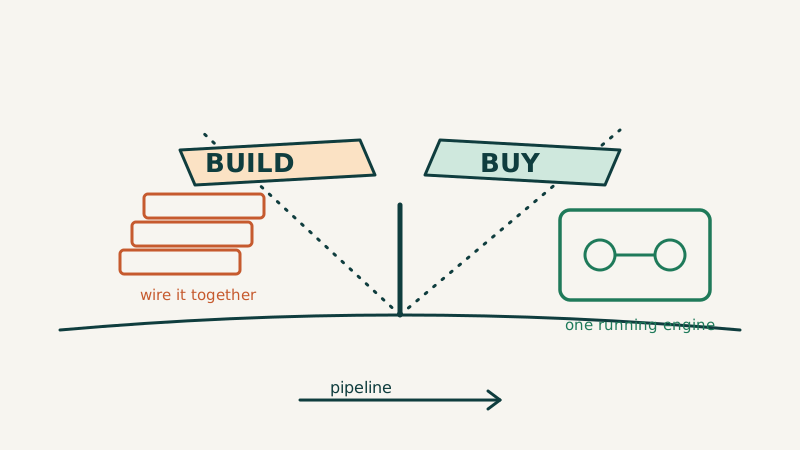
The decision that matters more than the vendor choice is whether your execution layer can act on a signal inside the window where it still means something. Intent data does not generate pipeline. It tells a working outbound engine where to point. If the engine is not running, the smarter purchase is the engine. Vendisys builds and operates that layer, and we are happy to tell you plainly whether intent data would help your motion or just give you a better-organized backlog.