AI SDR vs Sales Engagement Platform: Which One Actually Automates Your Outbound Motion
Buyers keep asking us the same question in different words. “We already pay for a sales engagement platform. Why would we add an AI SDR?” Or the reverse: “We bought an AI SDR. Do we still need Outreach or Salesloft?”
The confusion is fair. Both categories send sequenced emails. Both track opens, replies, and meetings. Both promise to make a small team punch above its weight. But they automate opposite halves of the outbound job, and buying the wrong one for your situation means either paying for a control panel with no driver, or paying for a driver you cannot steer.
Here is the distinction that actually matters, and how to decide which one belongs in your stack.
The one difference that explains everything
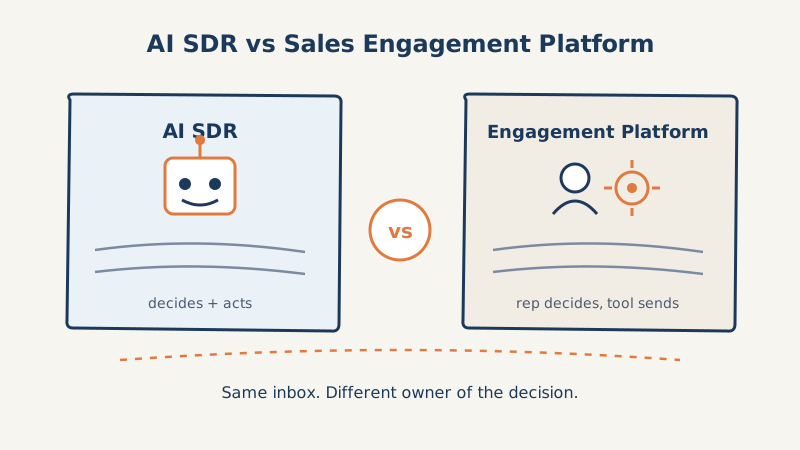
A sales engagement platform automates execution. A human still decides who to target, what to say, and when to follow up. The platform makes those decisions happen at scale: it queues the emails, spaces the touches, logs activity to the CRM, and reminds a rep to make the call on day four. Think of it as a very good assistant that never forgets a step but never has an original idea.
An AI SDR automates the decision. It reads a list, picks the accounts worth pursuing, drafts the message for each contact, chooses the follow-up angle, and often decides when to stop. A human sets the strategy and reviews the output, but the machine is making the per-prospect calls that a junior rep used to make.
Everything else, the pricing, the integrations, the reporting, follows from that split. Once you see it, the two categories stop looking like competitors and start looking like different answers to “which part of my rep’s day am I trying to give back?”
What a sales engagement platform is good at
Sales engagement platforms earn their keep when you already have reps and you want them spending time on the parts of the job only a human can do. The tool removes the administrative drag: no more copy-pasting templates, no more forgetting to follow up, no more guessing which of 200 open threads needs attention today.
They shine in a few specific situations:
- You have a team of SDRs or AEs doing real prospecting and you need consistency across all of them.
- Your motion is relationship-heavy, where the rep’s judgment on each account is the whole point and you would never want a machine writing the message.
- You need airtight CRM hygiene because RevOps is reporting on activity, and manual logging is where data goes to die.
The limitation is right there in the strength. The platform is only as good as the rep driving it. Point it at a bad list with a weak message and it will deliver that bad list with that weak message very efficiently. It automates the motion, not the thinking, and it does nothing about the quality of the data going in. That last part is why teams pair these platforms with list-cleaning tools like Scrubby before a single sequence goes out. A sequencer will happily burn your domain reputation sending to invalid addresses, because catching that was never its job.
What an AI SDR is good at
An AI SDR earns its keep when the bottleneck is not execution but capacity to think per-prospect. It is built for the situation where you do not have enough reps, or any reps, and you need the research-write-send-decide loop to run without a person in each step.
They shine when:
- You are pre-team or lean, a founder or a small GTM group that cannot afford three SDRs but still needs pipeline.
- Your addressable market is large and you cannot cover it manually, so the constraint is how many thoughtful, personalized touches you can produce.
- The message benefits from research that a rep would do if they had the time, pulling a trigger, a role, a recent signal, and turning it into a relevant opener.
The category is crowded and uneven. Products like vsdr.ai, getaia.io, getchampions.io, and triguna.ai all promise an autonomous rep, and the gap between the best and the worst is wide. A strong AI SDR is doing genuine account selection and writing messages a prospect would actually reply to. A weak one is a language model stapled to a list you already had, producing personalization that reads like a mail merge with extra steps.
The limitation here is the mirror image of the sequencer’s. An AI SDR is making judgment calls, so when its judgment is off, it is off at scale and without a human noticing until the replies come back annoyed. That is why the serious ones keep a human in the loop for strategy and review, and why the data and deliverability layer underneath matters even more than it does with a sequencer.
They automate opposite halves, which is why teams run both
Here is the part most comparisons miss. These are not always an either-or. The decision layer and the execution layer are different jobs, and plenty of mature teams run an AI SDR to generate and prioritize the outreach, then push qualified, engaged prospects into a sales engagement platform where a human rep takes over the relationship.
In that world the AI SDR is the top of the funnel: it finds the accounts, opens the conversations, and handles the high-volume low-stakes touches. The sequencer is the middle: once a prospect raises a hand, a human owns the thread and uses the platform to stay organized. The handoff between them is where deals are won or lost, and it is worth designing deliberately rather than letting leads fall through the gap.
The failure mode is buying both to do the same job. If your AI SDR is writing messages and your sequencer is also writing messages, you have two tools fighting over the same inbox and no clear owner of the prospect experience. Pick which layer each tool owns before you sign anything.
How to decide
Strip it down to three questions.
Do you have reps who prospect today? If yes, and they are good, a sales engagement platform amplifies them. If no, an AI SDR gives you a motion you do not currently have. Buying a sequencer with no reps is buying a steering wheel with no car.
Where is your actual bottleneck? If your reps have great lists and messages but no time to execute consistently, you have an execution problem, buy the sequencer. If you have coverage you cannot reach and no one to do the per-account thinking, you have a decision problem, buy the AI SDR.
How much of the judgment are you willing to delegate? A sequencer delegates none of it, the rep decides everything. An AI SDR delegates a lot of it, and you need to be comfortable reviewing output rather than authoring it. Teams that want the messages to sound like a specific person, in a specific voice, on high-value accounts, often keep humans on the writing and use automation only for the motion.
Whichever way you go, the layer underneath decides whether either tool works at all. The best decision engine and the smoothest sequencer both collapse if the data is stale and the domains are cooked. Validate the list before it enters any sequence, watch sending-domain reputation continuously, and feed both tools the buying signals that make a message relevant. That intent layer, tools like CAM that surface which accounts are showing competitive intent right now, is what separates automation that books meetings from automation that just sends volume.
The honest answer
Most teams asking “AI SDR or sales engagement platform?” are really asking “where is my outbound actually stuck?” The tools are not interchangeable, and neither is a magic button. A sequencer makes good reps consistent. An AI SDR gives capacity to teams that do not have it. Run the wrong one and you will feel like you bought automation and got more work.
If you are not sure which bottleneck you have, that is usually a sign the whole outbound motion needs a second look before you add software to it. That is the diagnosis we run for teams every day at Vendisys, because the right tool is obvious once you know which half of the job is actually broken.