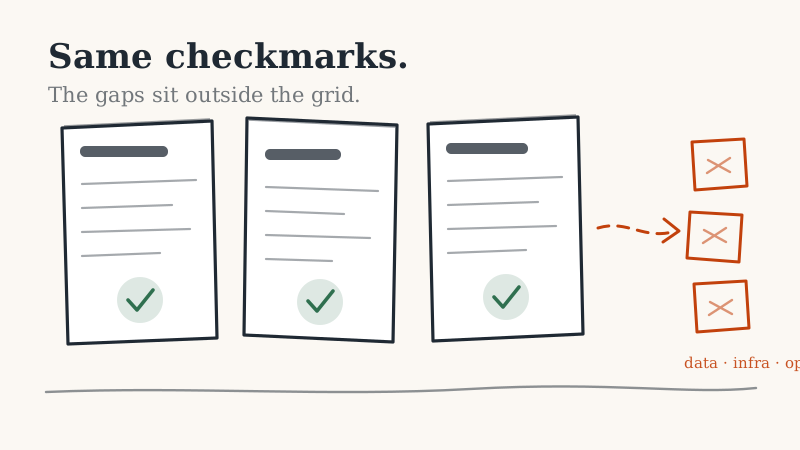
Every sales engagement platform evaluation starts the same way. Someone builds a spreadsheet with the vendors across the top and the features down the side, fills in a grid of checkmarks, and discovers that all three vendors have almost every checkmark.
That is not a flaw in the spreadsheet. It is an accurate picture of a mature category. Outreach, Salesloft, and Apollo all do multi-step sequences across email and phone and LinkedIn tasks. They all have a dialer. They all sync bidirectionally with Salesforce and HubSpot. They all have A/B testing, task queues, reply detection, team analytics, and some flavor of AI assistance bolted on since 2024. If your evaluation criteria are “does it have sequences,” you are going to end up flipping a coin.
The real differences sit in three places the feature grid does not have rows for:
- Whether contact data comes with it, and what that data is worth.
- Who owns the sending infrastructure your email actually leaves through.
- How much operator time the platform needs every week to keep producing.
Get those three right and the pick is usually obvious within an hour. Get them wrong and you will sign a year-long contract for software that works exactly as advertised while your pipeline stays flat.
The short version
- Apollo is a database with a sequencer attached. You buy it for the contact data, and the outbound tooling is included. It is by far the cheapest entry point, it publishes its pricing, and the data quality is good enough for mid-market prospecting and visibly weaker at the enterprise end.
- Salesloft is a seller workflow product. Its strength is the daily rhythm of a rep’s day: cadences, call coaching, conversation intelligence, deal management. It assumes you bring your own data. Teams that need their reps coached, not just sequenced, tend to prefer it.
- Outreach is the enterprise system of record for sales execution. Deepest reporting, strongest admin controls, most governance, most expensive, longest implementation. It pays off when you have many reps, real territory complexity, and a RevOps person whose job includes owning it.
And the part that applies to all three: none of them gives you clean data, healthy sending infrastructure, and someone to actually run the thing. Those are the three inputs that decide whether any sequencer produces meetings, and all three are bought separately.
What each platform actually is
Apollo: the data play with a sequencer included
Apollo’s product logic is different from the other two, and the difference matters more than any feature comparison. Outreach and Salesloft sell you a place to run sequences and expect you to supply contacts. Apollo sells you contacts and throws in the place to run sequences.
That bundling is why Apollo wins so many evaluations on price. It publishes tiered pricing, offers a usable free tier, and its paid seats land in a range (roughly the $50 to $120 per user per month band depending on tier and annual commitment) that is a fraction of what the other two quote. For a team of four doing its first serious outbound motion, Apollo replaces two line items with one.
The tradeoff is data depth at the top of the market. Apollo’s coverage of mid-market and SMB contacts is broad and generally serviceable. Its coverage of large enterprise, of senior titles inside complex orgs, and of non-US markets is thinner than the specialist data vendors, and the gap shows up as bounces and wrong-role contacts rather than as empty search results. That is the dangerous version of a data problem, because the list looks full right up until you send to it. If you are weighing Apollo’s data specifically against the dedicated providers, we broke that down separately in our Apollo vs ZoomInfo vs Lusha comparison.
Apollo’s sequencer is real but it is the junior product in the suite. Sequence logic is less expressive than Outreach’s, reporting is shallower, and administration at scale (permissions, territory rules, multi-team governance) is where you feel that you are using the bundled option rather than the purpose-built one.
Salesloft: the seller workflow product
Salesloft is built around the question “what should this rep do in the next hour.” Its cadence model, its task prioritization, its Conversations product for call recording and coaching, and its deal inspection views all point the same direction: making a human seller more effective hour by hour.
That focus produces a genuinely different experience. Reps tend to find Salesloft easier to live in all day than Outreach, and managers tend to find the coaching surface more useful than the reporting surface. If your constraint is “my five SDRs do not run a consistent process and I cannot tell who needs help,” Salesloft addresses that constraint more directly than either alternative.
Pricing is not published. Reported seat costs sit broadly in the $100 to $160 per user per month range on annual terms, usually with tiered packaging that puts the dialer, conversation intelligence, and the analytics you actually wanted in the higher tiers. Budget for the tier above the one you were quoted, because the feature you are evaluating is frequently in it.
Salesloft assumes you bring data. It also assumes you bring deliverability. Both assumptions are reasonable for the enterprise buyer it targets and expensive for the team that did not realize it was making them.
Outreach: the enterprise execution system
Outreach is what you buy when sales execution needs to be governed, not just run. Sequence logic is the most expressive of the three, including genuinely complex branching. Reporting goes deep enough to answer questions the other two cannot (sequence-level attribution against closed revenue, rep-versus-rep variance on the same cadence, content performance across segments). Admin controls, permissioning, and territory handling are built for organizations where a hundred reps must not be able to edit each other’s templates.
All of that has a cost profile to match. No public pricing, annual contracts, and reported totals that commonly include a platform fee on top of per-seat costs, landing many mid-sized deployments in the tens of thousands per year. Implementation is measured in weeks, not days, and the platform expects an owner. A frequent and avoidable failure mode is a 15-seat team buying Outreach for its reporting depth, never configuring the reporting, and paying enterprise rates for a sequencer.
Outreach is the right answer more often than its price suggests, but only when the organizational complexity is already there. It does not create process maturity. It rewards it.
How to actually choose
Skip the feature grid. Answer these four questions instead.
1. Do you have contact data, or do you need it?
If you need data and have no budget line for it, Apollo is the pragmatic pick and the bundling is a genuine advantage. If you already own ZoomInfo or a Clay-driven enrichment pipeline, Apollo’s main differentiator is neutralized and you should be comparing Salesloft and Outreach on workflow, not comparing all three on price.
2. Are you managing a process problem or a reporting problem?
Reps who do not follow a consistent motion are a process problem, and Salesloft’s coaching and cadence surfaces are aimed at it. Leadership that cannot see which sequences generate revenue is a reporting problem, and Outreach is aimed at that. These are different purchases that look identical on a feature list.
3. How many reps, and is there an owner?
Under roughly ten reps with no dedicated RevOps person, Outreach’s advantages are mostly unreachable. You pay for governance you do not need and configuration you will not do. Above roughly thirty reps with real territory structure, Outreach’s advantages become the reason you switch.
4. Who is responsible for deliverability?
This is the question that changes outcomes most and gets asked least. We will take it separately.
The three things none of them do
Here is the uncomfortable part of any sales engagement platform evaluation. The platform is the least likely component to be the reason your outbound is not working.
1. None of them makes your list clean
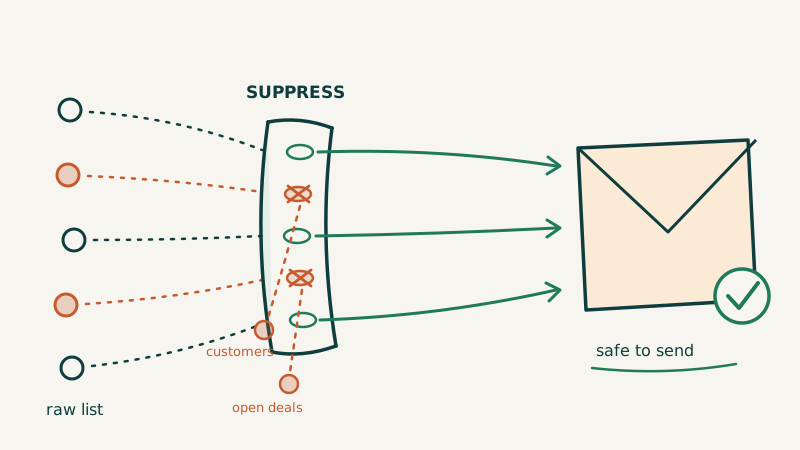
Every one of these platforms will cheerfully send to a bad address. The sequencer is not a validator, and the enrichment built into Apollo is coverage, not verification. The specific killer is catch-all domains, where the receiving server accepts everything at the SMTP layer so standard verification tools return “unknown” and your list builder either guesses or discards. Guess wrong at volume and you are burning sender reputation on addresses that were never real. Discard them all and you throw away a meaningful share of the enterprise accounts you most wanted, since catch-all configuration is more common the larger the company.
That is a validation problem, and it needs a validation tool rather than a sequencer setting. Scrubby is the data infrastructure layer we run for exactly this: the validator that safely clears catch-all email, so the list that reaches your sequencer is one you can send to without gambling your domains on it.
2. None of them owns the infrastructure your email leaves through
This is the single most common reason a correctly configured sequence produces nothing. Outreach, Salesloft, and Apollo all send through mailboxes you connect to them. They do not provision your sending domains, they do not warm your mailboxes, they do not monitor your domain reputation, and they do not rotate you off a domain that got burned. Apollo and Salesloft both offer some warmup and mailbox health tooling, and it is better than nothing, but the responsibility for the infrastructure still sits with you.
So the failure looks like this: the platform reports that it sent 4,000 emails, the sequence logic is flawless, the copy is fine, and your reply rate is a rounding error, because most of those sends landed in spam. The sequencer has no visibility into that and will keep reporting success.
Sending infrastructure is a thing you either operate deliberately or lose to silently. Inboxy is the email infrastructure side of what we run: sending domains, mailboxes, and warmup, owned and operated rather than connected and hoped for. If you want to check your own setup before signing anything, start with SPF, DKIM, and DMARC authentication and then work through monitoring domain reputation and blacklist alerts.
3. None of them handles the replies, or the channel your buyers actually answer on
All three platforms are strongest at outbound sends and weakest at what happens after someone responds. Replies land in a rep’s inbox, LinkedIn conversations land in LinkedIn, and the context for a given prospect ends up split across two or three places with the CRM getting a partial copy of each. The handoff from “they replied” to “a meeting is on the calendar” is where most outbound leaks, and it leaks in the gap between tools rather than inside any one of them.
LinkedIn is the sharpest version of this. All three platforms treat LinkedIn as a manual task they remind a rep to do, not as a channel they operate, because they are not provisioning the identities or the connection infrastructure. We handle that side separately: AIA for the LinkedIn infrastructure (aged, verified identities on dedicated residential IPs) and LIA for the outreach that runs on it, with Underfive as the unified inbox so email and LinkedIn threads sit in one place and stay wired into your CRM.
The timing input is its own gap. Sequences fire on the day a rep adds someone, which is almost never the day that account is in market. CAM exists to fix the input side of that: every buying signal on your market in one feed, so the trigger comes from the account rather than from your enrollment date. The mechanics of using signals that way are in our guide to trigger-based outbound timing.
The scorecard
| Apollo | Salesloft | Outreach | |
|---|---|---|---|
| Core strength | Bundled contact data | Seller workflow and coaching | Governance and reporting depth |
| Contact data included | Yes | No | No |
| Pricing published | Yes | No | No |
| Reported seat cost | Low (roughly $50 to $120 per user per month) | Mid (roughly $100 to $160) | High, often plus a platform fee |
| Contract shape | Monthly or annual, free tier available | Annual, tiered | Annual, enterprise |
| Time to productive use | Days | Weeks | Weeks, with an owner |
| Best fit | First real outbound motion, 1 to 10 reps | 10 to 50 reps needing consistent process | 30+ reps with RevOps and territory complexity |
| You still own | Deliverability, reply handling, operator time | Data, deliverability, reply handling, operator time | Data, deliverability, reply handling, operator time |
Treat the pricing numbers as directional. Two of the three do not publish rates, discounting on annual commitments is significant, and the quote you get will depend on seat count and term more than on which logo is on the invoice.
What this usually means in practice
Most teams running this evaluation are not actually choosing between three platforms. They are discovering that the platform is one of five components they need, and that the other four do not come in the box.
If you have a RevOps function, in-house SDRs, and someone who owns deliverability, pick on the four questions above and you will do fine. Apollo if data is the gap, Salesloft if process consistency is the gap, Outreach if scale and governance are the gap.
If you do not have those things, the honest read is that buying any of the three puts you one purchase closer to a working outbound motion and several purchases away from meetings. The sequencer was never the hard part. The hard parts are a list you can trust, infrastructure that reaches the inbox, and a person whose actual job is running the campaigns every day.
That is the problem Vendisys is built around. We are not a sequencer and not an agency: we operate the stack, including the infrastructure and the data layer and the daily campaign work, and report on meetings booked rather than emails sent. If you would rather compare that against the build-it-yourself path directly, our breakdown of outsourced GTM infrastructure is the place to start, and the true cost of an in-house SDR is the number worth running before you add the seat licenses on top.