There is one email in every cold sequence that gets read more carefully than all the others, and most teams throw it away.
It is the last one. The breakup email. The message you send when a prospect has ignored four, five, or six touches and you are formally giving up. Reply rates on that final touch routinely beat the messages that came before it, sometimes by a wide margin. And yet the version most SDRs send is a passive aggressive shrug: “I guess this isn’t a priority, I’ll close your file.” That wastes the single most-opened slot in your whole cadence.
This is a breakdown of why the breakup email works, why the common version fails, and how to write one that reopens dead threads instead of slamming them shut.
Why the last email outperforms the first
A cold sequence is a war of attrition against attention. Your first email lands in a crowded inbox from a stranger, and the prospect owes you nothing. By the time your final message arrives, three things have changed.
First, familiarity. Even prospects who never replied have now seen your name several times. Repetition lowers the threshold for a response, and the breakup email cashes in on that recognition.
Second, urgency. A breakup email introduces a deadline that none of the earlier touches had. “This is the last time you’ll hear from me” is a small loss-aversion trigger. People who felt no reason to act now feel a closing window.
Third, ease. The breakup email is easy to answer because it asks for almost nothing. A one-word reply resolves the thread. That low friction is exactly why it converts.
The mistake is treating the breakup email as an emotional exit rather than a strategic re-open. You are not saying goodbye. You are giving the prospect the easiest possible on-ramp back into a conversation.
Why the guilt-trip version fails
The default breakup email reads something like this:
“Hi Sarah, I’ve reached out a few times and haven’t heard back, so I’ll assume the timing isn’t right and stop reaching out. If things change, you know where to find me.”
It feels polite. It is actually three mistakes stacked on top of each other.
It centers you, not the prospect. “I’ve reached out a few times” is about your effort and your disappointment. The prospect does not care how many emails you sent. They care about their own problems.
It offers no reason to reply. “You know where to find me” puts all the work back on a person who has already shown they will not do that work. You are handing the follow-up to the least motivated party in the exchange.
It closes with a whimper. There is no question, no hook, no easy action. A message with no ask gets no reply.
The guilt trip also risks the one thing you cannot afford in outbound: looking like every other rep. If your breakup email sounds like a template, it confirms the prospect’s suspicion that you were never paying attention to them specifically.
The anatomy of a breakup email that books meetings
A strong breakup email does four jobs in under sixty words. Keep it short. This is a last touch, not a manifesto.
1. Acknowledge the silence without blaming. One line, no guilt. “Haven’t heard back, which usually means one of three things.” Neutral framing invites correction instead of defensiveness.
2. Give them an absurdly easy way to respond. The best-performing breakup emails offer a menu. Multiple choice beats an open question because it removes the effort of composing a reply.
3. Restate the value in one crisp sentence. Remind them what they would be walking away from, in outcome terms, not feature terms. Not “our platform does X,” but “teams like yours book 30 to 40 meetings a quarter without hiring.”
4. Make the close a real door, not a slammed one. End with a single, specific, low-commitment ask. A calendar link or a yes or no question. Never “let me know if anything changes.”
Three breakup templates you can steal
Here are three variations that follow the anatomy above. Swap in your own specifics and keep them short.
The multiple-choice breakup
Subject: should I close your file?
Hi Sarah, I haven’t heard back, which usually means one of three things:
- You’re interested but slammed. (totally fair, want me to check back next quarter?)
- This isn’t a fit right now. (a quick “no” and I’ll stop)
- I’ve got the wrong person. (who should I talk to?)
A single number is all I need. Thanks for reading either way.
This is the workhorse. The numbered menu does the heavy lifting because a prospect can reply with one character.
The value-reminder breakup
Subject: closing the loop
Hi Marcus, I’ll stop reaching out after this. Before I do: the reason I flagged you is teams your size usually spend six figures a year on SDR salaries to book the same 30 to 40 meetings a quarter we deliver without the headcount. If that’s worth 15 minutes, here’s my calendar. If not, no hard feelings.
This one works when the offer is strong and quantifiable. The value restatement earns the last line.
The pattern-interrupt breakup
Subject: giving up (gracefully)
Hi Priya, this is my last email, so I’ll be honest: I have no idea if this is landing. If pipeline isn’t a problem for you right now, ignore this and I’ll disappear. If it is, just reply “curious” and I’ll send one specific idea for your team, no meeting required.
The “reply with one word for value, no meeting required” hook lowers commitment even further than a calendar link. It restarts the conversation before anyone commits to a call.
Timing, deliverability, and the details that decide it
A great breakup email still fails if the mechanics are wrong.
Send it three to five business days after your previous touch, not the next morning. The pause signals you are genuinely wrapping up, which makes the finality believable.
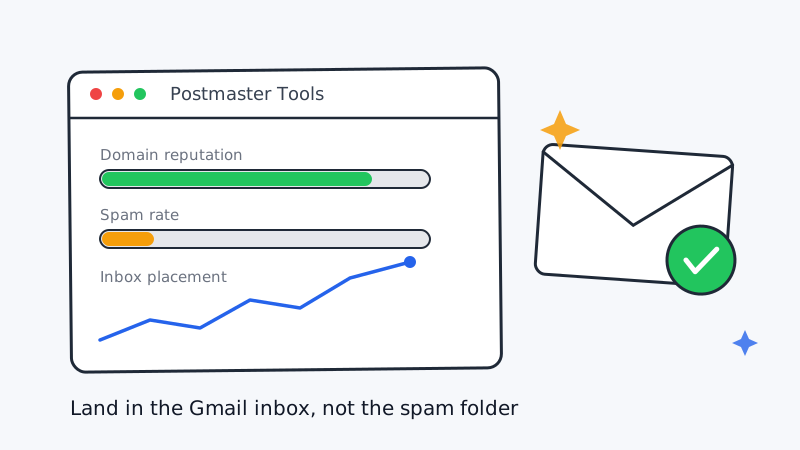
Make sure it actually reaches the inbox. A breakup email that lands in spam is worse than no email, because you have spent your last touch and gotten zero signal. If your reply rates on final touches look suspiciously flat, the problem may be deliverability rather than copy. Cleaning your list with a verification tool like Scrubby before a campaign keeps bounce rates down and protects the sender reputation that decides whether any of your sequence lands at all.
Make the meeting frictionless to book. If your call to action is a back and forth about availability, you will lose the momentum the breakup email just created. A booking flow like Kali turns a one-word “yes” into a confirmed slot without the scheduling ping pong that kills warm-but-fragile intent.
And keep the subject line honest. “Should I close your file?” or “last email” perform because they match the message. A clickbait subject that oversells will get the open and lose the reply.
What a breakup email is not
It is not a place to add three new value props you forgot to mention earlier. It is not a second pitch. It is not the moment to attach a case study PDF. Every extra element you add raises the friction and lowers the reply rate. The entire power of the breakup email comes from how little it asks.
It is also not a real ending. A prospect who replies “check back next quarter” has just handed you a warm lead with a timestamp. Log it, and re-enter them into a sequence when the window opens. The breakup email is often the start of the relationship, not the end of it.
Where this fits in a real outbound engine
The breakup email is one lever, and it only pays off when the rest of the machine is sound: a clean list, a tight sequence, believable copy, and fast follow-up on every reply. Getting all of that right consistently is the hard part, and it is why many teams hand the whole motion to a partner rather than rebuild it in-house. At Vendisys, running breakup touches that reopen dead threads is a standard part of the sequences we operate, because the last email is too valuable to waste on a guilt trip.
Write the final touch as an invitation, not an obituary. Give the prospect one easy door, remind them what is behind it, and let the deadline do the rest. The email you almost did not bother sending is the one most likely to book the meeting.