Warm Outbound vs Cold Outbound: When Each Motion Wins and How to Run Both Without Wasting Reps
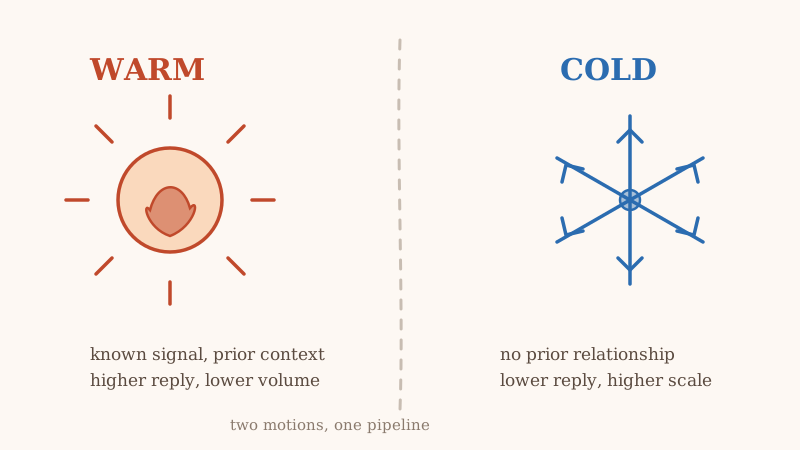
Most teams argue about warm versus cold outbound as if they have to pick one. The cold camp says warm does not scale and the pipeline math falls apart the moment you run out of referrals and job-change alerts. The warm camp says cold is a spray-and-pray relic that burns domains and reputation for a 1 percent reply rate. Both are describing a failure mode, not the method.
The honest framing is that warm and cold are two settings on the same machine. Warm outbound spends context to buy a higher reply rate on a smaller number of accounts. Cold outbound spends reach to buy volume across accounts where you have no prior relationship. Neither is better in the abstract. The question is always which setting a specific account, at a specific moment, actually deserves. Get that routing right and the two motions feed each other. Get it wrong and you either starve pipeline or torch your sender reputation chasing lists that were never going to convert.
What actually separates warm from cold
The line is not “did we email them before” or “do we like them.” The real dividing line is whether a credible, personal reason to reach out exists right now that the prospect would recognize as legitimate.
Warm outbound has a reason the recipient accepts on sight: a former colleague now works there, they downloaded something, a mutual connection introduced you, their company just tripped a trigger you can name, or a champion who bought from you at their last job just started a new role. The opening line writes itself because the context is real.
Cold outbound has no such reason. You believe the account fits your ideal customer profile, but the prospect has never heard of you and has no pending event tying them to your outreach. The burden is entirely on you to manufacture relevance from research rather than from a relationship.
That distinction matters because it changes the entire economics of the motion:
- Reply rate. Warm outreach commonly replies at 15 to 40 percent. Genuinely cold outreach, done well, lands somewhere between 1 and 5 percent. That is not a small gap, it is an order of magnitude.
- Volume ceiling. Warm sources are finite. You cannot manufacture ten thousand job changes or referrals a month. Cold is effectively unbounded, capped only by your list and your sending infrastructure.
- Time to first meeting. Warm compresses the cycle because trust is partially pre-loaded. Cold requires multiple touches to earn the first reply.
- Infrastructure risk. Cold, at scale, is where deliverability goes to die. Warm rarely threatens your domain reputation because volumes are low and engagement is high.
Once you see them as different points on a volume-versus-context tradeoff, the “which is better” argument dissolves. You need both, and you need a rule for routing accounts between them.
When warm outbound wins
Warm is the right setting whenever a real signal exists and the deal is worth the manual effort. Concrete cases:
A champion changed jobs. Someone who bought your product, or advocated for it, just landed at a new company. This is the single highest-converting outbound play in existence, because you are not selling to a stranger, you are re-engaging a believer. Monitoring for these moves across your customer base and your target accounts is worth building a system around. A tool like CAM that watches for account and personnel changes turns this from a happy accident into a repeatable, alert-driven motion.
A trigger event fires. New funding, a leadership hire, a product launch, an acquisition, a hiring spree for roles your product supports. These are timing signals that make outreach feel observant rather than random. The reason to reach out is external and undeniable, which is exactly what a cold email lacks.
Inbound gave you a thread to pull. Someone from the account visited pricing, attended a webinar, or downloaded a guide but never booked. That is not inbound you can wait on, it is warm outbound waiting to happen. The context is on your side.
High ACV, small account list. When each logo is worth six or seven figures and your total addressable market is measured in hundreds rather than tens of thousands, volume is irrelevant. Every account justifies deep research and a personal, multi-threaded approach. Spraying a cold sequence at a 200-account enterprise TAM is malpractice.
The trap with warm is assuming it scales on its own. It does not. Referrals and triggers arrive at their own pace, and if warm is your only motion you will hit a pipeline ceiling the moment the signal well runs dry. Warm is high-yield, low-throughput. Which is exactly why you also need cold.
When cold outbound wins
Cold is the right setting when you need reach, when your TAM is large, and when no warm signal exists for the accounts you want to open. Concrete cases:
Entering a new market or segment. You have zero relationships, zero referrals, and zero brand recognition in the new territory. Cold is the only way in. You are buying awareness and pipeline where warm sources do not yet exist.
Large, homogeneous TAM. When you sell to thousands of similar companies and your ACV supports a volume motion, cold outbound at scale is efficient. The 2 to 4 percent reply rate is fine because the denominator is enormous and the cost per contact is low.
Testing new ICPs and messaging. Cold is your laboratory. You can run controlled sends across segments, compare reply rates, and learn which value propositions land before you invest in the expensive warm motion. It is the cheapest way to find out who actually cares.
Filling the gap between warm signals. Even a great warm program has quiet weeks. Cold provides the steady baseline of volume that keeps pipeline from going lumpy. It is the floor under your number.
The catch is that cold punishes sloppiness far more harshly than warm does. Bad data, unverified addresses, and thin personalization do not just lower your reply rate, they wreck your deliverability and pull your legitimate emails into spam folders. Before any cold send at volume, the list has to be clean. Running addresses through a validator like Scrubby to strip catch-alls, spam traps, and dead mailboxes is not optional hygiene, it is the difference between landing in the inbox and torching a domain you cannot easily replace. Cold outbound lives and dies on infrastructure discipline.
The routing decision: a simple framework
You do not want reps deciding warm versus cold by gut on every account. Codify it. A workable rule set:
- Does a named warm signal exist? Champion move, trigger event, prior engagement, or referral. If yes, route to warm. Personalize deeply and multi-thread.
- If no signal, how big is the account? Above your ACV threshold, treat it as a warm-style manual play even without a signal: research, personalize, and be patient. Below it, route to cold sequence.
- How large is the addressable segment? Small and high-value goes warm. Large and homogeneous goes cold, at volume, with tight list hygiene.
- What is your infrastructure headroom? If your domains and mailboxes are already near capacity, do not pour more cold volume in. Prioritize warm, which delivers more meetings per send, until you have expanded sending capacity.
The output of this framework is a per-account tier, not a company-wide philosophy. The same rep, on the same day, should be running deep warm plays on tier-one accounts and letting an automated cold sequence work the long tail. Trying to run one motion for everything is what actually fails, and it is usually what people mean when they say “cold does not work” or “warm does not scale.”
How to run both without cannibalizing
The danger in running two motions is collision. A prospect who gets a thoughtful warm email from an AE on Monday and a generic cold blast from an SDR on Wednesday learns that your personalization was theater. Guardrails that prevent this:
One system of record for touches. Every warm and cold contact logs to the same CRM so no account gets hit by both motions in the same window. Suppression lists are not a nice-to-have, they are the thing that keeps warm credible.
Warm always takes precedence. If an account in a cold sequence suddenly trips a warm signal, pull it out of the cold flow and hand it to the warm motion immediately. A live trigger always beats a scheduled cold step.
Different senders, different intent. Keep cold volume on dedicated sending domains, isolated from the mailboxes your AEs use for warm, high-trust conversations. This protects your primary domain reputation from the deliverability risk that cold inevitably carries.
Book the meeting the moment interest appears. Whether the reply came from a warm champion or a cold sequence, the conversion point is the same: get time on the calendar before the intent cools. Removing friction from that step, with a calendar-first tool like Kali that lets a prospect grab a slot inside the thread, protects the reply rate you worked to earn. The fastest-decaying asset in outbound is a warm reply you did not book.
Run this way and the two motions compound. Cold generates awareness and surfaces accounts that later throw off warm signals. Warm harvests the highest-intent moments that cold volume helped create. Your cold data hygiene protects the deliverability that both motions depend on. It is one engine with two settings, tuned per account.
The mistake that makes both motions look broken
The teams who conclude that “outbound is dead” almost always ran one motion for every account. They sprayed cold at enterprise logos that deserved warm, so conversion cratered. Or they leaned entirely on warm signals, hit the volume ceiling, and watched pipeline stall the first slow month. Neither outcome is a verdict on outbound. It is a verdict on routing.
The operators who make outbound predictable treat warm and cold as a portfolio. They build the signal-monitoring and list-hygiene infrastructure that each motion requires, they route accounts by tier and trigger rather than by preference, and they measure the two separately so a soft cold week does not get blamed on the warm program or vice versa. This is the kind of dual-motion system that outsourced GTM partners like Vendisys are built to run end to end, because doing it well takes deliberate infrastructure, not just more reps sending more email.
Warm versus cold was never the real question. The real question is whether you have a rule for deciding which account gets which, and the infrastructure to run both cleanly at the same time. Answer that, and the debate stops mattering.