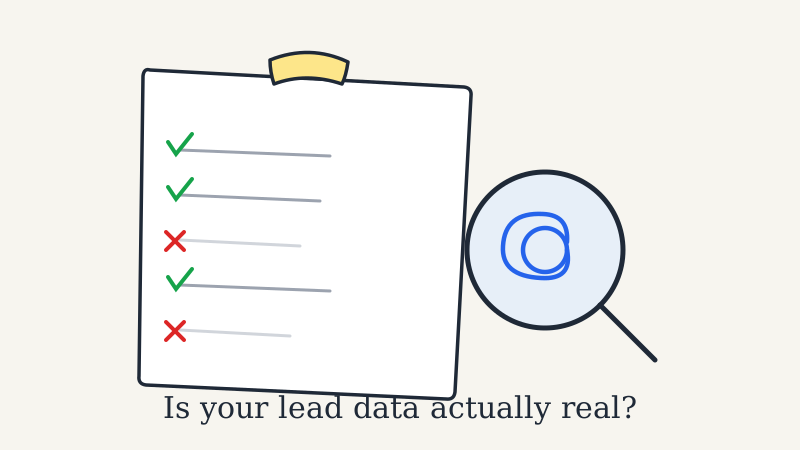
Most outbound post-mortems blame the copy or the offer. The real culprit is often upstream: the list. If a third of your contacts have the wrong email, left the company, or never existed, no subject line saves the campaign. You will send into the void, watch bounces climb, and slowly poison the sending reputation you spent months building.
Lead data is the input that quietly decides everything downstream. Yet most teams choose a data provider on price per record and a slick demo, then discover the accuracy problem only after the damage is done. This checklist gives you a structured way to vet a B2B lead data provider before you trust it with your pipeline, so you find the weak spots in a trial rather than in a live campaign.
Why data quality is a deliverability problem, not just a CRM problem
It is tempting to treat stale records as a nuisance you clean up later. In outbound, bad data is a deliverability problem with a deadline.
Mailbox providers like Google and Microsoft track how often a sender hits invalid addresses. A high bounce rate is one of the strongest signals that a sender is working from a scraped or unverified list, and it pushes your messages toward spam folders for everyone, including the valid contacts on the same list. A list that is 90 percent accurate is not 10 percent worse than a clean one. It can be the difference between landing in the inbox and landing in spam.
So before you measure a provider on coverage or price, measure it on the thing that protects your reputation: how many of its addresses are real, current, and safe to send to.
1. Test accuracy on a sample, not on the sales deck
Every provider claims high accuracy. The number on the slide is meaningless until you verify it against your own segment.
Ask for a sample export of 200 to 500 records that match your real ideal customer profile, not a cherry-picked demo segment. Then validate the emails independently. Run the sample through an email verification tool like Scrubby to measure the true valid rate, including catch-all and risky addresses the provider may be counting as deliverable. A provider that quotes 95 percent accuracy but lands at 78 percent valid on your segment has told you everything you need to know.
Pay attention to catch-all domains. Many providers report a catch-all address as valid because the server does not reject it outright, but those addresses carry real bounce and complaint risk. The point of independent validation is to surface exactly these gray-area records before they reach your sequences.
2. Check freshness and how often data is refreshed
Accuracy decays. B2B contact data goes stale at roughly 2 to 3 percent per month as people change jobs, titles shift, and companies reorganize. A database that was accurate a year ago can be badly out of date today if it is not continuously refreshed.
Ask the provider two direct questions:
- How often is the underlying data re-verified? Monthly re-verification is a meaningfully different product from a one-time scrape sold on repeat.
- What is the average age of a record in my segment? If they cannot answer, assume the data is older than they would like to admit.
Freshness matters most for the fields that drive routing and personalization: current title, current company, and direct email. A record with the right name but a two-jobs-ago employer is not a small error. It sends your whole message to the wrong context.
3. Measure coverage against your actual ICP
Coverage is the share of your target market the provider can actually reach with usable contact data. A database of 200 million records sounds impressive until you filter to your real segment and find thin coverage of the exact roles, company sizes, or regions you sell into.
Take your defined target list, whether that is a set of named accounts or a firmographic filter, and ask the provider to report match rate against it. You are looking for two numbers: how many of your target accounts they have any contact for, and how many they have a valid direct email for. The gap between those two is where pipeline quietly disappears.
If you have not nailed down your segment yet, fix that first. A precise outbound ICP is what makes a coverage test meaningful, because it tells you which records actually matter.
4. Inspect the data sources and compliance posture
Where the data comes from determines both its quality and your legal exposure. Cold outbound runs into CAN-SPAM in the US, GDPR in Europe, and CASL in Canada, and a provider built on questionable scraping can hand you compliance risk along with the records.
Ask how contacts are sourced, whether the provider honors suppression and do-not-contact requests, and how it handles data subject deletion. A serious B2B data vendor will have clear answers and documentation. A vendor that gets vague about sourcing is a vendor whose data you do not want anchoring your sending reputation.
5. Look at the signal data, not just the contact data
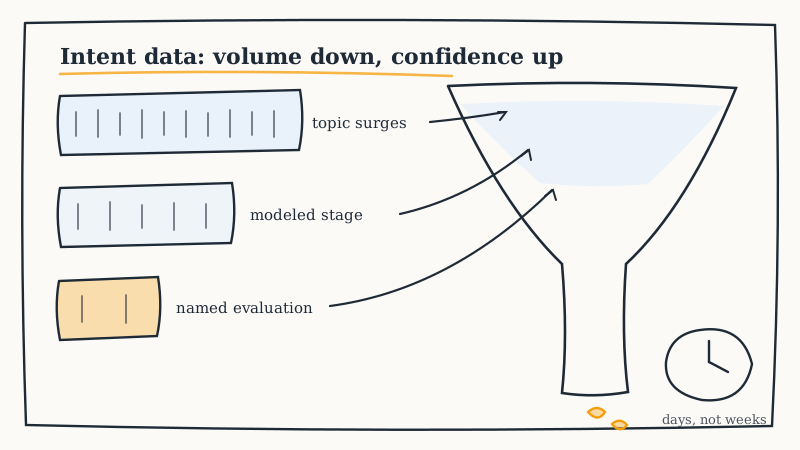
The best providers do more than tell you who exists. They help you decide who to contact now. Intent and trigger signals, such as recent funding, hiring for relevant roles, tooling changes, or competitor activity, let you prioritize the accounts most likely to respond instead of spraying the whole list.
This is where contact data and signal data combine. Pairing accurate firmographics with timing signals from a tool like CAM, which monitors competitor and target-account websites for changes, lets you reach accounts when something has actually changed rather than at random. Even modest signal data, used to sequence your outreach, lifts reply rates more than another 50,000 unsorted records ever will.
6. Run a real trial before you sign an annual contract
Once a provider passes the sample test, run a contained pilot before committing to a year. Pull a few hundred records, validate them, load them into a live sequence, and watch the metrics that matter: bounce rate, reply rate, and the share of replies that are actually in your target role.
Bounce rate is your fastest quality signal. If a validated list still bounces above 2 to 3 percent in a live send, something in the provider’s pipeline is weaker than the sample suggested. A clean trial, by contrast, gives you the confidence to scale spend, and the baseline numbers to hold the provider accountable later.
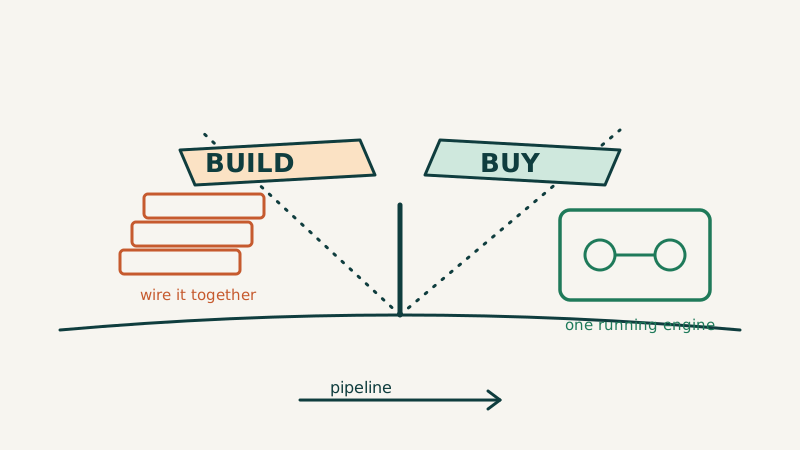
The build-versus-buy question underneath all of this
Vetting a data provider properly is real work. It means defining your ICP, running validation, checking compliance, designing a pilot, and reading the results without flattering yourself. Many teams do not have the time or the in-house benchmarks to do it well, which is exactly how bad lists slip into production.
This is one reason teams hand the whole motion to an outsourced GTM partner instead. A partner that runs outbound across many accounts already sources, validates, and refreshes data as part of the operation, and already knows which providers hold up under live sending. You inherit the vetting discipline rather than rebuilding it from scratch, and your team spends its energy on the offer and the conversations instead of auditing CSVs.
The bottom line
Treat lead data like the foundational input it is. Test accuracy on your own segment, demand freshness and clear sourcing, measure coverage against a real ICP, prize signal data, and prove it all in a live trial before you sign. Run every list through validation with Scrubby so a bad provider never gets the chance to spend your sending reputation. The teams that protect the top of the funnel this carefully are the ones whose outbound numbers actually hold up.