How to Verify Catch-All Emails Before Cold Outbound Without Torching Your Sending Domain
Most deliverability problems do not start at the inbox. They start in the spreadsheet, weeks before you hit send, when a batch of unverifiable addresses slips into your campaign because the validation tool shrugged and marked them acceptable. The single biggest source of that ambiguity is the catch-all domain, and it is also the one most outbound teams understand the least.
If your bounce rate keeps creeping above the safe line no matter how carefully you build lists, catch-all handling is almost certainly the reason. This guide explains what catch-all domains actually are, why standard verification cannot resolve them, and how to process risky addresses before they cost you a sending domain.
What a catch-all domain really is
A normal mail server rejects mail sent to an address that does not exist. That rejection is what email verification tools rely on: they open a conversation with the receiving server, ask whether a mailbox exists, and read the yes or no.
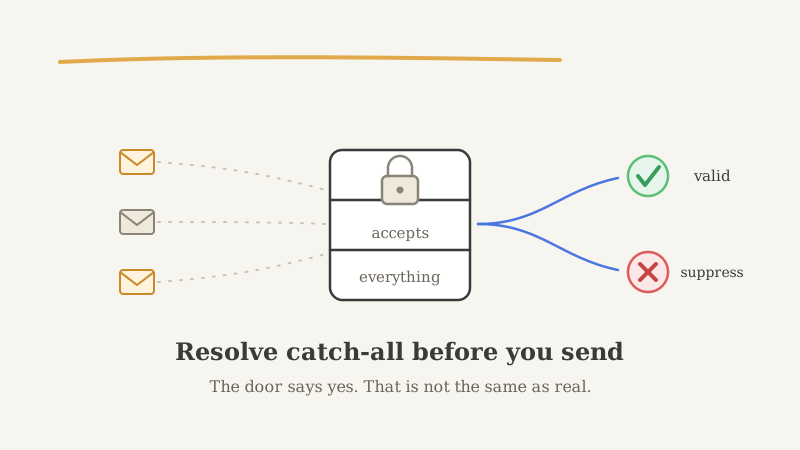
A catch-all domain refuses to give that answer. It is configured to accept mail for every possible address at the domain, valid or not, and sort it out later on the inside. Send to [email protected] or to a random string of letters at the same domain, and the server says yes to both. Nothing bounces at the door.
That design makes sense for the company running it. They never lose a message because of a typo in their own address, and they can route unknown mail to a shared inbox. But for anyone verifying a list from the outside, a catch-all domain is a locked room. The server confirms it will accept the mail. It tells you nothing about whether a human is actually behind the address.
Why standard verification returns “unknown”
Run a catch-all address through most validation tools and you get back a status like accept-all, unknown, or risky. This is not a bug. It is the honest answer. The tool asked the server whether the mailbox exists, and the server said it accepts everything, so the tool has no way to distinguish a real employee from a fabricated address.
Here is where teams get burned. Many bulk verification services quietly bucket catch-all results as valid, or leave the classification to you and assume you will handle it. So the addresses pass through into the campaign looking clean. Then, days later, the ones that were never real bounce, because catch-all servers frequently accept the message at the door and reject it internally afterward. Your validation report said the list was healthy. Your bounce rate says otherwise.
On a small enterprise list this is a rounding error. At outbound scale, where catch-all configurations are common across mid-market and enterprise domains, unresolved catch-all addresses can make up a large share of your list. Passing them through untouched is how a carefully built campaign ends up with a bounce rate that puts the sending domain at risk.
Why the bounce rate matters more than the wasted sends
The obvious cost of a bad address is a wasted email. The real cost is what those bounces do to your reputation.
Mailbox providers like Google and Microsoft read your bounce rate as a proxy for list quality and sender intent. A sender who consistently mails addresses that do not exist looks like a spammer working a scraped or purchased list, because that is exactly what spammers do. Cross a bounce threshold, often cited around three percent, and providers start throttling you, routing more of your mail to spam, or filtering the domain outright.
That damage does not stay contained to the bad addresses. It degrades placement for the good ones too. The prospect who would have replied never sees the message, because the domain reputation you spent weeks building got spent on mail to mailboxes that were never there. This is the quiet mechanism behind a lot of “our open rates fell off a cliff and we do not know why” stories.
How to actually resolve catch-all addresses
The wrong answer is to delete every catch-all address. You would throw away a large and often high-value slice of your total addressable market, because many of the best target accounts run catch-all domains. The right answer is to resolve them with methods that go beyond the basic mailbox-exists handshake.
Use deeper verification, not just SMTP checks. A basic verifier only performs the door knock that catch-all servers defeat. More capable validation applies additional signals: historical send-and-engagement data, pattern analysis against known-good addresses at the same domain, and secondary checks that infer whether a specific mailbox is genuinely in use. A verification service built to handle this ambiguity, such as Scrubby, is designed specifically to resolve catch-all and risky addresses that generic bulk tools mark as unknown and move on. The point is to convert an unknown into a real valid-or-invalid decision rather than gambling on it.
Separate catch-all addresses into their own bucket. Do not blend resolved catch-all addresses back into your fully verified list as if they carry the same confidence. Keep them in a distinct segment so you can send to them on a lower-risk footing and watch how they behave before trusting them at volume.
Send catch-all segments from a lower-stakes lane. If you run multiple sending domains and inboxes, and you should, route your less certain segments through infrastructure whose reputation you are willing to spend down slightly. Never test an ambiguous segment on the domain carrying your best-performing, most-engaged campaigns.
Warm into the segment gradually. Start with a small, throttled batch of catch-all addresses, measure the actual bounce and engagement response, and expand only if the numbers hold. Real behavior at small volume tells you more than any predicted status.
Building catch-all handling into your list process
The teams that never think about catch-all bounces are not lucky. They have a repeatable list-hygiene step that runs before every launch, not as a cleanup after a bad campaign. A workable version looks like this.
- Verify at the source. Validate addresses as they enter your list, not the night before send. Data decays continuously, and a verification that was accurate two months ago is not accurate today.
- Classify into three buckets, not two. Valid, invalid, and catch-all or risky. Collapsing the third bucket into either of the first two is the original sin that produces surprise bounces.
- Resolve the risky bucket deliberately. Route catch-all and risky addresses through deeper verification, then decide segment by segment which resolved addresses earn a place in the campaign.
- Suppress what stays ambiguous. If an address cannot be resolved to a confident decision after deeper checks, suppress it rather than sending on hope. One held-back prospect is cheaper than a bounce that costs domain reputation.
- Re-verify on a cadence. Lists churn. Job changes, departures, and domain migrations turn valid addresses into bounces over time, so a list that passed cleanly last quarter needs another pass before you mail it again.
None of these steps is difficult in isolation. The difficulty is doing them consistently, before every campaign, while also writing copy, building sequences, and chasing replies. That is exactly the kind of unglamorous, continuous discipline that slips first when a small team is stretched.
Why this belongs in your infrastructure
Catch-all handling is a good example of why outbound is better treated as infrastructure than as a series of one-off campaigns. The knowledge is not exotic. The problem is that the safe path requires a verification workflow, segmented sending domains, warmed infrastructure, and the operational patience to test ambiguous segments before trusting them. Standing all of that up and maintaining it, campaign after campaign, is real work that competes with everything else on the roadmap.
When that layer is owned by a team that runs it as a system across a portfolio of domains, catch-all resolution and list hygiene happen as a matter of routine rather than as a scramble after a bounce spike. That is a meaningful part of what you are buying when you run outbound through an outsourced GTM partner like Vendisys instead of assembling and babysitting the verification and sending stack yourself: the boring, continuous discipline that keeps bounce rates low and keeps your best domains landing in the inbox.
If you run the program in-house, the takeaway is identical even though the ownership is not. Treat catch-all addresses as their own bucket, resolve them with verification built for ambiguity instead of guessing, send them from a lane you can afford to test on, and re-verify on a cadence. A catch-all domain will never tell you whether the mailbox is real. Your job is to find out before the bounce does it for you, on the domain you least wanted to spend.