The best outbound email you will ever write, sent at the wrong time, still gets ignored. The most average outbound email you will ever write, sent the week a prospect starts a project you can help with, books a meeting. Timing is the variable most teams underinvest in, because it is harder to control than copy. You can rewrite a subject line in ten minutes. Catching a buyer in the window when they actually care takes a system.
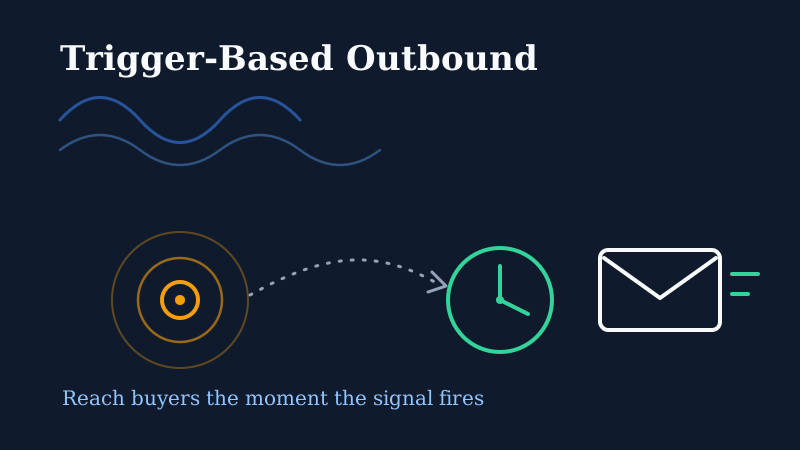
That system is trigger-based outbound: instead of blasting a static list on a calendar cadence, you watch for events that signal a prospect just entered a buying window, and you reach out while the signal is still warm. This post breaks down which triggers actually predict intent, how to wire them into an outbound motion, and how to run the whole thing without hiring a dedicated intent-data team.
Why calendar-based outbound leaves pipeline on the table
Traditional outbound treats every account on the list as equally ready to buy on the day you happen to email them. It is not. On any given week, the vast majority of your total addressable market is not in-market at all. They are heads-down on other priorities, locked into an incumbent, or simply not thinking about the problem you solve. Emailing them changes nothing except your sender reputation.
The small slice that is in-market this week is where nearly all of your winnable pipeline lives. A calendar cadence reaches that slice only by accident, when the random day you sequence an account happens to line up with the day they started caring. Trigger-based outbound flips the odds. You stop guessing when an account is ready and start reacting to evidence that they are. The same rep, the same offer, and the same copy produce dramatically different results when the send is anchored to a real event instead of a spreadsheet row.
There is a deliverability dividend too. When your sends concentrate on accounts showing genuine interest, reply rates climb and spam complaints fall, which protects the inbox placement of every other email you send. Timing is not just a conversion lever. It is an infrastructure one.
The triggers that actually predict intent
Not every event is a buying signal. A useful trigger has to correlate with a real change in the prospect’s willingness to have a conversation. These are the categories that consistently earn their place in a sequence.
Hiring signals. A company posting a role tells you what they are about to invest in. A new VP of Sales usually means a wave of process and tooling changes in the next ninety days. A cluster of SDR openings means an outbound build-out is underway. Job postings are public, structured, and refreshingly honest about a company’s near-term priorities.
Leadership changes. A new executive in your buyer persona is the single strongest trigger in B2B. New leaders arrive with a mandate to change things, a budget to prove themselves, and no loyalty to the incumbent vendor their predecessor chose. The first ninety days of a new VP or director is the most winnable window you will ever get.
Funding and expansion events. A fresh round, a new office, or an acquisition all mean new budget and new headcount that has to be equipped. These events are time-stamped and easy to monitor, and they reliably precede a burst of purchasing.
Technographic and competitor signals. When an account adds a tool adjacent to yours, drops a competitor, or shows renewed activity around a category you play in, that is a window. If a prospect is actively evaluating or renewing a competitor’s contract, they are already in buying mode, and a well-timed message that speaks to why teams switch can redirect that evaluation toward you. Watching for changes on a competitor’s site, pricing page, or careers page is one of the highest-signal, lowest-noise triggers available, and it is exactly the kind of thing a monitoring tool like CAM is built to catch and alert you on the moment it happens.
Engagement signals. Someone from the account visited your pricing page, opened three emails in a week, or engaged with your content. First-party engagement is the warmest signal of all because it is behavior, not inference.
The discipline is not collecting every possible signal. It is picking the three or four that map to your motion and acting on them fast, because a trigger has a short half-life. A leadership change you act on in week one is gold. The same change acted on in week ten is stale.
Turning a signal into a sequence
A trigger is only useful if it changes what you send. The mistake teams make is capturing signals and then dropping those accounts into the same generic sequence everyone else gets. The whole advantage of a trigger is that it hands you a specific, provable reason to reach out. Use it.
Start the first message by naming the trigger, not your product. “Saw you just brought on a new VP of Revenue” or “Noticed you are hiring three SDRs this quarter” earns the next sentence because it proves you are paying attention to them specifically. Then connect that event to the problem you solve, and only then to your offer. The signal is your permission to be in the inbox.
Match the urgency of the sequence to the half-life of the signal. A funding announcement is relevant for months, so a standard multi-touch cadence is fine. A pricing-page visit is relevant for hours, and speed to lead matters enormously: reach out same-day or the moment is gone. Build fast lanes for perishable triggers and slower lanes for durable ones, and route each signal to the lane that fits its shelf life.
Keep the list underneath it clean. Trigger-based outbound concentrates volume on a smaller, higher-intent set of accounts, which means a single bounce or spam trap does proportionally more damage to a tightly targeted send. Validate every address before a triggered send fires, so a well-timed message actually lands in the inbox instead of a spam folder. Running your triggered lists through an email verification layer like Scrubby before the sequence starts protects both the send and your domain reputation.
Operationalizing triggers without a RevOps team
The reason most teams admire trigger-based outbound but never run it is that it looks operationally heavy. Watching dozens of signal sources, deduplicating them, scoring them, and routing them into sequences feels like it needs a data engineer and a RevOps hire. It does not have to.
Start narrow. Pick one trigger that maps cleanly to your best-fit buyer, one you can monitor without buying an expensive intent platform. Hiring signals and competitor-site changes are both observable with lightweight monitoring and a disciplined weekly review. Prove that a signal-anchored sequence outperforms your baseline cadence on that one trigger before you add a second.
Define the response before the signal fires, not after. For each trigger, write the fast-lane sequence, the owner, and the target response time in advance, so when the alert lands, the play is already loaded and nobody is improvising. A trigger that sits in a queue for a week is no longer a trigger.
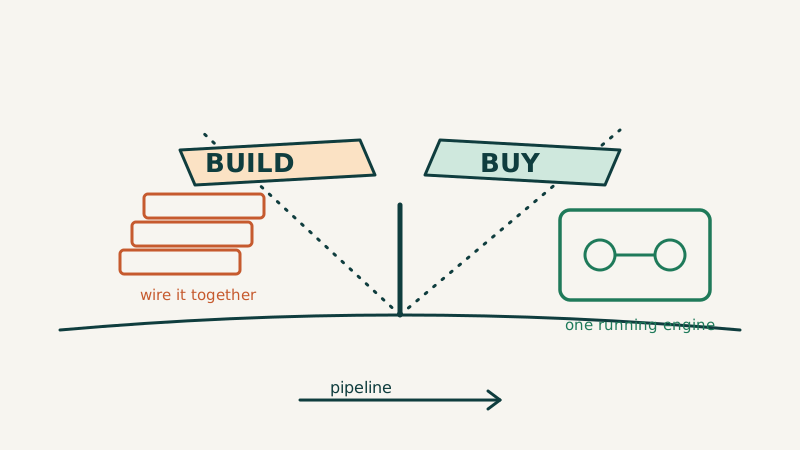
Then decide honestly whether to build the monitoring-and-routing layer in-house or hand it to a partner. Standing up durable signal capture, keeping the data fresh, and staffing same-day response on perishable triggers is real ongoing work. This is where outsourced GTM infrastructure earns its keep: rather than hiring a RevOps function to build the signal engine and an SDR bench to work it, teams increasingly rent both as a managed motion. That is the core of what Vendisys does for outbound teams, running the signal-to-sequence pipeline so the buying window is caught and worked without the client staffing every layer of it themselves.
Measuring whether the timing is actually working
The point of trigger-based outbound is efficiency, so measure it that way. Compare reply rate and meetings booked per hundred sends for triggered sequences against your baseline cadence. If the triggered lane is not meaningfully outperforming, the signal you picked is not predictive, and you should swap it rather than sending more volume through it.
Watch the lag between signal and send. If your average time from trigger to first touch is measured in days for a perishable signal, you are leaving most of the value on the floor, and tightening that lag is usually a bigger lever than adding new signal sources. Track it, put a target on it, and treat a slow response as the defect it is.
Finally, do not let trigger-based outbound become your entire motion. The freshest signal only tells you an account entered a window. It does not tell you they will buy from you. Layer triggers on top of a solid ICP and a durable baseline cadence, so you are catching in-market accounts opportunistically while still building coverage across the whole market. Timing wins the deals that are live right now. Consistency wins the ones that go live next quarter.
Trigger-based outbound is not a tool you buy. It is a discipline: watch for the moments that matter, respond before the window closes, and let evidence of intent decide where your reps spend their hours. Get the timing right, and mediocre copy books meetings. Get it wrong, and your best writing never gets read.