Ask ten sales leaders how much pipeline their team needs and nine of them will say “3x.” Three times quota in open opportunities, the logic goes, and you will comfortably close your number. It is one of the most repeated rules in B2B sales, and it is wrong just often enough to sink a quarter.
The problem is not the number itself. The problem is that 3x is an output of your win rate, sales cycle, and deal-stage discipline, not a universal law. A team closing 40 percent of qualified opportunities needs far less coverage than one closing 15 percent. When you borrow someone else’s ratio without checking your own math, you either build too little pipeline and miss, or you burn budget stuffing the funnel with deals that were never going to close.
This post walks through how to calculate the coverage ratio your outbound motion actually needs, why the standard rule misleads, and how to keep the ratio honest once you set it.
What pipeline coverage ratio really measures
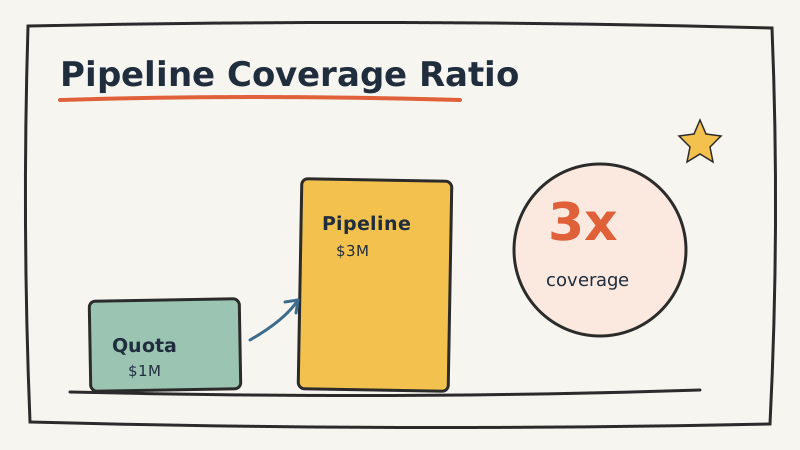
Pipeline coverage ratio is simple arithmetic: the total value of open opportunities in a period divided by the quota for that period. If your team carries a $1M quarterly quota and has $3M in open pipeline, your coverage is 3x.
The ratio is a bet on your own conversion math. It answers one question: given how often we win and how much slips, is there enough in the funnel today to land the number by quarter end? A coverage ratio in isolation tells you nothing. A coverage ratio next to your historical win rate tells you almost everything.
The reason 3x became the default is that a lot of B2B teams historically closed somewhere near 33 percent of their qualified pipeline. Invert 33 percent and you get roughly 3. The rule is really “1 divided by your win rate,” dressed up as a convenient round number. Once you see that, the fix is obvious: use your win rate, not the industry’s.
The formula that actually works
Start with your true win rate, measured from the stage where an opportunity becomes real (a qualified meeting or a defined “stage 2”), not from every lead that ever entered the CRM. Then adjust for the pipeline that will not survive to the close date.
The working formula is:
Required coverage = (1 / win rate) x slippage buffer
- Win rate is closed-won divided by closed-won plus closed-lost, over a trailing period long enough to smooth out noise (two to four quarters).
- Slippage buffer accounts for deals that push to a later period. If 20 percent of your pipeline typically slips out of the quarter, multiply by about 1.2.
A team winning 25 percent of qualified opportunities with 20 percent slippage needs (1 / 0.25) x 1.2, which is 4.8x, not 3x. A team winning 45 percent with tight forecast discipline needs closer to 2.4x. Same “rule,” wildly different answers.
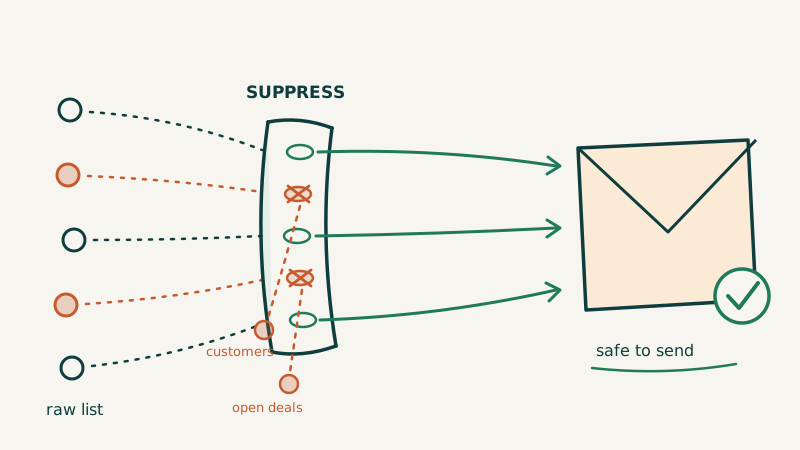
The single biggest input error is a garbage win rate, and the most common cause is dirty data feeding it. If half your “qualified” opportunities were built on invalid contacts, dead email addresses, or leads that never actually engaged, your denominator is inflated and your win rate looks artificially low. Running your prospect list through an email validation layer like Scrubby before opportunities get created keeps junk out of the funnel, which means the win rate you calculate reflects real selling rather than data cleanup. A clean pipeline produces a coverage target you can trust.
Why the 3x rule quietly fails outbound teams
Inbound-heavy and outbound-heavy funnels do not behave the same way, and coverage math is where the difference bites.
Outbound win rates run lower per opportunity. A prospect who raised their hand on your pricing page converts at a different rate than one your SDR interrupted mid-week with a cold sequence. That is not a knock on outbound, it is the nature of proactively created demand. Lower per-opportunity win rates mean outbound teams genuinely need higher coverage, so applying an inbound-calibrated 3x undershoots.
Stage inflation hides the real gap. Teams under coverage pressure have a habit of promoting weak deals into “committed” to make the ratio look healthy. The number reads 3x, but a third of that pipeline is oxygen. Coverage ratio is only as honest as your stage definitions, and outbound funnels with loose qualification criteria inflate fastest.
Coverage is a lagging signal for a leading problem. By the time your ratio drops below target, the meetings that would have filled the gap needed to be booked weeks ago. If your sales cycle is 60 days and you notice thin coverage on day 30, no amount of activity saves the current quarter. This is why the ratio has to be paired with a booked-meetings leading indicator, so you catch shortfalls while there is still time to act. Consistent top-of-funnel volume, whether from an in-house team or an outsourced GTM partner like Vendisys, is what keeps coverage from collapsing before you can react.
How to set your target in four steps
-
Pull your real win rate. Closed-won over closed-won plus closed-lost, trailing two to four quarters, measured from a consistent qualification stage. Ignore leads that never became opportunities.
-
Measure your slippage. Look at how much pipeline forecast for a quarter actually pushed to the next one. That percentage becomes your buffer multiplier.
-
Calculate required coverage. Apply (1 / win rate) x slippage buffer. Round up, never down. Under-coverage is a missed quarter; slight over-coverage is a busy team.
-
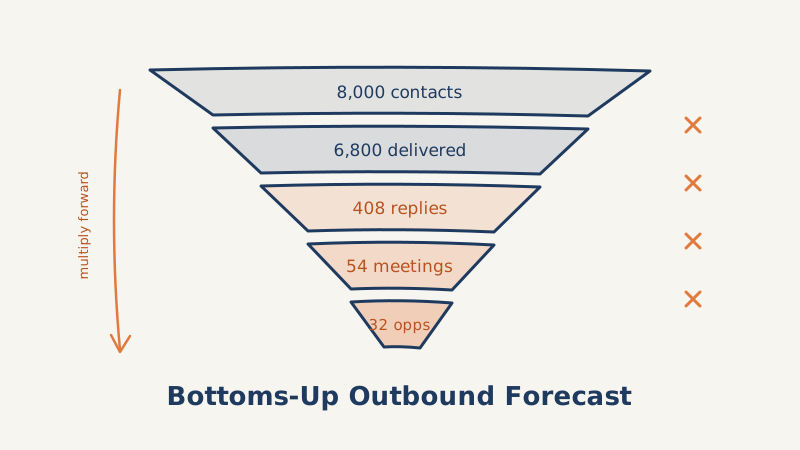
Set a booked-meetings floor to feed it. Work backward from required coverage to the number of qualified meetings your team must book each week to sustain it. If you need 4x coverage on a $1M quota with a $25K average deal, that is roughly 160 open opportunities, which sets a hard weekly meeting target for your reps.
That last step is where most coverage plans fall apart. Knowing you need 4x is useless if meeting volume swings week to week. Reliable booking mechanics matter as much as the math. Calendar-first outreach tools like Kali that put a real meeting invite in front of the prospect, rather than another “are you free to chat?” email, tighten the connection between activity and booked meetings, which is exactly the input your coverage ratio depends on.
Keep the ratio honest
A coverage target is not a set-and-forget number. Recalculate your win rate every quarter, because the moment your product, pricing, or ICP shifts, your required coverage moves with it. Audit stage definitions on a cadence so inflation does not creep back in. And watch the ratio and the booked-meetings leading indicator together, never one alone.
The teams that hit their number quarter after quarter are not the ones chasing a bigger pipeline for its own sake. They are the ones who know their real win rate, build exactly the coverage that math demands, and feed it with predictable meeting volume. Three times quota might be right for you. It might be 2.4x, or it might be 5x. The only way to know is to run your own numbers, and to make sure the data underneath them is clean enough to believe.