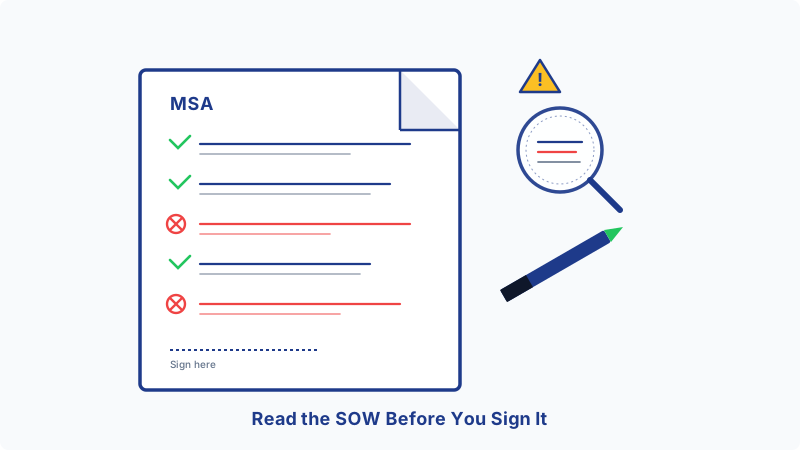
Outsourced SDR contracts are the most negotiable, least negotiated documents in B2B procurement. Founders and revenue leaders evaluate three agencies, pick the one whose pitch deck resonated, agree on a monthly retainer, and sign whatever Word document the agency emails over. The MSA, the SOW, the scope, the IP terms, the termination language all get signed in 48 hours because everyone wants to start tomorrow.
Three months later, the engagement is in trouble. Pipeline is below target, the team wants to pivot the ICP, the agency is pushing back on scope changes, and the contract is silent (or, worse, explicit and bad) on every question that matters. The agency holds the leverage because they wrote the document, and the document was written to protect the agency.
These are the six clauses worth slowing down to negotiate before you sign. They are not legalese. They are operational levers that decide whether the engagement protects you or quietly favors the agency.
1. ICP and Scope Change Rights
The single most expensive clause in any outsourced SDR contract is the one that governs what happens when your ICP changes mid-engagement.
Outsourced agencies build campaigns around a defined ICP: industry, company size, geography, persona, intent signals, account list size. The first 30 to 60 days reveal whether that ICP produces real pipeline. Sometimes it does. Often it does not, because the original ICP was a hypothesis and the market data hits differently. Maybe the SMB segment converts faster than mid-market. Maybe the East Coast list is responsive and the West Coast list is dead. Maybe a vertical that was supposed to be the wedge is full of incumbents.
The wrong contract language locks you into the original ICP, treats every change as a new SOW, and bills extra hours for “re-research” or “new list build.” Some agencies bury a clause that one ICP pivot per quarter is included; additional pivots cost X.
Negotiate the right to redirect the ICP based on data after each monthly business review at no additional cost. The agency should be incentivized to chase pipeline, not preserve scope. If they push back hard on this clause, treat it as a signal about what the next 12 months will look like.
2. Data Ownership and Portability
When the engagement ends, who owns the prospect list, the email sequences, the response data, and the CRM records?
Default agency contracts often classify the prospect database, sequence content, and reply data as agency IP licensed back to the client for the duration of the contract. When you terminate, the agency keeps the list, keeps the sequence library, and you start over from scratch with the next vendor or your in-house team.
This is one of the most consequential terms in the document and one of the easiest to negotiate. The clause you want is straightforward: all prospect data sourced for the client, all outbound content created for the client, and all response data collected during the engagement belongs to the client. The agency is granted a license to use it during the engagement and an obligation to deliver it (in a usable export format, not a PDF of screenshots) within 14 days of termination.
If the agency resists, ask why. Some legitimate agencies argue that proprietary list-building tooling produces lists that include their own enriched data. Fine. The compromise: client owns the names, titles, emails, companies, and any data the client provided. The agency owns any proprietary enrichment scores, but they are obligated to provide a clean export that excludes those scores so the client can hand the list to another vendor or use it internally.
3. Termination Notice and Pipeline Carryover
Most agency contracts include a 30, 60, or 90-day termination notice. That is not the clause that matters. The clause that matters is what happens to in-flight pipeline during the notice period and how it is handed off to the next operator.
A 60-day termination notice is fine if the agency continues full-effort execution during those 60 days. It is a disaster if the agency reduces effort the day notice is given, books no new meetings, lets sequences run dry, and hands you a dead pipeline at the end. The clause you want is explicit: during any termination notice period, the agency commits to maintain the agreed-upon activity volume (outbound sends, calls, meetings booked) at no less than the trailing 90-day average, and reduction in activity during the notice period entitles the client to a pro-rata refund.
Pair this with a handoff clause: at termination, the agency provides a final report including all in-flight conversations, scheduled meetings, prospects in active sequence, and the sequence content in editable format. This is the difference between a clean handoff to the next vendor and a 90-day rebuild from zero.
Vendisys outlines the operational version of this handoff pattern in how to align outsourced SDRs with your AE team: the same logic applies at termination, not just at start.
4. Sender Domain and Email Infrastructure
This clause is technical, easy to skip, and an enormous source of damage when it goes wrong.
When an outsourced agency runs outbound on your behalf, they typically send from one of three configurations: their own sender domain (least common), a lookalike domain registered for the campaign (most common), or your primary sender domain (highest risk, highest deliverability if done right).
The MSA needs to specify which configuration, who owns the sender domains, who is responsible for SPF / DKIM / DMARC setup, and what happens to the sender domains at termination.
The two failure modes to avoid:
Lookalike domains owned by the agency. Agency registers getyourbrand.io (variant of your yourbrand.com), runs campaigns from it, books meetings, transfers leads. At termination, the agency keeps the domain. They have the warmed-up reputation. Your prospects who reply months later land in the agency’s inbox, not yours. The next time the agency works with a competitor, that warm domain is still in their toolkit. Negotiate: lookalike domains are registered in the client’s name (or transferred to the client at no cost within 14 days of termination), with full DNS access.
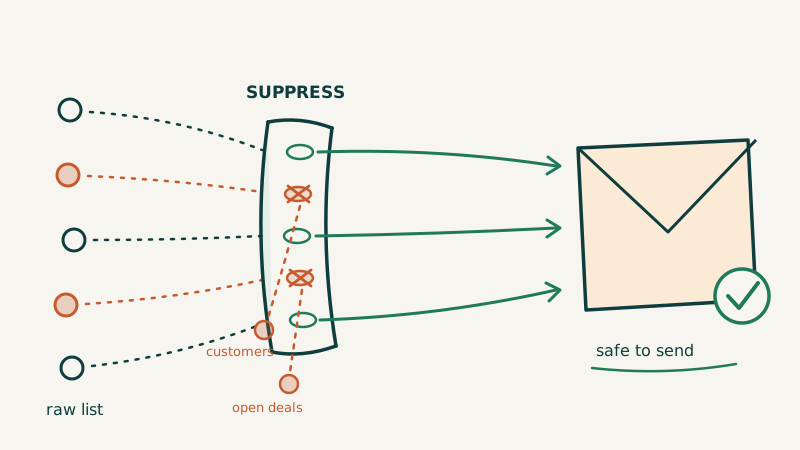
Primary sender domain usage without deliverability safeguards. Some agencies push for sending from your primary domain because deliverability is dramatically better. That can work if the contract requires the agency to maintain bounce rates below a defined threshold (typically 2 percent) and includes a list-validation step before every send. Without those guardrails, one bad list pushes your primary domain’s sender reputation off a cliff and damages every email you send for months. Wire in a contractual obligation to validate lists with a deliverability tool like Scrubby before any high-volume send.
5. Performance Metrics and the Definition of “Meeting”
Outsourced SDR contracts are usually structured as monthly retainers with a target number of “meetings booked” or “qualified opportunities.” Every word in that target needs a written definition.
What counts as a “meeting”? Is it a scheduled calendar event, a held event, a held event where the prospect showed up, or a held event where an AE on your team confirmed it was qualified? Each definition produces a different number, and the gap between “scheduled” and “AE-qualified” is often 40 to 60 percent.
A scheduled-but-not-held meeting is worth a fraction of a qualified-and-held meeting. If the contract counts scheduled meetings, the agency is incentivized to over-book and ignore no-show rates. If the contract counts held-and-qualified meetings, the agency is incentivized to filter aggressively and only push high-quality opportunities.
Negotiate two things. First, the meeting definition: held AND qualified by the client’s AE within a defined SLA (typically 5 business days post-meeting). Second, the dispute process: the client can mark meetings as unqualified within the SLA window, and the agency does not get retainer credit for unqualified meetings. The agency will push back on this with arguments about quality control on the AE side. The compromise: a maximum disqualification rate (typically 20 to 25 percent) above which the client and agency review jointly.
Also worth defining: what happens to leads that the agency books but the AE never takes? Is that a “no-show” against the agency’s metric, or against the client’s pipeline? Smart contracts split this: agency is responsible for show-up rate on the prospect side, client is responsible for show-up rate on the AE side.
6. Conflict-of-Interest and Concurrent Engagement Restrictions
This is the clause most operators forget until it bites them.
Outsourced agencies typically run engagements for multiple clients in adjacent industries. Sometimes those engagements directly compete with yours. An agency selling SDR services to your three biggest competitors at the same time is fishing in the same prospect pool, sending to overlapping account lists, and (in the worst case) sharing learnings and content across competing clients.
A reasonable clause: the agency cannot take on a new engagement with a defined list of named competitors during the term and for 6 months following termination. The “defined list” is the key part. Vague language like “direct competitors” is unenforceable. Specific company names are enforceable.
A more aggressive version: the agency cannot use specific account lists, sequence patterns, or learnings developed for the client in any other client engagement during the term and for 12 months following termination. This is harder to enforce in practice but useful as a deterrent.
Negotiate this clause with the named-competitor list updated quarterly (markets change, new competitors emerge). And ask the agency directly: who else are you working with in our space right now? If they decline to answer because of NDAs, that is an answer. If they answer and one of your top three competitors is on the list, walk away.
What to Do If the Agency Refuses to Negotiate
Some agencies will refuse to modify their standard MSA. That is also an answer.
A reputable outsourced GTM partner has worked with enough sophisticated buyers that these six clauses are familiar. They have language for each one. The negotiation is mostly about edge cases, thresholds, and definitions, not whether the clauses exist. An agency that pushes back on every clause with “this is non-negotiable, the document is standard” is signaling that they expect to extract value from the asymmetry, not from the engagement.
The cost of walking away from an agency before signing is one to two weeks of evaluation time. The cost of signing a bad contract and unwinding it 12 months later is six figures plus the opportunity cost of the lost pipeline. Negotiate hard. The good agencies will respect it. The bad ones will out themselves.
Closing Checklist
Before you sign the next outsourced SDR contract:
- ICP change rights at no additional cost, with monthly review cadence
- Client owns prospect data, content, and response data, with clean export at termination
- Termination notice requires sustained activity volume, with pro-rata refund if the agency drops effort
- Sender domain ownership defined (client-owned lookalikes, contractual deliverability safeguards on primary domain sends)
- Meeting definition is “held and qualified,” with SLA-bound dispute window and disqualification cap
- Named-competitor restriction list, updated quarterly, enforceable for term plus 6 months
The agencies that complain about these clauses are telling you something about their incentives. The ones that engage thoughtfully on each one are telling you something better. Either way, you learn something useful before the wire transfer clears. For a broader look at how outsourced GTM relationships should be structured operationally, Vendisys outlines the full pattern and how it connects to AE handoff, deliverability, and pipeline measurement. Tools like Kali on the calendar-invite side and AI reply systems like Underfive on the inbound response side both depend on these contractual foundations being right. Get the paper right first, then the execution can scale.