Most outbound advice assumes you have a near-infinite list. Blast more volume, add more sending domains, accept the spray-and-pray math, and pipeline shows up. That model works when your total addressable market (TAM) runs into the hundreds of thousands of accounts. It quietly destroys you when your TAM is 2,000.
Vertical SaaS companies, niche infrastructure vendors, and category creators face a different problem. The entire market fits in a spreadsheet. If you burn through it with a generic three-touch sequence in a single quarter, you have nothing left, and the accounts that ignored you now associate your brand with noise. A small TAM is not a smaller version of a big TAM. It is a different game with different rules.
Here is how to run outbound into a finite market without torching the only list you will ever have.
Know exactly how finite your market is
The first mistake is not knowing the number. Teams with a small TAM often behave as if the market is large because they have never counted it. Before you send anything, build the actual list of named accounts that could plausibly buy.
Be honest about qualification. If you sell compliance software to mid-market credit unions in North America, that is roughly 1,200 institutions, not “financial services.” If you sell to hospital procurement leaders at systems with more than 500 beds, that is a few hundred systems. Write the real number down. It changes every decision that follows.
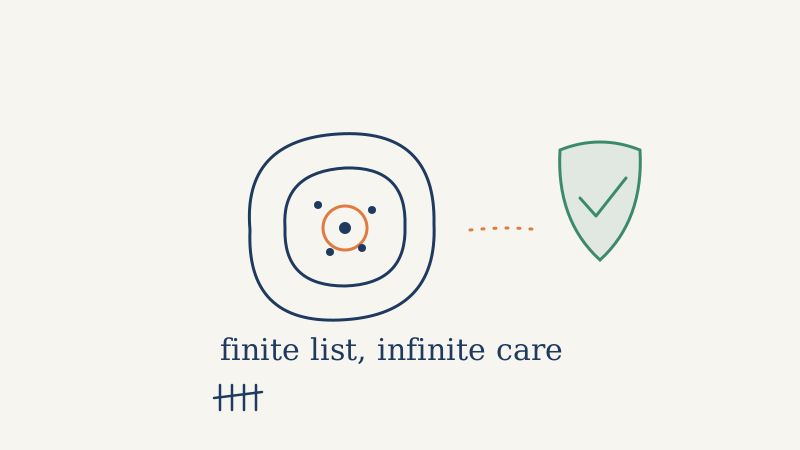
Once you have the count, do the contact math. A 1,200-account market with three relevant personas per account is 3,600 humans. That is your entire universe of outbound for the life of the company until the market grows. Treat each one like the scarce resource it is. This is the opposite of high-volume outbound, where you can afford to learn from accounts you will never miss.
Protect deliverability like the list depends on it, because it does
In a large TAM, a deliverability problem costs you some percentage of an effectively unlimited pool. In a small TAM, a deliverability problem can cost you the whole market. If your domain reputation tanks and your messages start landing in spam across a 1,200-account universe, you do not get a do-over with fresh accounts. You have to repair the reputation that those exact buyers already formed.
Two non-negotiables for small-TAM senders:
First, validate before you send. Bouncing a generic prospect is a rounding error. Bouncing 8 percent of a finite list spikes your bounce rate, hammers your sender reputation, and the damage applies to the accounts you have not even contacted yet. Run the entire list through verification, and re-verify before every major push, because roles in niche markets change slowly but they do change. Tools like Scrubby catch the invalid and risky addresses (including the catch-all and accept-all domains that are common in older niche-industry mail servers) so a single dirty import does not poison delivery to your whole market.
Second, keep your sending volume per domain low and human. High-volume outbound leans on many domains and many inboxes precisely because the per-domain reputation is disposable. You cannot think that way. Your domains and your brand are the same asset to a buyer who will see your name a dozen times over two years. Warm domains slowly, cap daily sends, and never let automation make your finite list look like a blast.
Sequence for depth, not for volume
The high-volume playbook optimizes for throughput: short sequences, fast disqualification, move on. With a small TAM you optimize for the opposite. You want the maximum number of relevant, well-spaced touches per account across a long horizon, because you are not moving on. There is nowhere to move on to.
Practical shifts:
- Stretch the calendar. Instead of a 14-day sequence that exhausts an account and marks it dead, design a campaign that touches each account a handful of times per quarter for a year. The same human will see your name across seasons, not across two weeks.
- Rotate the angle, not just the copy. Each touch should carry a genuinely different reason to engage: a relevant regulatory change, a peer customer outcome, a new feature that maps to their workflow. In a niche market you actually know what these are. Use that knowledge.
- Mix channels deliberately. Email carries the narrative, but a calendar-invite touch or a well-timed direct outreach can break through when an inbox is saturated. Booking motions like Kali let you put a real meeting option in front of a known buyer without another cold email landing in the same crowded inbox.
- Treat a “no, not now” as data, not death. In a big TAM you discard it. In a small TAM you log the timing signal and come back when the trigger you were told about actually fires.
Personalize at the account level, because you can
The defense of generic outbound is scale: you cannot research 50,000 accounts. You can research 1,200. A small TAM removes your excuse for templated, irrelevant messaging. The buyers in a niche market talk to each other, attend the same five conferences, and read the same two newsletters. They notice when a vendor clearly does not understand their world, and they notice when one does.
Invest in real account intelligence: the buyer’s tech stack, their recent leadership changes, the specific operational pain your category solves for their segment. You are not personalizing the first line of an email. You are demonstrating, across an entire campaign, that you belong in their market. That credibility compounds in a small community in a way it never does in a large one.
This is also where the math finally works in your favor. A 2 percent reply rate against 50,000 prospects is a thousand conversations you can barely staff. A 20 percent reply rate against 3,600 deeply researched contacts is a manageable pipeline you can actually work to close. Small TAM rewards quality at a ratio that large TAM never will.
Build a system that remembers
The fatal small-TAM failure mode is institutional amnesia. A rep runs a campaign, half the market goes quiet, the rep leaves, and the next rep re-imports the same list and runs the same sequence into accounts that already heard the exact pitch eight months ago. Now you look incompetent to the only buyers you have.
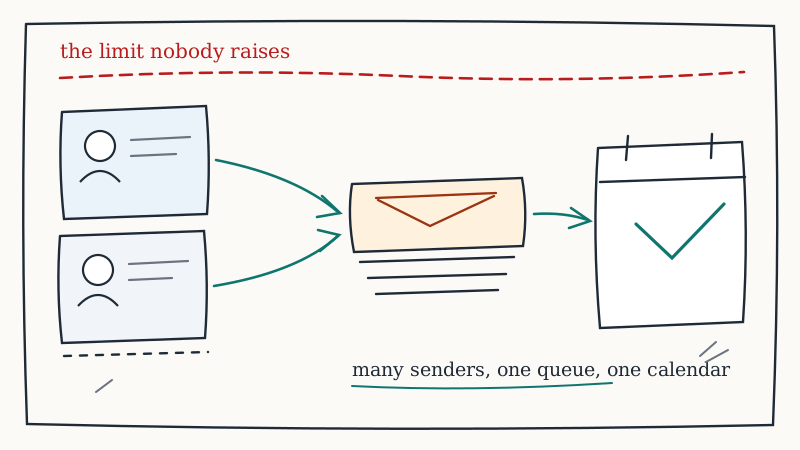
You need a durable record of every touch, every response, and every timing signal at the account level, independent of who is doing the outbound this quarter. That is an operational discipline most early teams do not have the headcount to maintain, which is one reason small-TAM companies often run their outbound through an outsourced partner that owns the infrastructure and the memory. Vendisys builds and runs this kind of finite-market outbound motion as managed GTM infrastructure, so the institutional knowledge of your market lives in a system instead of in one rep’s head. The list, the history, and the cadence survive turnover, which in a small TAM is the difference between a renewable pipeline and a market you only get to contact once.
The mindset shift
Running outbound into a small TAM is closer to account-based field sales than to growth marketing. The unit of patience is the quarter, not the day. The metric that matters is coverage quality across a finite universe, not raw send volume. And the worst thing you can do is treat a scarce, finite list like a disposable one.
Count your market. Protect your deliverability as if your reputation with every future buyer is on the line, because it is. Sequence for depth, personalize because you finally can, and build a system that remembers what you already said. Do that, and a 2,000-account market can generate pipeline for years. Burn it in a quarter, and no amount of volume will bring it back.