Every outbound team eventually hits the same wall. The reps who personalize deeply book meetings but can only touch 15 accounts a day. The reps who blast templates reach thousands but their reply rates crater and their domains land in spam. Leadership asks for more pipeline, so volume goes up, relevance goes down, and results flatten out.
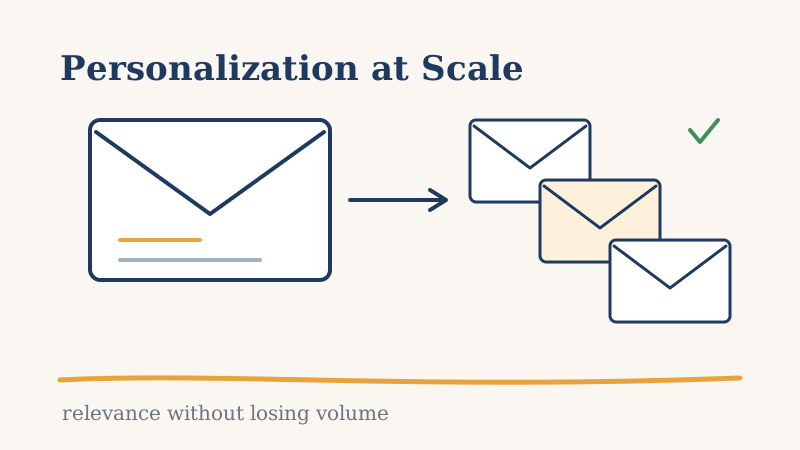
The framing is wrong. Personalization and volume are not opposite ends of a single dial. They are two different problems that need two different solutions. Once you separate them, you can run both at once.
Why “personalize everything” fails
The instinct after a bad quarter is to tell reps to research harder. Spend more time per prospect. Reference a recent funding round, a podcast appearance, a LinkedIn post. It feels rigorous, and the first few emails are genuinely good.
Then the math shows up. If a rep needs 20 minutes of research per prospect and you need 200 touches a day to hit pipeline targets, you need a headcount you cannot afford. So reps cut corners. The “personalization” degrades into a copy-pasted first line about the company’s mission statement that every competitor also references. You get the cost of manual research with none of the payoff.
Deep manual personalization does not scale linearly. It scales terribly. The teams that win do not personalize everything. They personalize the right things, at the right layer, for the right accounts.
The three layers of relevance
Think about relevance as three stacked layers, each cheaper to produce than the one above it.
Layer 1: Segment relevance. This is the message written for a tightly defined group. A VP of Sales at a 50-person Series A SaaS company has a specific, predictable set of problems. If your list is segmented well, you can write one email that feels personal to all of them because it names a pain they actually have. No individual research required. This is where most of your leverage lives, and it is entirely a function of list quality and segmentation, not writing effort.
Layer 2: Trigger relevance. This is the message tied to an observable event: a new hire in a relevant role, a funding announcement, a job posting that signals a gap, a technology change. Triggers are personal because the timing is personal, even when the copy is templated. A well-built trigger system produces relevance at volume because the machine does the watching, not the rep.
Layer 3: Individual relevance. This is the classic one-to-one research: the specific detail about the specific person. It is the most expensive layer and you should spend it deliberately, on your highest-value accounts only.
Most teams try to win entirely on Layer 3 and starve Layers 1 and 2. That is the volume-versus-personalization trap. Fix your segmentation and triggers first, and Layer 3 becomes a scalpel you use on 20 accounts, not a burden you carry across 2,000.
Match the layer to the account tier
Not every account deserves the same investment. Split your target list into tiers and assign a personalization layer to each.
- Tier A (dream accounts, maybe 5 percent of the list): Full Layer 3. Individual research, multi-channel, sometimes a custom asset. A rep might touch only a handful of these per day, and that is correct.
- Tier B (strong-fit accounts, 25 percent): Layer 2. Wait for a trigger, then send a segment-quality email with the trigger woven in. Fully repeatable, still highly relevant.
- Tier C (good-fit volume, 70 percent): Layer 1. Excellent segment messaging, sent at scale. No individual research. This tier is where your volume comes from, and it performs well precisely because the segmentation is tight, not because someone hand-wrote each note.
This tiering is what lets you send enough. The bulk of your volume runs on Layer 1, which costs almost nothing per incremental email once the segment copy is written. Your scarce research time concentrates on Tier A, where it actually moves revenue.
The list is the real personalization engine
Here is the uncomfortable truth: most “personalization” problems are actually data problems. If your list is a loosely filtered export where half the titles are wrong and a chunk of the emails bounce, no amount of clever copy saves you. Segment relevance depends entirely on the segment being real.
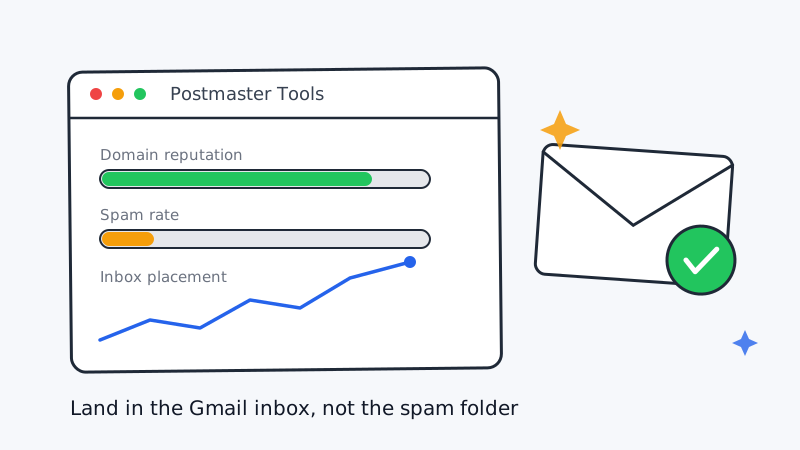
Two things have to be true before you scale. First, the data has to be accurate enough that your segment assumptions hold, which is why disciplined teams treat list quality and data hygiene as the foundation of the whole program rather than an afterthought. Second, the emails have to actually be deliverable, because a personalized message that lands in spam is worth exactly zero. Running your list through a verification tool like Scrubby before a send protects both your reply rate and your sender reputation, and it is the single cheapest insurance you can buy against a scaled campaign quietly failing.
When the list is clean and correctly segmented, Layer 1 messaging punches far above its cost. When it is not, every layer above it inherits the noise.
Building triggers that produce relevance automatically
Layer 2 is where teams leave the most pipeline on the table, because triggers feel like something you need an expensive intent platform to run. You do not. You need a defined set of events that matter for your buyer and a reliable way to watch for them.
A few triggers that reliably outperform generic outreach:
- A new leader hired into the exact role you sell to. They are evaluating their stack in the first 90 days.
- A competitor’s tool showing up (or disappearing) from a prospect’s site or job descriptions.
- A funding event that unlocks budget for the category you sell.
- A public commitment (a new market, a hiring spree, a product launch) that your product supports.
The point of a trigger is that a machine flags the moment and the rep just sends. You get individual-feeling timing without individual-level research. Watching prospect websites and competitor pages for exactly these kinds of changes is what tools like CAM exist to do, so your reps get an alert instead of manually checking pages that update on their own schedule.
Templates are not the enemy, bad templates are
There is a lingering belief that templates and personalization are opposites. They are not. A template is just a repeatable structure. The best outbound teams run heavily templated Layer 1 and Layer 2 messaging, because the template guarantees the fundamentals are right every time: a relevant pain, a specific outcome, a low-friction call to action.
What kills reply rates is not the existence of a template. It is a template with no segment insight, a generic value prop, and a “just following up” close. Fix the template’s substance and you can send it a thousand times without embarrassment. That is the whole trick to volume: make the repeatable version genuinely good, so scaling it does not degrade it.
If you want to move past pure email, the same tiering logic applies to how you book the meeting. Low-friction, calendar-first outreach through a tool like Kali can lift Tier B and Tier C conversion because it removes a step from the prospect’s side, and it works precisely because the underlying message was already relevant.
What to measure
If you are running the tiered model correctly, you should watch different metrics per tier rather than one blended reply rate that hides everything.
- Tier A: meetings booked and opportunity creation. Volume is intentionally low, so a blended reply rate is meaningless here.
- Tier B: trigger-to-send latency and reply rate on triggered sends. If your triggers are good and your latency is low, this tier should out-convert cold Layer 1 by a wide margin.
- Tier C: reply rate, positive reply rate, and deliverability health. This is your volume engine, so protect the domains and watch spam placement closely.
The mistake is judging the whole program on one number. A 4 percent blended reply rate might be a fantastic Tier A result dragging up a mediocre Tier C, or a strong Tier C masking dead triggers. Separate the tiers and you can actually see which layer needs work.
The takeaway
You do not have to choose between relevance and volume. You have to stop treating them as one decision. Build tight segments so your default message is already relevant. Layer triggers on top so timing feels personal without manual research. Reserve deep individual work for the tiny slice of accounts that justify it. And keep the underlying data clean so the whole structure holds.
Done this way, the “personalization versus volume” debate disappears. You send a lot, and almost all of it is relevant, because relevance was engineered into the list and the triggers instead of hand-carved into every email. If your team is stuck picking between the two, the fix is not more effort per email. It is a better system underneath them, which is exactly the kind of outbound infrastructure Vendisys is built to run.