Most teams measure outbound by activity: emails sent, calls dialed, sequences launched. But activity is not an outcome, and it does not tell you whether the money you pour into outbound is working. The single number that cuts through all of it is cost per meeting.
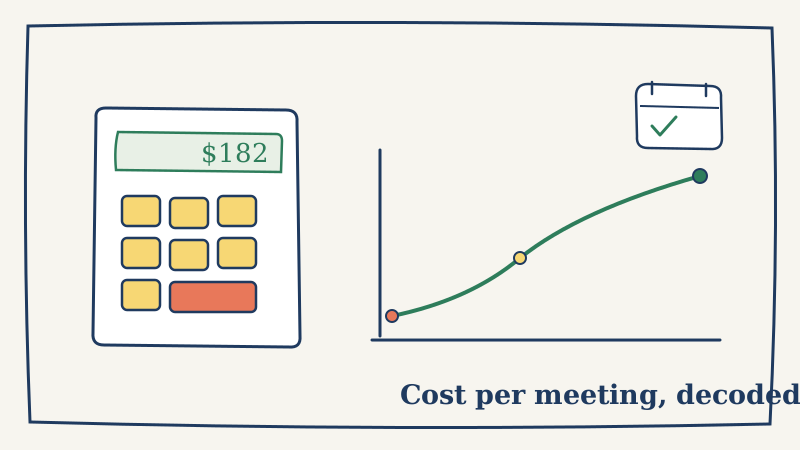
Cost per meeting (CPM, not to be confused with the advertising metric) tells you exactly how much you spend to put one qualified, booked meeting on a sales rep’s calendar. It is the closest thing outbound has to a unit economics figure, and once you track it, most other decisions get easier: whether to hire, whether to outsource, which channels to cut, and how aggressively you can scale.
This guide covers how to calculate it correctly, the mistakes that make the number lie to you, and the benchmarks that tell you whether you are healthy or overspending.
Why Cost Per Meeting Beats Cost Per Lead
Cost per lead is a vanity-adjacent metric. A lead can be anyone who downloaded a whitepaper or replied “not interested but thanks.” It says nothing about sales readiness. Cost per meeting only counts outcomes that a sales rep would actually take: a booked, qualified conversation with a real prospect who fits your ideal customer profile.
That distinction matters because it forces honesty into the funnel. You can generate cheap leads all day, but if none of them convert into meetings, your real cost of pipeline is far higher than your cost-per-lead dashboard suggests. Meetings are where outbound either earns its keep or exposes itself as expensive noise.
If you have not tightened your ideal customer profile yet, do that first. A vague ICP inflates cost per meeting because reps waste cycles on prospects who will never buy. Our guide on how to build an outbound ICP that generates pipeline is a good starting point.
The Formula
The core calculation is simple:
Cost Per Meeting = Total Outbound Cost / Number of Qualified Meetings Booked
The denominator is the easy part. The numerator is where most teams get it wrong. To calculate a true cost per meeting, your total outbound cost has to include every input, not just the obvious ones.
A complete numerator includes:
- Fully loaded rep cost. Salary, commission, benefits, payroll tax, and management overhead for every SDR or BDR running outbound. A “$70k SDR” usually costs closer to $110k fully loaded.
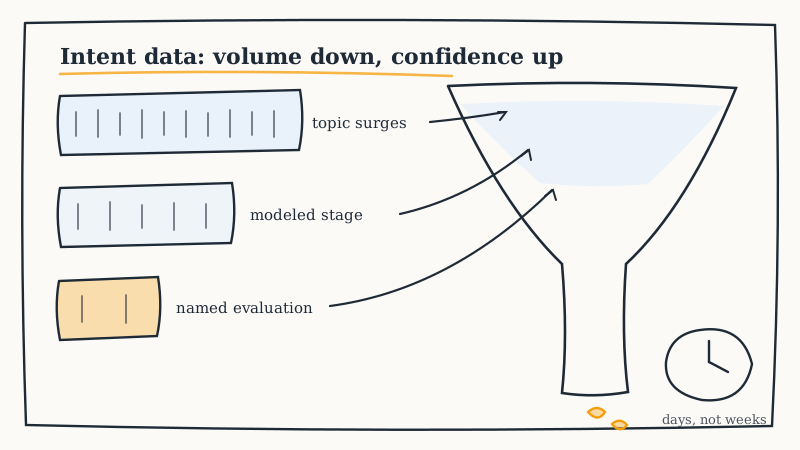
- Tooling. Sequencer, dialer, data provider, email verification, intent data, and CRM seats attributable to outbound.
- Data and list costs. Every dollar spent buying, enriching, or verifying contact data.
- Infrastructure. Sending domains, inboxes, warm-up tools, and deliverability monitoring.
- Management time. The fraction of a sales leader’s salary spent coaching, reviewing, and running outbound.
Add all of that up for a given period, divide by the number of qualified meetings booked in that same period, and you have your real cost per meeting.
The Two Mistakes That Make the Number Lie
Mistake one: counting meetings booked instead of meetings held. A meeting that gets scheduled but never happens is not a meeting. No-shows and reschedules can eat 20 to 40 percent of booked meetings, so if you calculate on “booked,” your cost per real conversation is much higher than you think. Always calculate on meetings that actually occurred and passed a basic qualification bar. If your no-show rate is high, that is its own problem worth fixing before you scale spend.
Mistake two: ignoring data waste. Bad contact data silently inflates cost per meeting because reps burn hours on bounced sends and disconnected numbers. If a quarter of your list is invalid, you are effectively paying 25 percent more for every meeting. Running your list through an email validation layer like Scrubby before a campaign protects deliverability and keeps reps working live contacts instead of dead ends. Clean data is one of the fastest levers for pulling cost per meeting down.
What Good Looks Like
Benchmarks vary by market, deal size, and motion, but here are working ranges for B2B outbound targeting mid-market and enterprise:
- Under $150 per meeting: Excellent. Usually indicates a tight ICP, clean data, and a well-tuned sequence. Common in high-volume, lower-ACV motions.
- $150 to $350 per meeting: Healthy for most mid-market B2B. This is the range most efficient outbound programs land in once they are past the ramp phase.
- $350 to $600 per meeting: Acceptable for enterprise or highly technical products with small total addressable markets, where each meeting is worth more.
- Over $600 per meeting: A warning sign for most teams. Either your targeting is too loose, your data is dirty, your reps are underperforming, or your product-market fit for outbound is weak.
The absolute number matters less than the trend. A cost per meeting that climbs quarter over quarter means your system is degrading, list fatigue is setting in, or your total addressable market is saturating. A number that falls means your team is compounding its learning.
How to Drive the Number Down
Once you have a baseline, four levers move cost per meeting the fastest:
- Sharpen targeting. Every meeting with a poor-fit prospect is wasted spend. A narrower, better-researched list beats a bigger, sloppier one every time.
- Clean your data. Verify contacts before you send. This single step protects deliverability and stops reps from paying the invalid-data tax on every campaign.
- Cut no-shows. Confirmation sequences, calendar reminders, and easy rescheduling recover meetings you already paid to book. Booking tools like Kali that send calendar invites directly can lift show rates meaningfully.
- Fix the weakest channel. Calculate cost per meeting per channel. If cold calling costs three times what email does and books fewer meetings, reallocate.
When the Math Says Outsource
Here is where cost per meeting becomes a strategic decision, not just a dashboard metric. Once you know your fully loaded cost per meeting, you can compare it directly against what an outsourced outbound partner charges per meeting or per month.
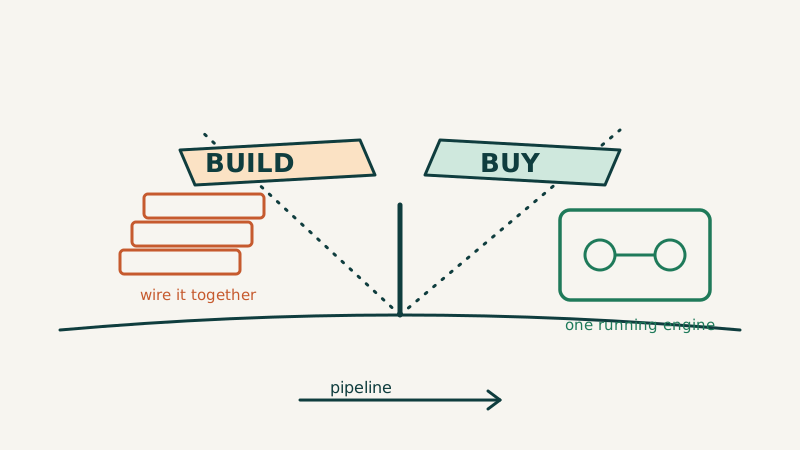
Building an in-house outbound function carries fixed costs (recruiting, ramp time, tooling contracts, management) that take months to amortize. If your blended in-house cost per meeting is $500 and a specialized partner can deliver qualified meetings at $300 with no ramp risk, the decision makes itself. This is exactly the kind of build-versus-buy math that outsourced GTM infrastructure is designed to win. Vendisys runs the full outbound engine (data, infrastructure, sequencing, and trained SDRs) so you get a predictable cost per meeting without carrying the fixed overhead or the ramp risk of building it yourself.
Cost per meeting will not tell you everything about your outbound program, but it is the fastest way to know whether you are running an efficient pipeline machine or quietly overpaying for every conversation. Calculate it honestly, benchmark it against your motion, and revisit it every quarter. The teams that treat it as a north-star unit economic almost always end up with cheaper, faster pipeline than the ones still counting emails sent.