Job-Change Triggers: How to Turn Former Champions Into Your Warmest Outbound Pipeline
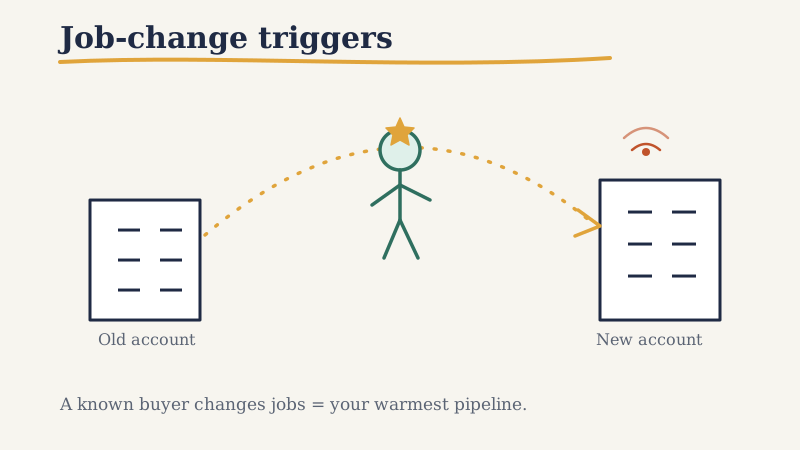
Most outbound is a battle against indifference. You are reaching someone who has never heard of you, at a company that has never bought from you, about a problem they may not know they have. Every part of that is friction. Now imagine the opposite: a person who already used your product, already liked it, and already knows exactly what it does, suddenly lands in a new role at a new company with budget and a mandate to fix things. That is not a cold prospect. That is the warmest lead your team will touch all quarter, and most companies miss it entirely because nobody was watching when it happened.
Job-change signals are one of the highest-converting triggers in all of outbound, and they are systematically under-used. This guide covers why they work, how to catch them at the right moment, and how to build a repeatable motion around them instead of stumbling on them by accident.
Why job changes are the best trigger in outbound
A trigger event is any observable change that suggests a prospect is more likely to buy right now than they were last month. New funding, a leadership hire, a product launch, a competitor switch: these all raise the odds that someone is in motion. Job changes sit at the top of the list for a simple reason. They combine intent, authority, and existing trust in a single event.
Think about what actually happens when a champion changes jobs. A person who advocated for your product internally, who knows its value and can describe the outcome it delivered, now walks into an organization that has never used it. They arrive with fresh political capital, a budget to spend, and a strong incentive to show early wins. Bringing in a tool they already trust is one of the fastest ways to do that. You are not selling a stranger on an unknown product. You are reminding a friend that the thing they liked exists and is available to them again.
The math is stark. Reply rates and conversion on job-change plays routinely run several times higher than standard cold outbound, because you are removing the two hardest parts of the sale at once: establishing credibility and creating urgency. Both are already handled by the mover’s own history with you.
There is a second, quieter version of this play that is just as valuable. When a champion leaves an existing customer account, that account is now at risk, because the person who defended your renewal internally is gone. The same signal that opens a new-logo opportunity flags a retention threat on the account they left. A team watching job changes gets both edges of the same event.
The three types of movers worth tracking
Not every job change is a fit. The skill is knowing which movements to act on and which to ignore, so your team spends effort where it converts.
Former customers and users. This is the core of the play. Anyone who used your product at a previous company is a prime target the moment they resurface somewhere new. They need no education and carry no skepticism. If you track only one category, track this one.
Former champions and buyers. Broader than daily users, this includes the economic buyer, the internal advocate, and anyone who sat on the buying committee for your product. They may not have touched the product hands-on, but they remember the decision and the outcome, and they can restart the conversation with authority.
Target-persona movers into target accounts. The looser tier: a person who fits your ideal buyer profile moving into a role at an account you already want. There is no prior relationship, but the newness of the role still creates a window, because new executives reassess their stack in the first ninety days. This tier converts less than the first two but massively widens your addressable signal.
The discipline is in the prioritization. A former power user landing in a VP seat at a perfect-fit account deserves a same-day, hand-written outreach. A loose persona match deserves a lighter, automated touch. Treating all three the same either buries your best signals in noise or wastes your best effort on your weakest leads. Fit-based prioritization is a core outbound competence, and job-change signals are one more input into the same scoring model that ranks the rest of your list.
Catching the signal at the right moment
The value of a job-change trigger decays fast. A move you catch in the first two weeks is worth far more than one you notice six months later, because the window of maximum openness (the new-role honeymoon, before the calendar fills and the stack ossifies) is short. Timing is most of the play.
The naive approach is to manually check LinkedIn for a handful of past contacts, which does not scale past a few dozen names and misses the moment more often than it catches it. The systematic approach is to maintain a tracked list of everyone worth watching (former users, past buyers, closed-lost contacts, and current-account champions) and monitor that list for role changes continuously. Purpose-built tools like Champions exist to do exactly this: they watch your relationship graph and alert you the moment a tracked person shows up in a new role, so the outreach fires while the signal is still hot instead of weeks after the window closed.
If you already run intent and enrichment tooling, wire job-change detection into the same alerting path you use for other triggers, so a move lands in the same queue your reps already work rather than in a spreadsheet nobody opens. The goal is a single fact reaching a rep within days: this known buyer just changed jobs, here is where they went, act now.
Verify before you send
There is one operational trap that quietly kills job-change plays: the email address is wrong. A person who just changed companies has, by definition, a brand-new work address, and any old contact record you have is now dead. Firing your carefully personalized outreach at a former address means it either bounces or, worse, reaches someone else entirely.
Fresh moves are exactly the situation where your data is least reliable, so verification is not optional. Before you send, confirm the new work email is real and deliverable. Running new addresses through a validation service like Scrubby catches the dead and catch-all addresses that come with any recent job change, which protects both the individual send and the sending-domain reputation that keeps the rest of your outbound out of spam. There is no point catching a perfect signal and then wasting it on an address that never existed.
While you are enriching, pull the surrounding context too: the new company, the new title, the team they now own, and any public signal about why they were hired. That context is what turns a generic congratulations note into a message that lands. Research automation and AI SDR platforms like vSDR can assemble that new-role picture at scale, so a rep opens each alert with the address verified and the angle already framed rather than starting the research from zero.
Write the outreach like a person who remembers you
The message is where most teams squander the advantage. They catch the signal, then send the same templated cold email they send everyone, throwing away the single thing that makes this lead special: the prior relationship. The entire point of a job-change play is that you are not a stranger, so the email must not read like one.
A few principles keep the message true to the situation.
Lead with the shared history, not the pitch. Open by naming the connection: the previous company, the outcome they drove there, the fact that they know the product. “Saw you just joined Northwind as VP of Sales. You ran the outbound program at Acme where we worked together.” That first line does what no cold opener can, because it is simply true.
Congratulate without groveling. A brief, genuine acknowledgment of the new role is human and appropriate. A paragraph of flattery is not. One sentence, then move on.
Make the relevance obvious, then ask. Connect the product to the problem they almost certainly face in the new seat, and trust them to see it. They already know what the tool does, so you do not need to explain it. You need to remind them it exists and that it solved this exact problem for them before. Then ask directly for the conversation.
Keep it short. The prior relationship earns you a reply, not a lecture. Five or six sentences is plenty. If you find yourself explaining the product from scratch, you have forgotten who you are writing to.
The tone should be that of a former colleague reaching back out, because functionally that is what you are. That warmth is the whole asset. Spend it, do not template over it.
Build it into a repeatable motion
Catching one lucky job change and closing it is a story. Catching them reliably, every week, is a system. The teams that win with this trigger treat it as a standing motion, not a happy accident.
- Maintain the watch list. Continuously add former users, past buyers, closed-lost contacts, and current-account champions to a tracked list. The list is the asset, and it compounds as your customer base and pipeline grow.
- Monitor continuously. Automate detection so a move surfaces within days, not months. Manual checking guarantees you miss the window on most of them.
- Score and route. Rank each mover by fit and prior relationship strength, and route the strongest signals to your best reps for hand-written outreach while lighter matches run on automated sequences.
- Verify, then personalize. Confirm the new address is deliverable and pull the new-role context before the send. Never fire at a stale record.
- Guard the accounts they left. Every departure from a customer account is a retention flag. Route it to the account owner so a champion’s exit does not quietly become a lost renewal.
Building and running that loop takes real infrastructure: the tracking, the enrichment, the verification, the routing, and the discipline to work the signals fast. Teams that would rather not stand all of that up in-house can run job-change plays through an outsourced GTM partner like Vendisys, which operates the tracking, research, and outreach as a managed program so the warmest leads in your pipeline get worked while the window is still open.
Job changes are the rare outbound signal where the person on the other end is genuinely happy to hear from you, because you already earned it once. The only question is whether anyone on your team is watching when it happens. Build the system that catches the move, verify the address, write like the colleague you actually are, and you turn the ordinary churn of the job market into the most reliable warm pipeline your team has.
Want to turn job-change signals into booked meetings without building the tracking and outreach engine yourself? Talk to Vendisys about running it as a managed motion.