The most common reason an outbound program “isn’t working” has nothing to do with the copy, the targeting, or the tool. It is that the program is running at a fraction of the volume the math requires, and the founder is judging the results as if the volume were adequate.
Outbound is a conversion funnel with brutal, well-documented drop-off at every stage. If you do not run enough at the top, the bottom produces noise instead of pipeline, and no amount of message tweaking will fix it. This post works the math backward from a pipeline target so you can see exactly how much volume a real program demands, and why thin volume is the silent killer of early outbound.
Start From the Number You Actually Care About
Forget activity metrics for a moment. The only number that matters to the business is pipeline: qualified opportunities, or the revenue they represent. So start there and work backward.
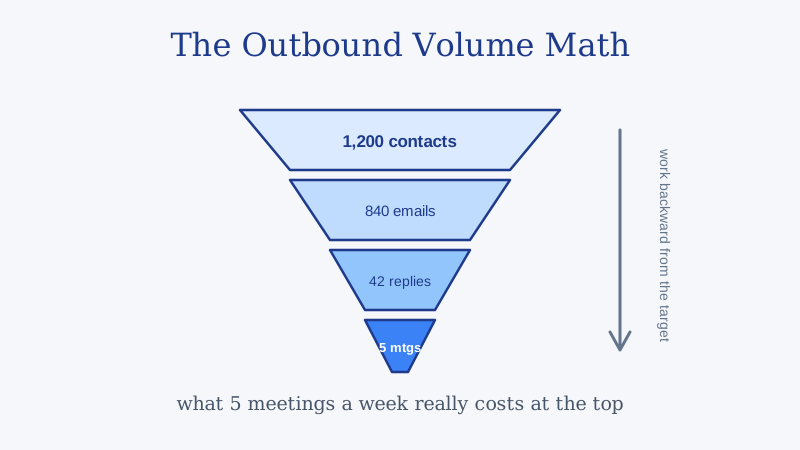
Say your target is 5 net-new qualified meetings per week. That is a modest, realistic goal for an early-stage B2B company trying to build repeatable pipeline. Now we walk the funnel upward, stage by stage, applying conservative but typical conversion rates for cold outbound.
The Funnel, Worked Backward
Here is a representative cold-email funnel. Your exact rates will differ, but the orders of magnitude hold across most B2B motions:
| Stage | Typical conversion | Working backward from 5 meetings/week |
|---|---|---|
| Meetings booked | — | 5 |
| Positive reply → meeting | ~40% | 13 positive replies |
| Total reply → positive | ~30% | 42 total replies |
| Email sent → reply | ~5% | ~840 emails delivered |
| Contact → deliverable (after bounces/bad data) | ~70% | ~1,200 contacts loaded |
So to reliably book 5 meetings a week, you are sending on the order of 800–900 deliverable emails a week to roughly 1,200 fresh contacts. Over a month, that is ~3,400 emails to ~4,800 contacts. To hit 10 meetings a week, double everything.
Two things jump out the moment you see it laid out:
- The top of the funnel is enormous relative to the bottom. You need ~240 contacts to produce a single meeting in this model. That ratio is not a sign something is broken — it is the normal physics of cold outbound.
- Small rate changes compound violently. If your deliverability slips and reply rate halves from 5% to 2.5%, you now need twice the volume for the same result. Every leak upstream multiplies the volume required downstream.
Why Founders Consistently Run Too Thin
When founders run outbound themselves or hire a single junior SDR, they typically generate a few hundred touches a week, decide the channel “doesn’t convert,” and quietly wind it down. But a few hundred touches against the funnel above predicts one or two meetings a week at best — indistinguishable from random noise. They didn’t disprove outbound; they never ran enough of it to get a signal.
There are three structural reasons thin volume is so common:
- Data runs out fast. Producing 1,200 fresh, accurate contacts every week is a research and enrichment problem most teams underestimate. Reusing the same list inflates your numbers while torching your reputation.
- Deliverability caps per-inbox sending. You cannot blast 900 emails from one mailbox without landing in spam. Real volume requires a managed infrastructure of multiple domains and warmed inboxes — which is operational work, not a setting.
- Consistency beats intensity. A burst of 2,000 emails one week and silence the next produces worse results than a steady 850/week, because pipeline is a trailing function of sustained top-of-funnel activity.
The Two Levers: Volume and Conversion
Once you can see the funnel, you have exactly two ways to hit your target: send more at the top, or convert better at each stage. The mistake is obsessing over conversion while running too little volume to even measure it reliably.
The right sequence is:
- Establish enough volume to get statistically meaningful data. You cannot optimize a 5% reply rate off 40 sends. Get to a few hundred replies before you start drawing conclusions about messaging.
- Then optimize the leaks that multiply hardest — deliverability first (it gates everything), then targeting, then copy.
- Hold volume steady so improvements compound instead of getting masked by week-to-week swings.
Why This Is an Infrastructure Problem, Not a Hiring Problem
Here is the part that catches founders off guard. Hitting the volume above is not “send more emails.” It requires sourcing thousands of accurate contacts a month, maintaining a fleet of sending domains and warmed inboxes, monitoring deliverability daily, and keeping the cadence consistent through holidays, vacations, and product fires. That is a system, and standing it up in-house typically means months of ramp and well into six figures of fully loaded cost before the first predictable meeting.
This is precisely the case for outsourced outbound infrastructure: the volume math only works when someone owns the data pipeline, the deliverability layer, and the daily operational consistency as their full-time job. The founder’s job is to define the ICP and judge the meetings — not to babysit inbox warmup.
The Bottom Line
Before you conclude outbound “doesn’t work,” do the arithmetic. Take your meeting target, divide by realistic conversion rates, and look honestly at whether you are running anywhere near the implied volume. Most stalled programs are not broken — they are simply under-fed at the top of the funnel.
If the volume the math demands looks impossible to sustain in-house, that is the signal to build it as managed infrastructure instead. Talk to Vendisys about what a properly resourced outbound engine looks like for your pipeline target — starting from the number you actually care about and working backward.