Every metric in your outbound funnel sits downstream of one number: the open rate. A prospect cannot reply to an email they never opened, and they will never open an email whose subject line reads like every other pitch in their archive folder. Yet most outbound teams spend hours tuning email body copy and treat the subject line as an afterthought typed in the last ten seconds before a campaign goes live.
That is backwards. The subject line is the single highest-leverage line of text in the entire sequence. This is a framework for writing subject lines that get opened, the patterns that consistently fail, and how the subject line connects to the rest of your outbound machine.
Why the subject line decides everything
Picture a busy buyer scanning a phone notification or a crowded inbox. They are not reading. They are pattern-matching at a glance, sorting messages into “deal with later” and “delete.” Your subject line has roughly two seconds to land on the right side of that split.
Two seconds is not enough time to communicate value. It is only enough time to communicate one thing: this is relevant to me, and it was written by a human who knows who I am. Everything in the framework below serves that single goal.
The five-rule framework
Rule 1: Write like a colleague, not a campaign
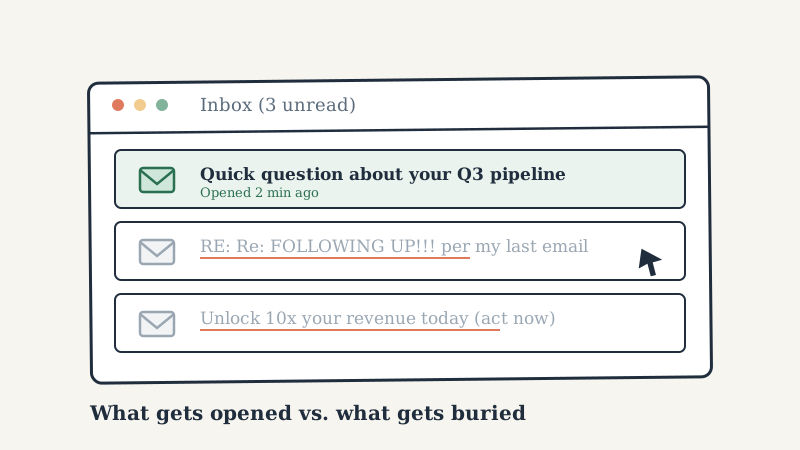
The fastest way to get deleted is to sound like marketing. Internal emails between coworkers have short, lowercase, specific subject lines: “q3 numbers,” “quick question on the rollout,” “tuesday instead?” They never say “Unlock Your Potential” or “Revolutionary Solution for Industry Leaders.”
Mirror that register. A subject line that looks like it came from a peer gets opened because the brain has not yet flagged it as an interruption.
- Bad: “Transform Your Sales Pipeline Today!”
- Better: “your pipeline question”
- Best: “question about [specific thing on their site]“
Rule 2: Be specific enough that it could not be a blast
Generic subject lines signal mass sending, and mass sending signals “safe to ignore.” Specificity signals research. If your subject line could be pasted into ten thousand emails unchanged, it is too generic.
Reference something only this prospect would recognize: a recent funding round, a job posting, a product launch, a competitor they just lost a deal to. The subject line “saw the Series B” outperforms “growth opportunities for your team” because it proves a human looked before they typed.
Rule 3: Keep it under five words
Most inboxes truncate subject lines, and mobile clients truncate them hard. Three to five words is the sweet spot. A short subject line is also psychologically lighter: it reads as a quick note rather than a demand on the reader’s time.
If you cannot say it in five words, the idea is not sharp enough yet. Cut until only the essential noun and hook remain.
Rule 4: Curiosity, not clickbait
A good subject line opens a small loop the reader wants closed. “the thing nobody tells you about outbound” creates curiosity. The difference between curiosity and clickbait is the payoff: if the email body delivers on the implied promise, curiosity builds trust. If it does not, you have trained that prospect to never open you again, and you have taught the inbox provider that your mail disappoints.
Never manufacture false urgency. “URGENT: action required” and “RE: our call” (when there was no call) are the two fastest ways to torch your sender reputation and your credibility in the same click.
Rule 5: Match the subject to the first line
The subject line and the preview text work as a pair. Inboxes show the first sentence of your body alongside the subject, so treat them as one unit. If the subject is “quick question,” the first line should immediately deliver the question, not open with “I hope this email finds you well.” The preview text is a second subject line. Waste it on pleasantries and you have thrown away half your real estate.
Patterns that reliably fail
Through thousands of outbound sends, the same losers show up again and again:
- ALL CAPS or excessive punctuation. “FREE!!!” is a spam-filter magnet and a human turnoff.
- Fake reply threading. Putting “RE:” or “FWD:” on a first-touch email is a trust violation. It works once, then never again, and it damages your domain reputation.
- Personalization tokens that misfire.
"Hi {{first_name}}"sent literally, or"your company at [Company]"with a broken merge field, instantly exposes the automation. - Vague value props. “Increase your revenue” means nothing because everyone claims it.
- Emoji overload. One emoji can occasionally help in the right vertical. Three emojis read as a newsletter, and newsletters get archived.
The subject line is only as good as your list
Here is the part most subject-line advice skips. You can write the sharpest subject line in your industry, and it still earns you nothing if it lands on a dead mailbox, a spam trap, or an inbox that already filed your domain under junk.
Open rate is a function of two things: the subject line and the deliverability of the send. Both have to be healthy. If half your list is invalid, every bounce drags your sender reputation down, and soon even your best subject lines route straight to spam for the recipients who are real. Before you obsess over word choice, validate the list. Tools like Scrubby clean and verify your outbound list so your carefully written subject lines actually reach a human inbox instead of bouncing and burning your domain. A clean list is the precondition that makes subject-line optimization worth doing at all.
It also pays to think beyond the cold email entirely. Subject-line fatigue is real, and some of the highest-reply outbound motions skip the open-rate game by leading with a calendar invite rather than a pitch. Approaches like Kali book meetings through calendar-invite outreach, which sidesteps the inbox triage problem because a meeting request reads differently than a sales email. Pairing a strong email subject-line program with an invite-based channel gives you two independent paths to the same prospect.
How to test your way to better subject lines
Frameworks give you a strong starting hypothesis. Data tells you what actually works on your specific audience. Build subject-line testing into every campaign:
- Run two or three variants per send, not ten. Too many variants splinter your sample size and you learn nothing conclusive.
- Change one thing at a time. If you swap both the angle and the length, you will not know which moved the number.
- Judge on opens for the subject test, replies for the campaign. A subject line that wins on opens but loses on replies was probably clickbait. The real scoreboard is meetings booked.
- Re-test quarterly. Inbox behavior, spam filters, and buyer fatigue all shift. Last year’s winner can become this year’s loser.
Keep a running log of every subject line and its open rate. Over a few quarters you will build a private playbook of what resonates in your market, which is worth more than any generic list of templates.
When to hand the whole motion to a partner
Writing, testing, and maintaining subject lines is a continuous discipline, not a one-time project. It has to be run alongside list hygiene, domain warmup, sequencing, and reply handling, and it never stops. For teams that would rather buy pipeline than build and babysit the machinery, outsourcing the entire outbound function is a legitimate path. A managed GTM partner like Vendisys runs subject-line testing, deliverability, and the full outbound operation as a service, so the open-rate work happens continuously without pulling your team off closing.
The takeaway
Subject lines are not decoration. They are the gate every other outbound metric has to pass through. Write like a colleague, be specific enough that the email could not be a blast, keep it short, open an honest curiosity loop, and pair it with the first line of the body. Then make sure the list underneath it is clean and the domain is healthy, because the best subject line in the world cannot save a send that never reaches a real inbox.
Get those pieces working together and the open rate stops being the thing that caps your pipeline. It becomes the thing that compounds it.