You bought fresh domains, spun up new inboxes, and you are ready to send. Then someone on the team asks the question that stalls every launch: how long do we have to wait before these domains can actually carry real outbound volume?
The honest answer is that warm-up is not a fixed countdown. It is a trust-building process, and mailbox providers decide when it is finished, not you. But there is a reliable timeline that most new domains follow, and knowing it keeps you from either sending too much too soon (and torching your reputation) or waiting three months out of misplaced caution while pipeline sits idle.
This is the week-by-week schedule we use when standing up sending infrastructure, plus the signals that tell you a domain is genuinely ready and the mistakes that reset the clock.
Why warm-up exists at all
Gmail, Outlook, and every other provider score senders on reputation. A brand-new domain has no reputation, which is not the same as a good one. To an inbox provider, a domain that registered last week and suddenly sends 400 cold emails a day looks exactly like a spammer who just bought a throwaway domain to blast a list.
Warm-up is how you prove you are not that. By starting with a trickle of low-volume, engaged email and ramping gradually, you build a track record of positive signals: opens, replies, messages moved out of spam, and almost no bounces or complaints. Those signals accumulate into a reputation that lets you scale.
Skip the warm-up and you do not just risk one campaign. You can burn the domain’s reputation so badly that it never recovers, and you are back to buying new ones.
The prerequisites before day one
Warm-up only works on top of correct technical setup. Before you send a single message, confirm all of the following are in place:
- SPF, DKIM, and DMARC are configured and passing for every sending domain.
- Custom tracking domain is set up rather than a shared one.
- MX records resolve and the mailbox can receive replies.
- The domain has a real website it redirects to, ideally your primary brand. A domain that resolves to nothing is a red flag.
- Your list is clean. Warming up while sending to dead or risky addresses is self-sabotage. Run every new address through a verification pass first. This is exactly the job of a validation tool like Scrubby, which catches invalid, catch-all, and risky mailboxes before a single bounce hits your new domain’s record.
Bounces during warm-up are far more damaging than they are on an established domain, because you have no reputation buffer to absorb them. One bad batch in week one can undo two weeks of careful ramping.
The week-by-week warm-up timeline
The schedule below assumes a standard B2B cold outbound setup: a handful of inboxes per domain, each expected to send roughly 30 to 50 cold emails a day at full capacity. Adjust proportionally if your target per-inbox volume is different.
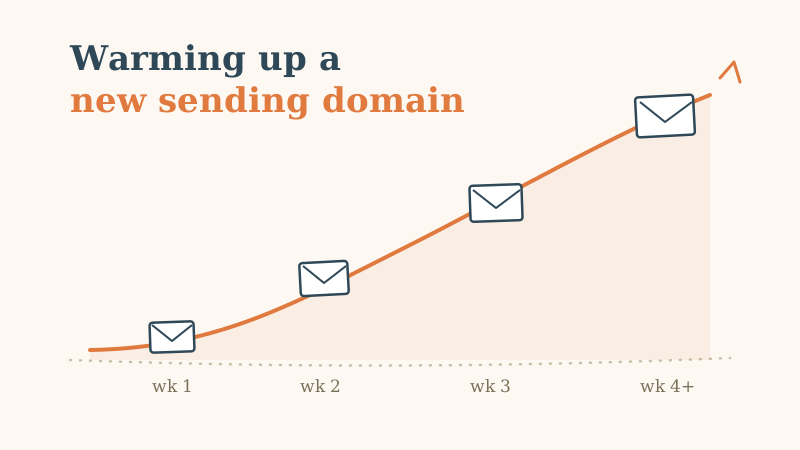
Week 1: establish a heartbeat (5 to 10 sends per inbox per day)
The first week is about existence, not volume. Each inbox sends a small number of emails per day, ideally to addresses that will open and reply. Automated warm-up networks handle this by exchanging seeded messages between real inboxes, generating opens and replies that build early positive signal.
If you are sending any real cold email this week, keep it to your warmest, highest-intent segment (people who are likely to reply) and keep daily volume in the single digits per inbox. The goal is a steady daily heartbeat, not a spike.
Week 2: gentle ramp (10 to 20 sends per inbox per day)
Roughly double the daily volume, but keep the increases smooth. Providers watch the shape of your ramp, not just the totals. A curve that climbs a little each day looks human. A flat line that jumps 5x on a Monday looks automated.
Start blending in real prospects now, but stay in tiers where replies are likely. Reply rate is one of the strongest trust signals you can generate, and early replies pay dividends for weeks.
Week 3: approach real volume (20 to 35 sends per inbox per day)
By week three most domains can carry meaningful campaign volume. Continue the daily ramp and start running your actual sequences, while watching deliverability metrics closely (more on which ones below). If your engagement stays healthy, keep climbing.
Week 4 and beyond: full capacity and maintenance (35 to 50 sends per inbox per day)
Most B2B domains reach steady-state cold sending volume somewhere between the end of week three and the middle of week four. From here, warm-up shifts from ramping to maintenance: keep some warm-up traffic running in the background, avoid sudden volume swings, and never let a domain sit completely idle for long stretches and then blast it.
A domain that has been quiet for two weeks and then sends at full volume looks suspicious all over again. Consistency is the reputation asset, not the peak number.
The signals that tell you a domain is actually ready
Do not treat the calendar as the finish line. A domain is ready when the numbers say so:
- Bounce rate under 2 percent, ideally under 1. Higher than that and either your list or your warm-up is off.
- Spam complaint rate near zero. Even a handful of complaints during warm-up is a warning.
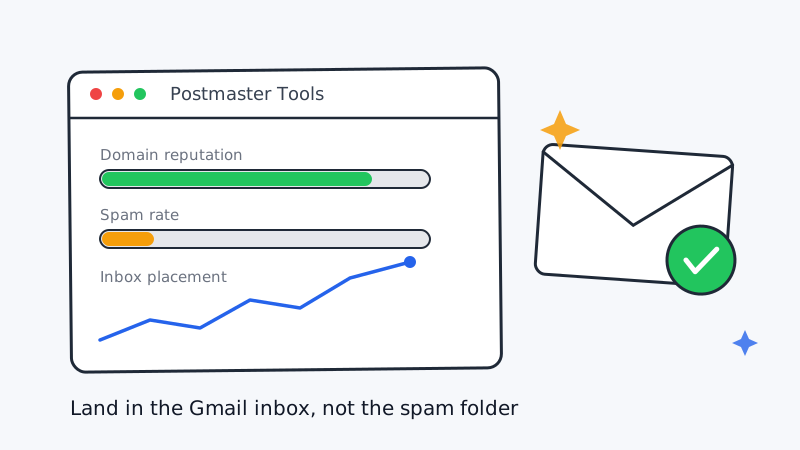
- Inbox placement, not just delivery. A message can be delivered and still land in spam. Seed-test across Gmail and Outlook to confirm you are hitting the primary inbox.
- Reply rate holding steady as volume climbs. If replies fall off a cliff when you scale, you scaled too fast.
If any of these degrade as you ramp, hold volume flat (or step it down) until they recover before climbing again. Warm-up is not strictly linear, and pausing the ramp is always cheaper than rebuilding a burned domain.
The mistakes that reset the clock
A few habits quietly undo warm-up progress:
- Ramping too aggressively. The single most common way to kill a new domain is doubling volume every day out of impatience.
- Sending to a stale or unverified list. Bounces during warm-up hit harder than at any other time.
- Identical templates at scale. Thousands of byte-for-byte identical emails read as automated. Vary your copy.
- Ignoring replies. A warmed inbox that never responds to real humans looks abandoned, and abandoned inboxes lose trust.
- Going dark, then blasting. Long idle gaps followed by a surge reset you to square one.
Where warm-up fits in the bigger deliverability picture
Warm-up gets a domain to the inbox. Staying there is a separate, ongoing discipline. That is why serious outbound teams treat sending infrastructure as a system rather than a one-time setup: multiple domains in rotation, per-inbox volume caps, continuous list hygiene, and reputation monitoring that flags a problem before it spreads. We break down that broader system in our guide to keeping cold email out of spam at scale.
If standing up and babysitting all of this in-house sounds like a lot, that is because it is. It is one of the main reasons companies hand outbound infrastructure to an outsourced partner rather than build it from scratch. At Vendisys, warmed domains, verified lists, and deliverability monitoring come as part of the managed setup, so your first real campaign launches on infrastructure that is already trusted instead of a fresh domain crossing its fingers.
The short version
Plan for a roughly four-week ramp for new cold email sending domains: a light heartbeat in week one, a smooth daily climb through weeks two and three, and full campaign volume by the end of week three or into week four. But let the signals, not the calendar, make the final call. Verify your list before you start, ramp gradually, watch your bounce and reply rates, and never confuse a delivered email with an inboxed one.
Get the warm-up right and every campaign after it inherits the trust you built. Rush it, and you spend the next quarter buying new domains instead of booking meetings.