Most teams obsess over subject lines and personalization while ignoring the one variable that decides whether anyone ever reads their email: deliverability. You can write the sharpest cold email in your category, target the perfect account, and time it flawlessly. If it lands in the spam folder, your reply rate is zero.
Deliverability is not luck and it is not a black box. It is a system of technical setup, sending discipline, and reputation management that you can build once and maintain forever. This guide walks through exactly how to do that so your outbound consistently lands in the primary inbox instead of the promotions tab or the spam folder.
Why Deliverability Breaks Down
Cold email lives in a harder environment than newsletter marketing. You are emailing people who have never opted in, from domains they have never seen, at volumes that mailbox providers watch closely. Gmail, Outlook, and the corporate filters in between are all asking the same question: does this sender look trustworthy, and do recipients actually want these messages?
When the answer trends negative, providers do not bounce your mail. They silently route it to spam. You keep sending, your dashboard still shows delivered, and you have no idea your open rates are cratering because nobody sees the message. That silent failure is what makes deliverability so dangerous. By the time you notice, your domain reputation may already be damaged.
Three forces drive most deliverability failures: weak technical authentication, aggressive ramp-up before a domain has earned trust, and content or engagement signals that look like spam. Fix all three and you solve the problem.
Layer 1: Get the Technical Foundation Right
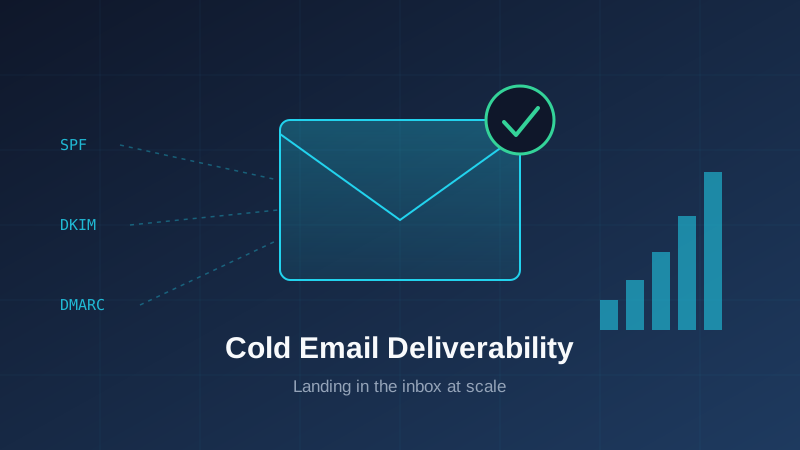
Before you send a single cold email, three authentication records need to be in place on your sending domain. These are non-negotiable, and mailbox providers increasingly reject unauthenticated mail outright.
SPF (Sender Policy Framework) tells the world which servers are allowed to send email on behalf of your domain. It is a single DNS TXT record listing your authorized sending sources. If you send through a platform, add its include statement to your SPF record.
DKIM (DomainKeys Identified Mail) attaches a cryptographic signature to every message so the receiving server can verify the email was not tampered with in transit and genuinely came from your domain. Your sending platform generates the keys; you publish the public key as a DNS record.
DMARC (Domain-based Message Authentication) ties SPF and DKIM together and tells providers what to do when a message fails both. Start with a monitoring policy so you can see who is sending as your domain, then tighten it over time.
Getting all three green is the price of admission. Skip any one of them and modern filters will treat you as suspicious no matter how good your content is.
There is one more foundational rule that surprises people: never send cold email from your primary company domain. If deliverability tanks, you do not want it dragging down the domain your existing customers and prospects use to reach you. Buy separate sending domains, close variants of your main one, and route all outbound through those. Isolating outbound protects the asset that actually matters.
Layer 2: Warm Up Before You Scale
A brand new domain has no reputation. Sending 500 cold emails on day one is the fastest way to get flagged and burn it permanently. Mailbox providers expect trustworthy senders to build volume gradually, the way a real human relationship grows.
Domain warmup is the process of ramping sending volume slowly while generating positive engagement signals: opens, replies, and messages being moved out of spam and marked as important. Automated warmup tools simulate this by exchanging emails across a network of real inboxes, but the principle holds even if you do it manually.
A sane ramp looks something like this:
- Weeks 1 to 2: very low volume, mostly warmup traffic, almost no real prospects
- Weeks 3 to 4: begin blending in small batches of real cold email
- Weeks 5 to 8: scale real sending steadily while keeping warmup running in the background
Two guardrails matter more than the exact numbers. First, keep per-inbox daily volume modest. Rather than blasting hundreds from one mailbox, spread sending across many inboxes each doing a small, human-looking amount. Second, watch your reply and bounce rates as you scale. If bounces climb, your list is dirty and you should stop and clean it before continuing.
This is precisely where a lot of in-house teams stumble. Warmup, inbox rotation, and volume management are tedious operational work that never ends. It is one of the reasons companies build outbound on top of managed GTM infrastructure instead of stitching the plumbing together themselves.
Layer 3: Keep Your List Clean
Nothing destroys deliverability faster than emailing addresses that do not exist. Every hard bounce is a signal to mailbox providers that you are working from a low-quality list, which is a classic spammer pattern.
Verify every address before it enters a sequence. Remove role-based catch-alls, obvious typos, and anything that fails verification. Aim to keep your bounce rate low; if it drifts up, pause and re-verify rather than pushing through.
List hygiene is not a one-time task. Contacts change jobs, companies fold, and inboxes get deactivated. A list that verified clean six months ago will have decayed. Re-verify before major campaigns and prune anyone who has never engaged across multiple touches.
Clean lists also make everything downstream better. Your reply rate looks healthier, your reputation stays strong, and your reps waste no time chasing dead contacts.
Layer 4: Write and Send Like a Human
Even with perfect authentication and a warmed domain, content signals can still push you to spam. Filters read your message the way a skeptical human would, and certain patterns scream automation.
Keep these habits:
- Send in plain text or very light HTML. Heavy templates, big images, and lots of links look like marketing blasts, not one-to-one email.
- Limit links. One relevant link is fine. Five links and a tracking pixel is a red flag.
- Avoid spam-trigger language. Aggressive sales words, all caps, and excessive punctuation trip filters that were tuned on decades of spam.
- Personalize genuinely. Real personalization changes the body of the message per recipient, which makes each send look distinct rather than mass-produced.
- Make replies easy and expected. The single strongest positive signal is a reply. Copy that invites a short, genuine response does more for deliverability than any technical tweak.
The goal is for your cold email to be indistinguishable, at the protocol level, from a thoughtful message a person typed to one other person. The closer you get to that, the more the filters leave you alone.
How to Know It Is Working
Deliverability is measurable if you instrument it. A few practices keep you honest:
Run periodic inbox placement tests using seed accounts across Gmail, Outlook, and common corporate providers so you can see where your mail actually lands, not just whether it was accepted. Watch your reply rate as the leading indicator; a sudden drop with no change in copy usually means placement slipped. Monitor bounce and spam-complaint rates continuously, and treat any spike as a stop-and-diagnose event rather than something to sail past.
If placement degrades, work back through the layers in order: check authentication is still valid, confirm you have not scaled volume too fast, re-verify the list, and audit recent content changes. The cause is almost always in one of those four places.
The Compounding Payoff
Deliverability work is unglamorous. Nobody celebrates a correctly configured DMARC record. But it is the multiplier on everything else you do in outbound. A five point improvement in inbox placement lifts every downstream metric at once: more opens, more replies, more meetings, from the exact same list and copy.
That is why the highest-performing outbound programs treat deliverability as ongoing infrastructure rather than a one-time setup. Domains get warmed and rotated, lists get re-verified, authentication gets monitored, and placement gets tested on a schedule. It is a system, and systems compound.
If building and maintaining that system in-house sounds like more operational overhead than your team can carry, that is exactly the gap managed outbound infrastructure is designed to fill. Vendisys runs deliverability as part of the full outbound stack so your reps can focus on conversations instead of DNS records and warmup schedules.
Get the four layers right and inbox placement stops being a mystery. It becomes a reliable, boring, well-instrumented part of your pipeline machine. Which is exactly what you want it to be.
Vendisys helps SaaS and B2B teams build and operate outbound infrastructure, from deliverability and domain management through targeting and sequencing. If you want to see how the full stack fits together for your motion, reach out.