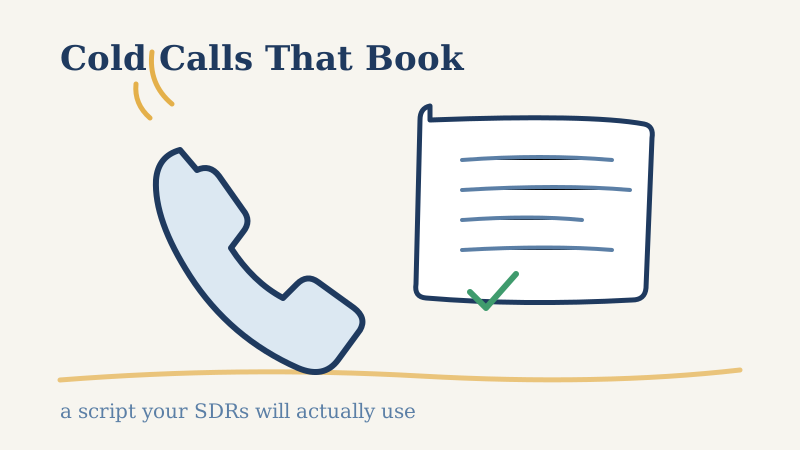
Email gets the credit, but the phone still books meetings that email never will. A well-timed call reaches a prospect who has three thousand unread messages and zero unread ringing phones. The problem is not that cold calling stopped working. The problem is that most cold call scripts are written to be read aloud once and then quietly abandoned. They sound like a press release, they collapse the moment a prospect pushes back, and within a week your reps are freelancing on every dial.
A script that survives contact with real prospects is not a paragraph to recite. It is a modular decision tree: a strong opener, a permission-based transition, a value hook tied to the prospect’s world, a small set of pre-written responses to the objections you already know are coming, and a clean ask for the meeting. This post gives you that framework line by line, and just as importantly, it covers how to get an outbound team to actually run it instead of going off-script on dial three.
Why most cold call scripts fail on the first objection
Open a typical cold call script and you will see a wall of text. It assumes the prospect stays silent while your rep delivers forty seconds of value proposition. Real calls do not work that way. The prospect interrupts at second four with “who is this?” or “now is not a good time,” and the linear script has no branch for that moment. The rep freezes, improvises, and the call falls apart.
The fix is to stop writing scripts as monologues and start writing them as a tree with named branches. Every point where a prospect can push back becomes a labeled node with a short, pre-decided response. Your rep is never reading a paragraph. They are navigating from one node to the next based on what the prospect actually says. That is the difference between a script that gets abandoned and one that gets internalized.
The second reason scripts fail is that they are written for the writer, not the caller. A marketing leader drafts beautiful copy that no human says out loud. Say every line of your script aloud before it ships. If it does not sound like something a person would say to another person at a bar, cut it. Contractions, short sentences, and plain words win on the phone.
The opener: earn seven seconds, not the whole call
You are not trying to close in the first sentence. You are trying to earn the next seven seconds. The best openers are honest about being a cold call, because pretending otherwise triggers the prospect’s sales radar instantly.
A pattern that consistently outperforms the fake-familiar approach:
“Hi Sarah, this is Marcus with Vendisys. I know I am an interruption, so I will be quick. Can I take thirty seconds to tell you why I called, and then you can tell me to get lost?”
This works because it does three things at once. It names the interruption, which disarms the reflex to hang up. It sets a tiny time box, which feels safe. And it hands control back to the prospect with the permission to end the call, which paradoxically makes them more likely to grant the thirty seconds. Most prospects say some version of “sure, go ahead.”
Avoid the “how are you today” opener. It signals a script, it invites a curt “fine, what do you want,” and it burns your seven seconds on nothing. Get to why you called.
The hook: talk about their problem, not your product
Once you have the thirty seconds, do not describe your features. Describe a problem the prospect’s peers have, and make it specific to their role and company type.
“We work with heads of sales at Series A companies who are trying to build outbound pipeline but do not want to spend six months hiring and ramping an in-house SDR team. Usually the pain is that pipeline needs to grow this quarter, but a real internal team is two quarters away. Is that anywhere close to what is happening on your side?”
Notice the structure: who we help, what problem they have, and then a question that hands the floor back. The question matters. A monologue lets the prospect check out. A question re-engages them and, more valuably, tells you whether the problem is real for this specific person. If they say “no, we already have a team,” you learned something and can pivot. If they say “yes, exactly,” you have earned the right to talk about the meeting.
Keep a validated list in front of your reps of the two or three problems that actually resonate for each segment. If your reps are guessing at the pain point on every call, your targeting upstream is the real issue. Before you scale calling volume, make sure your list is built from a tight ideal customer profile and that the contact data is accurate. A dialer pointed at stale or mistargeted records burns rep morale faster than any script problem. Cleaning and verifying that list with a tool like Scrubby before the campaign starts keeps your reps talking to people who can actually say yes.
Objection handling: pre-write the four you already know are coming
You do not need a response for every possible objection. You need clean, pre-decided responses for the four or five that account for ninety percent of your calls. Pull last month’s call recordings, list the objections in order of frequency, and write one response for each. Then drill them until reps do not have to think.
The most common ones and a response pattern for each:
- “Now is not a good time.” Agree, then ask for a smaller commitment. “Totally fair, I called you out of the blue. Rather than keep you now, can I grab fifteen minutes on your calendar later this week?” You are not fighting the objection. You are converting a bad-timing no into a scheduled yes.
- “We already have something for this.” Do not attack the incumbent. “Makes sense, most teams your size do. The reason folks still take the call is that they are curious how their current setup compares on cost per meeting. Worth a fifteen-minute look?” You reframe from replacement to comparison, which is much lower stakes.
- “Just send me an email.” This is usually a polite brush-off. Accept it, but anchor a next step. “Happy to. So I send the right thing and not a wall of text, what is the one number you care most about this quarter, pipeline or cost per meeting?” If they engage, you are back in the conversation. If they give you nothing, send a short email and add them to a nurture sequence.
- “How did you get my number?” Answer honestly and move on. “You are a head of sales at a growing company, so you are exactly who we look for. That is the whole reason I called.” Confidence, not apology.
The point is not to have a clever comeback for everything. It is to remove the moment of panic. When a rep knows the response is already written, their voice stays calm and the call keeps moving.
The ask: make the meeting the easiest yes on the call
Reps lose deals at the finish line by asking a vague question like “would you be open to learning more?” That invites a “maybe, send me something” and the meeting never gets set. Ask for a specific, small, concrete time.
“Here is what I would suggest. Fifteen minutes, Thursday at 2, I will show you exactly how teams like yours are building pipeline without the hiring. If it is not relevant, you have lost fifteen minutes. Does Thursday at 2 work, or is Friday morning better?”
The double option (“Thursday at 2, or Friday morning”) is doing quiet work. It moves the decision from “yes or no to a meeting” to “which of these two times,” which is a much easier yes. Book the meeting on the phone if you can, and send the calendar invite before you hang up so the commitment is real. Sending a clean, professional invite while the prospect is still on the line closes the loop, and teams that run high call volume often lean on a purpose-built tool like Kali to get that invite in front of the prospect the moment they say yes, which measurably cuts no-show rates.
How to get an outbound team to actually run the script
A perfect script that no one follows is worth nothing. Getting adoption is a management problem, not a copywriting problem.
Start by involving the reps in writing it. A script handed down from marketing gets resented and ignored. A script built from the team’s own best calls gets ownership. Pull the recordings of your top performer’s most effective dials and reverse-engineer the script from what already works in your reps’ own voices.
Then drill it before it goes live. Run role-play sessions where one rep plays a hostile prospect and throws the top objections. The goal is not memorization word for word, it is fluency, so the branches feel automatic under pressure. A rep who has practiced the “now is not a good time” branch twenty times will not freeze when it happens on a real call.
Measure the right thing. If you only track meetings booked, reps will chase the metric and abandon the script the moment it feels slow. Track leading indicators too: connect rate, conversations per hour, and the rate at which each objection converts to a next step. When you can see which branch is leaking, you fix the branch instead of blaming the rep.
Finally, keep the script alive. It is a living document, not a stone tablet. Review call recordings weekly, find the new objection that started showing up, write the response, and add the branch. A script that gets updated every week stays trusted. A script that gets written once and filed away gets abandoned by month two.
When calling is worth building in-house versus outsourcing
Cold calling is one of the hardest outbound skills to build and retain internally. It takes months to ramp a rep to fluency, the role has high turnover, and a single script and a good dialer are only the surface of what a productive calling motion requires underneath. You also need list hygiene, connect-rate optimization, local presence dialing, call coaching, and the operational discipline to keep the whole system tuned.
For a lot of teams, especially early-stage companies that need pipeline this quarter, standing all of that up from scratch is slower and more expensive than it looks. That is exactly the gap Vendisys fills: an outsourced outbound engine where the calling infrastructure, the scripts, the coaching, and the data hygiene already exist and are already tuned, so you get booked meetings without spending two quarters building a calling function from zero.
Whether you build it or outsource it, the fundamentals in this post hold. Write the script as a branching tree, not a monologue. Pre-decide your responses to the objections you already know are coming. Ask for the meeting as the easiest possible yes. And treat the script as a living document your reps own, not a paragraph they were told to read. Do that, and the phone goes back to being the highest-conversion channel in your outbound mix.