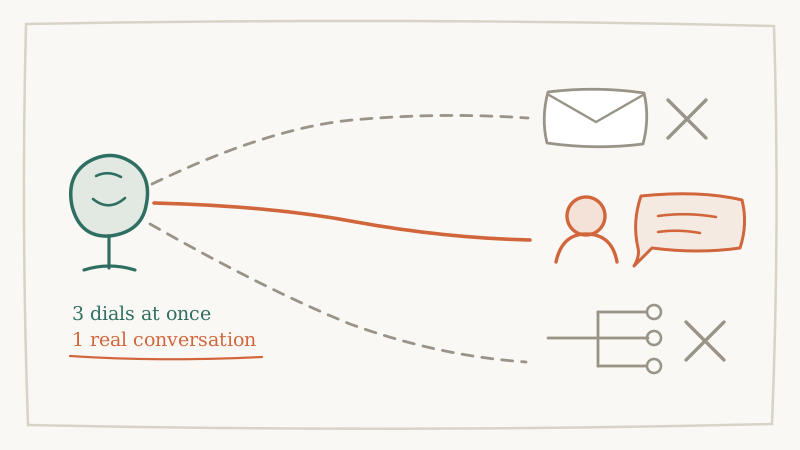
Most outbound programs run on two channels: email and LinkedIn. Both are crowded. Cold email reply rates sit between 2 and 5% for the average B2B sender, and LinkedIn connection requests now compete with dozens of other vendors hitting the same buyer in the same week. When everyone fishes in the same two ponds, response rates compress for the entire market.
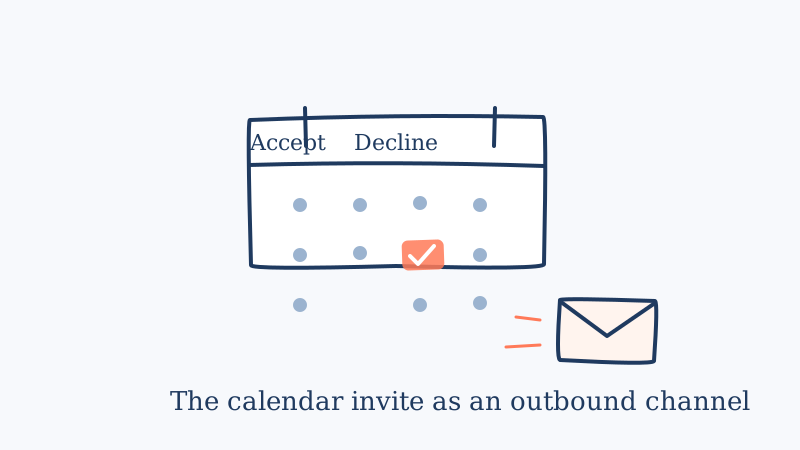
There is a third channel that very few teams use deliberately: the calendar invite. Instead of asking a prospect to reply, click a booking link, or accept a connection, you send a real meeting invitation to a proposed time. It arrives in the one tool every buyer checks multiple times a day, and it carries an action that takes one click to accept.
This is not a gimmick. Used with judgment, calendar invite outreach books meetings that email alone would never have surfaced. Here is how to run it without burning your reputation.
Why the calendar invite works
The mechanics of the channel explain most of its lift.
It lands where decisions already happen. A buyer ignores 40 cold emails a day because the inbox is where they triage noise. The calendar is where they commit time. An invite shows up next to their real meetings, with a clear date, time, and agenda. It is read in the context of “do I have this slot free,” not “is this spam.”
It collapses the ask. A normal cold email asks the prospect to do work: read, decide, reply, suggest times, wait for confirmation. An invite proposes a specific slot. The prospect accepts, declines, or proposes a new time, all in one motion. You have removed three steps from the booking funnel.
It signals confidence. Sending a concrete time communicates that you expect the conversation to be worth 30 minutes. That framing alone changes how the request is received, as long as the value is real.
The risk you have to respect
The same directness that makes calendar invites effective makes them easy to abuse. Drop an unsolicited invite on someone who has never heard of you, with a vague agenda and no opt-out, and you will earn a spam report and a declined meeting. Worse, you can poison the domain reputation you rely on for the rest of your outbound.
Two guardrails keep this channel healthy:
- Warm the prospect first. A calendar invite should rarely be the first touch. It performs best as step three or four in a sequence, after an email or two has introduced the context. The invite then reads as a natural next step rather than an ambush.
- Make declining frictionless. Every invite needs a one-line agenda, a clear sender identity, and an obvious way to say no. The goal is a booked meeting with a real buyer, not a trapped one.
Where it fits in a sequence
The highest-performing teams treat calendar outreach as one lane in a coordinated, multi-channel motion rather than a standalone blast. A simple structure that works:
- Touch 1 (email): Introduce the problem you solve and the specific reason you are reaching out to this account.
- Touch 2 (email or LinkedIn): Add a proof point or a relevant result. No ask beyond a soft question.
- Touch 3 (calendar invite): Propose a specific 20 to 30 minute slot with a one-line agenda that references the earlier context. Include a sentence inviting them to propose a better time.
- Touch 4 (email): If the invite goes unanswered, follow up acknowledging the busy calendar and offering two alternative windows.
The invite is the moment the sequence converts from interest to commitment. Everything before it exists to earn the right to send it.
Personalize the slot, not just the message
Generic personalization (“I see you work in fintech”) is table stakes now. With calendar invites, the highest-leverage personalization is the timing itself. Sending an invite for 8:30 a.m. in the prospect’s own time zone signals you did the homework. Proposing a Tuesday or Wednesday mid-morning slot, the windows where meeting acceptance is statistically highest, beats a Friday afternoon every time.
Tools built for this channel, like Kali, automate the calendar-invite motion at scale while keeping the timing and agenda personalized per prospect. That is the difference between a thoughtful invite and a mail-merge that gets you blocked.
Protect the channel with clean data
Calendar invite outreach is unforgiving of bad data in a way email is not. A bounced cold email is invisible. A calendar invite sent to a dead, mistyped, or role-based address (“info@”, “no-reply@”) either fails loudly or lands in a shared mailbox where it reads as obvious spam, and each one chips away at the sending reputation you depend on across every channel.
Verify the list before you send a single invite. Running prospects through an email validation layer like Scrubby removes the invalid, catch-all, and risky addresses that would otherwise turn a precise channel into a liability. With outbound, deliverability and data quality are the same problem viewed from two angles, and the calendar invite raises the cost of getting either one wrong.
Measure it like its own channel
Do not bury calendar invite performance inside your email metrics. Track it separately:
- Invite acceptance rate: the share of sent invites that turn into confirmed meetings.
- Show rate: accepted invites that actually attend. Calendar-native bookings tend to show at higher rates than link-based ones because the meeting is already on the buyer’s calendar.
- Decline-with-reply rate: declines that come with a “not now, but reach out in Q3” note. These are pipeline, not rejection.
When you measure the channel on its own terms, you can tune cadence, slot timing, and agenda copy with real feedback instead of guesswork.
The takeaway
Email and LinkedIn are not going away, but they are no longer enough on their own. The calendar invite is a third lane that reaches buyers where they actually commit time, collapses the booking funnel into a single click, and signals genuine confidence in the conversation you are offering.
Run it as a warmed-up step inside a coordinated sequence, protect it with verified data, and personalize the slot as carefully as the message. Done right, it is the channel that quietly turns interested prospects into booked demos. If building and running that motion in-house is more than your team can carry, an outsourced GTM partner like Vendisys can stand up the full multi-channel engine, calendar invites included, without you hiring a single SDR.