A prospect on a discovery call says, “We are already evaluating [Competitor].” This is the exact moment a battlecard is supposed to earn its keep. Yet most of the time the rep stalls, gives a vague answer about being “more flexible,” and the meeting quietly loses momentum.
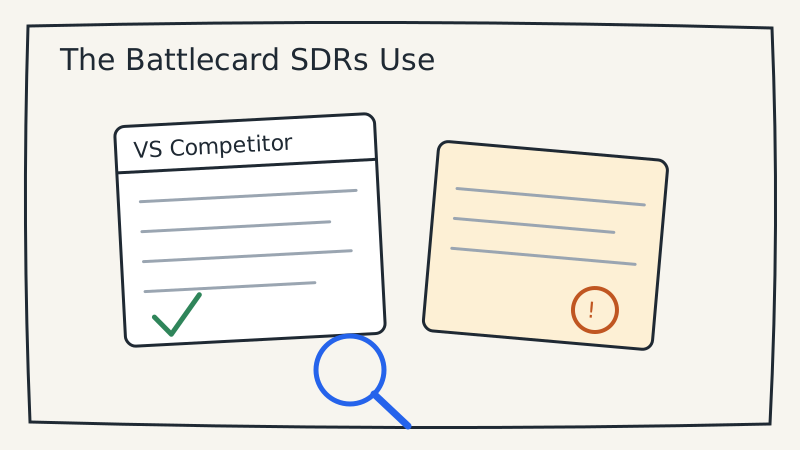
The problem is rarely the rep. It is the battlecard. The typical competitive battlecard is a five-tab spreadsheet built by product marketing, full of feature checkmarks and positioning language that nobody can recall under pressure. It was made to be admired in a planning meeting, not used live on a call.
For an outsourced SDR team, the stakes are higher. Your partner’s reps are representing your brand against competitors they did not grow up fighting. If the battlecard is not usable in the first two weeks of a call, it does not exist. Here is how to build one that actually gets used.
Why Most Battlecards Fail Outsourced Teams
Three failure modes show up over and over.
First, the battlecard is built for closers, not openers. It assumes a deep product conversation, demo context, and a buyer who has already shortlisted you. An SDR on a cold or early call has none of that. They need a fast, confident redirect, not a feature-by-feature teardown.
Second, it is too long to load into memory. A rep cannot scan a 12-row comparison grid while a prospect is talking. If the answer is not one breath long, it will not come out cleanly.
Third, it goes stale. Competitors change pricing, launch features, and rewrite their own positioning constantly. A battlecard written six months ago and never revisited will have your reps confidently repeating things that are no longer true, which is worse than saying nothing.
When you work with an outsourced go-to-market partner like Vendisys, the battlecard becomes part of the onboarding asset set. It has to survive contact with a rep who is ramping on your category for the first time, which means it has to be ruthlessly simple.
Start With the Three Questions Reps Actually Get
Before writing a single line of positioning, list the competitor objections your reps hear most. In practice they collapse into three buckets:
- “We already use [Competitor].” The prospect is anchored. Your goal is not to win the deal on this call, it is to earn a reason to keep talking.
- “How are you different from [Competitor]?” The prospect is comparing. They want a crisp, honest differentiator, not a list.
- “[Competitor] is cheaper / has feature X.” The prospect is testing. They want to see whether you get defensive or stay grounded.
If your battlecard answers these three cleanly, it covers the overwhelming majority of live competitive moments. Everything else can live in a deeper reference doc that the rep reads between calls, not during them.
The One-Page Structure That Works
Build one card per major competitor, and keep each to a single page or screen. Use this layout:
Top: the one-line frame. A single sentence that positions the category, not the feature war. Example: “They are a tool you configure. We are a team that runs the outcome.” This is what the rep says first, every time, before any detail.
Trap to avoid. The one thing reps tend to say that backfires. Naming it explicitly is more useful than another talking point, because it prevents unforced errors. For example: “Do not bash their product. Their users like it. Reframe to the operating model instead.”
Three proof points. Not ten. Three specific, defensible differences a rep can state without checking notes. Each should be a fact, not an adjective. “We replace a tool and a hire” beats “we are more comprehensive.”
Landmine questions. Two or three questions the rep can ask that quietly expose the competitor’s weak spot without attacking it. “How much of your team’s week goes to managing the tool versus using it?” lets the prospect arrive at the gap on their own.
One trap-door close. A single next step the rep drives toward regardless of how the comparison goes, usually booking the right person into a working session rather than a generic demo.
That is the entire card. If it does not fit on one screen, cut until it does.
Feed It With Live Competitive Intelligence
A battlecard is only as good as its freshness. The fastest way to make one wrong is to write it once and forget the competitor keeps moving. Pricing pages change, new features ship, and positioning gets rewritten, often without any announcement.
Rather than manually re-checking competitor sites every few weeks, set up automated monitoring on the pages that matter: pricing, product, and changelog. A tool like CAM watches competitor pages and alerts you the moment something changes, so your battlecard updates are triggered by real movement instead of a calendar reminder nobody honors. When a competitor drops a price or launches a feature, you want your reps to know before a prospect tells them on a call.
This matters even more for an outsourced team, because they are not living inside your competitive landscape every day. Pushing them a short “what changed this week” note keeps the shared battlecard accurate without expecting them to do their own research.
Pressure-Test It Before It Ships
A battlecard that has never been said out loud is a draft, not a tool. Before you hand it to an outsourced team, run a 20-minute role-play. Have someone play the prospect and throw the three core objections at a rep cold. Watch for the freeze. Anywhere the rep hesitates or reaches for the wrong answer is a line on the card that needs rewriting.
Pay attention to the data quality underneath the play too. If your reps are calling into a list full of dead or mistyped addresses, even a perfect battlecard never gets a chance to fire because the conversations never happen. Cleaning the list with a validation tool like Scrubby before a campaign means the competitive moments you prepared for actually occur, against real buyers, at the volume you planned.
Keep It Living
Set a standing 30-minute review on a fixed cadence, monthly is plenty for most categories. In it, do three things: pull the competitive objections reps logged that month, apply any monitoring alerts that changed the facts, and cut anything that has not been useful. A battlecard should get shorter over time, not longer. The discipline of cutting is what keeps it usable.
The test of a good battlecard is simple. Pull a rep aside, name a competitor, and ask them for the one-line frame. If it comes out in one confident breath, you have a tool. If they reach for a document, you have homework.
Most teams treat competitive enablement as a content problem and solve it with more pages. The teams whose reps win the competitive moment treat it as a memory problem and solve it with fewer, sharper words backed by intelligence that stays current. Build for the call, not the planning meeting, and your outsourced SDRs will actually use what you give them.