In 2026 the question is no longer “should we do outbound.” It is “who, or what, should run it.” Two answers dominate the conversation: spin up an AI SDR that drafts, sends, and books at machine scale, or hire an outsourced human SDR team that brings process and judgment without the cost of in-house headcount. Both pitches are seductive, and both have a failure mode that is easy to miss until the quarter is gone.
Here is how to think about it without the hype.
What an AI SDR is genuinely good at
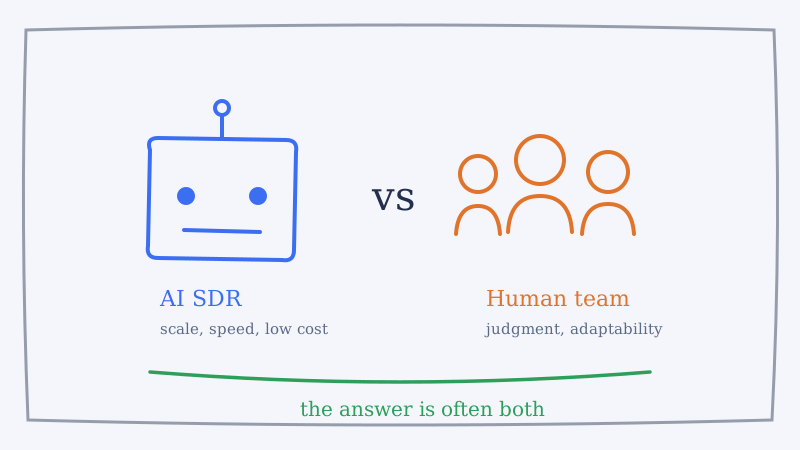
An AI SDR is not a gimmick anymore. The good ones do real work: enrich a list, draft a credible first-touch personalized to public signals, run multi-step sequences, and reply to easy inbound at any hour. Their advantages are structural.
- Marginal cost near zero. Once configured, sending the 10,000th email costs roughly what the 100th did.
- Speed and consistency. No ramp time, no Mondays, no drift in cadence.
- Tireless follow-up. The unglamorous work of touch four and touch five gets done every time.
Where AI SDRs struggle is exactly where outbound gets hard: a nuanced objection, a multi-stakeholder thread, an account that needs a human to read the room and change the plan. Push volume through a thin offer or a noisy list and an AI SDR will scale your mistakes faster than a human ever could.
What an outsourced human team is genuinely good at
An outsourced SDR partner sells judgment and accountability. A good one brings a tested playbook, infrastructure that is already warmed and configured, and people who can tell the difference between a prospect worth chasing and a polite brush-off.
- Adaptability. When a segment stops responding, a human notices and changes the angle.
- Complex conversations. Discovery, qualification, and handling the reply that does not fit a template.
- Strategic feedback. A partner who runs hundreds of campaigns can tell you your offer is the problem, not your subject line.
The trade-off is cost and scale ceiling. Humans cost more per touch and cannot 10x volume overnight without proportional hiring.
The framework: match the tool to the bottleneck
Stop comparing them as rivals and ask what is actually broken in your pipeline.
- Bottleneck is volume and coverage (you cannot touch enough accounts): lean on AI SDR capacity, with a human reviewing what converts.
- Bottleneck is conversion and messaging (you reach people but they do not engage): you need human judgment to fix targeting and offer before you scale anything.
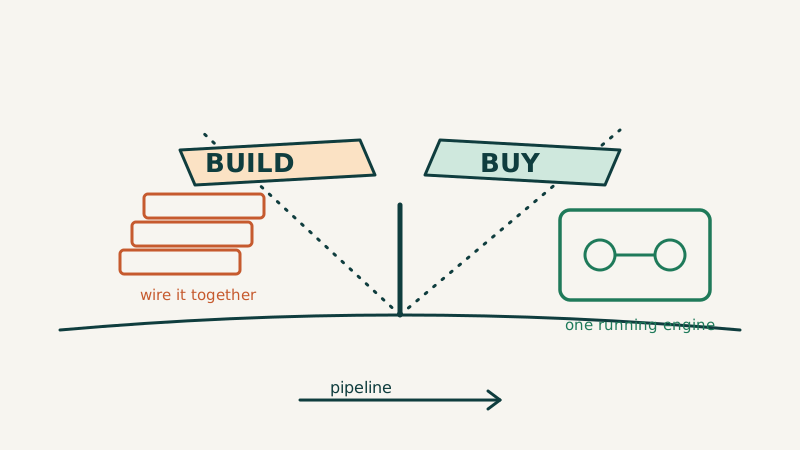
- Bottleneck is everything, because you have no system yet: start with a partner who can stand up the whole motion, then layer automation onto the parts that are working.
The expensive mistake is buying AI scale to paper over a conversion problem, or paying for human hours to do work software now does better.
Why the real answer is usually both
The framing of “AI versus human” is mostly a marketing artifact. In practice the strongest outbound motions in 2026 are hybrid: software handles list building, enrichment, sequencing, and the high-volume top of funnel, while humans own qualification, complex replies, and strategy. The skill is orchestration, deciding which layer owns which step, and that orchestration is itself a discipline most teams have not built yet.
This is the case for treating outbound as infrastructure rather than a hire. An outsourced GTM partner like Vendisys is increasingly the entity that runs the hybrid stack for you: the human judgment on top, the automation underneath, and one accountable owner for the number. You get the scale of AI and the adaptability of people without having to personally integrate five tools and manage a team to operate them.
The orchestration extends to the inbox too. As AI scales the number of conversations you start, something has to handle the replies fast enough to matter, which is why AI reply layers like Underfive increasingly sit between the volume your top of funnel generates and the humans who close. The bottleneck simply moves from “can we send enough” to “can we respond well enough, fast enough.”
How to actually decide this quarter
If you are choosing right now, run the cheap experiment instead of the philosophical debate:
- Define the one metric that is stuck (meetings booked, reply rate, qualified pipeline).
- Identify whether the stall is upstream (volume, coverage) or downstream (conversion, qualification).
- Apply the cheaper lever to that specific stage first, AI for upstream volume, humans for downstream judgment.
- Measure for one full cycle before adding the other layer.
The teams that win in 2026 are not the ones who picked the right side of an AI-versus-human argument. They are the ones who stopped treating it as a side to pick.